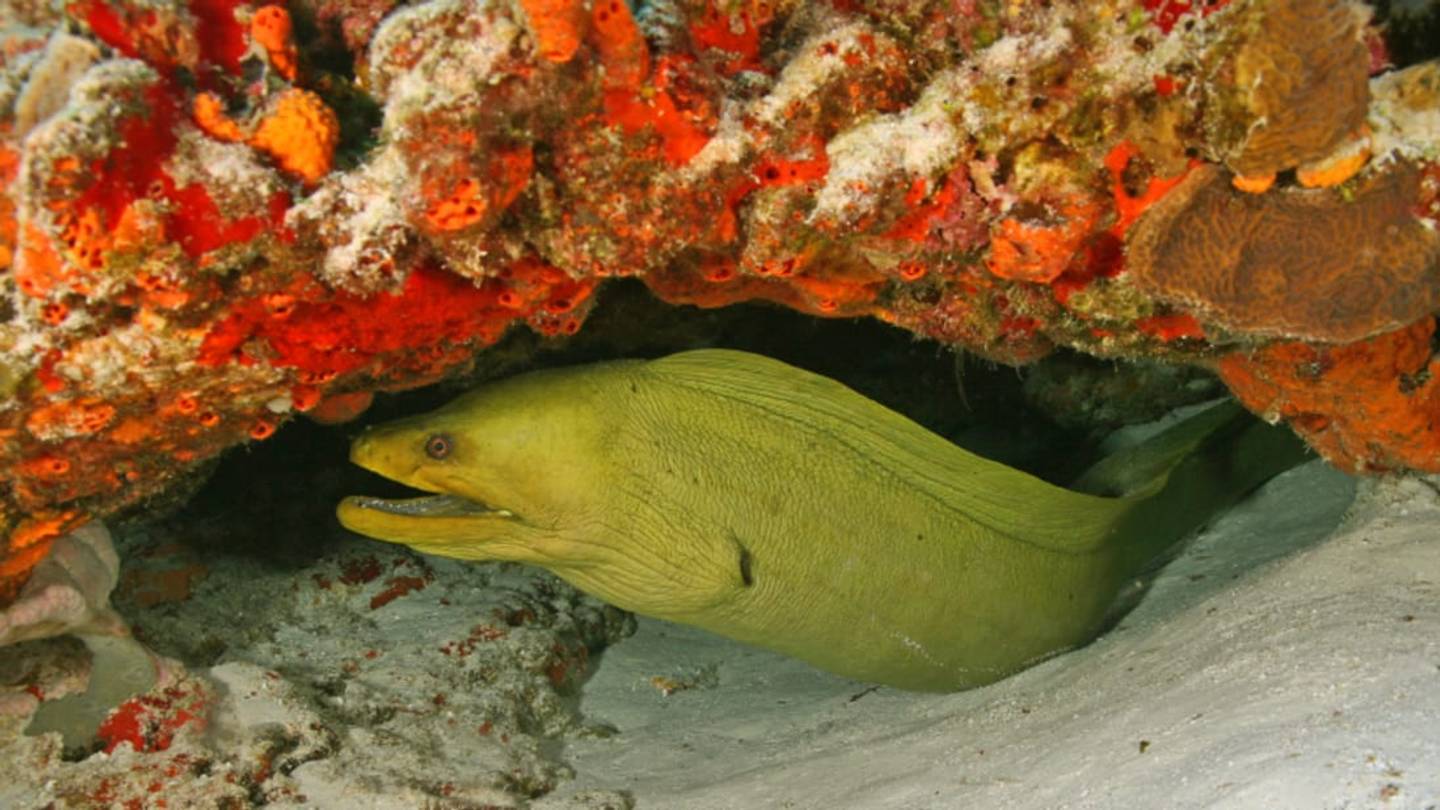
The fish that inspired Ursulaâs sidekicks in Disneyâs The Little Mermaid are at once odd, majestic, and dangerous.
Zina Deretsky, Wikimedia Commons // CC BY 3.0
Like the monster in Alien (1979), morays attack their victims with a hidden set of chompers. Inside the gullet are pair of concealed pharyngeal jaws that help the eel ensnare its prey. Whereas most predatory fish use suction to pull food down their throats, morays instead rely upon a two-step strategy. First, the outer jaws firmly grasp the target. Next, their pharyngeal set shoots forwards, bites the unfortunate victim, and pulls it into the throat.
The family is split into two main divisions: true morays and snake morays. The former are more common by far, with some 166 species presently recognized. Anatomically, their fins represent the biggest difference between these groupsâwhereas the dorsal fin of a true moray starts just behind its gills, the appendage is limited to the tail region in snake morays.
The largest species is the appropriately-named giant moray ( Gymnothorax javanicus ). So far, the most sizable individuals on record were around 8 feet in length and weighed 66 poundsâbut there are unconfirmed reports of monstrous 10-footers swimming around out there. Divers have spotted these animals in the Red Sea, off east African shores, and throughout the Indo-Pacific.
The average moray comes with curved teeth that are ideal for snagging fish. Still, a few varietiesâlike the zebra moray ( Gymnomuraena zebra )â dine on crabs, clams, mollusks, and sea urchins. Fare like this requires strong jaws and specialized grinding teeth, so their pearly whites are unusually blunt by moray standards.
Looking for morays? Take a night swim. By and large, these eels are active after the sun goes down, though a handfulâthe chain moray , Echidna catenata , for exampleâhave more diurnal lifestyles.   Â
When dinner swims down a narrow crevice, how does one retrieve it? Faced with this awkward predicament, the frustrated eel in the above video wraps its tail into a knot. Said knot then travels down the length of its body until it makes contact with the surrounding coral. Once there, the eel pulls with extra force. This technique not only helps morays yank prey out of tight places, butâon occasionâit can be used to rip bite-sized chunks off of large victims. Â
It only looks green because, like many morays, the animal wards off predators by secreting a layer of mucus that covers its skin. This slime contains various toxins , including one which destroys red blood cells. The goo also dramatically changes the fishâs appearance . While green morays are really a drab shade of brown, the gunkâs yellowish tint gives them a more vibrant hue.
While at rest, a moray will slowly open and close its jaws. At first glance, this looks like a âback offâ warning to other creatures, but in reality, itâs anything but. Normal fish have bony gill covers on their sides. By constantly opening and shutting these, water is forced over the internal gill chamber, allowing the animal to breathe. Morays have no such covers, so they have to orally pump down H 2 O in large gulps or die.
This appendage merges the dorsal, caudal, and anal fins into what appears to be an unbroken single structure.
Whereas the giant moray is a slender and slow-moving ambush hunter, the roving coral grouper ( Plectropomus pessuliferus )âwith which it shares the Red Seaâis a speedy killer thatâs well-suited for long chases in open water. But opposites are wont to attract once in a while.
Every so often, a grouper will invite a moray out onto a joint hunting trip . Upon locating an eel, the carnivore attracts its new partnerâs attention with some rapid head-shakes. Each fish complements the otherâs talents perfectly: With the moray wriggling through a craggy reef and the grouper hovering overhead, smaller animals have nowhere to hideâand at least one predator gets a meal.
Loading recommendations... Please wait while we load personalized content recommendations