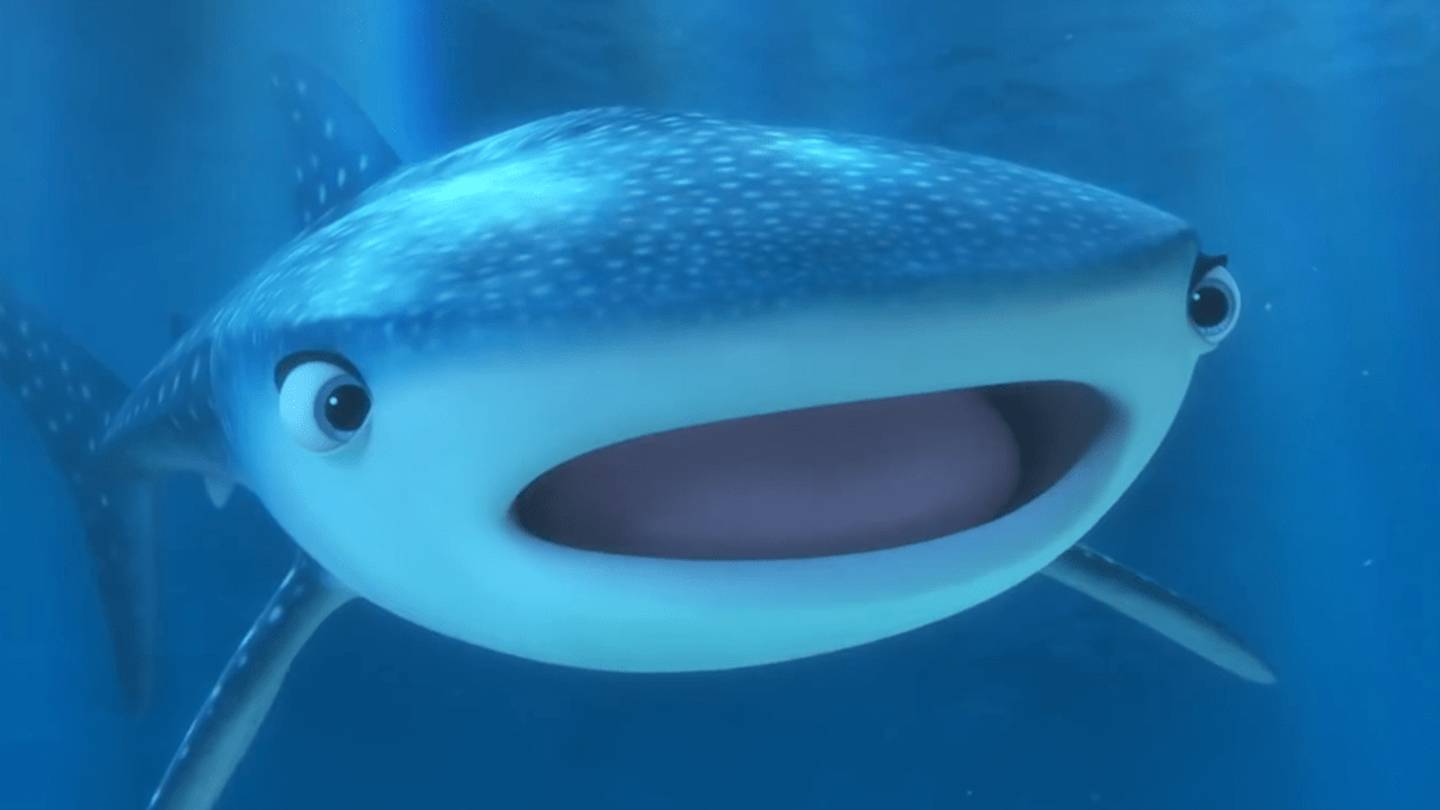
This fascinating, filter-feeding species will finally get its close-up in this summer's Finding Dory . Here are a few things you might not have known about the world's largest fish.
Itâs often said that the whale sharkâs maximum length  from end to end is about 45 feet, but this is a fish story. The longest verified measurements of live (or recently dead) specimens are in the 40-foot range.Â
How heavy can they get? Thatâs a difficult question to answer. Weighing such huge marine animals is no easy task; many scientists simply estimate instead. Still, researchers at the Okinawa Churaumi Aquarium have managed to weigh several individuals over the years. The heaviest theyâve encountered was a captured 30-footer that weighed just above 7 tons. In the wild, longer ones probably weigh a good deal more.
For years, there was much debate over how baby whale sharks come into the world. Then, in 1995, a pregnant female  was fatally harpooned near Taiwan. An autopsy revealed that her uteri (all sharks have two ) contained around 300 unborn embryos. This discovery confirmed that the species is ovoviviparous . In other words, whale sharksâlike certain snakesâhatch from eggs that are stored inside their motherâs body. Afterward, the little fish exit her womb fully-formed.
Thirty or 40-foot adult whale sharks have few natural enemies. Juveniles, on the other hand, are easy pickings for predators  like blue sharks and marlins. These youngsters have every incentive to get big quickâwhich is exactly what they do.
Consider this: In just three years and 68 days, one newborn whale shark at Japanâs Oita Ecological Aquarium went from weighing 1.7 to 333.4 pounds. Another infant showed the astonishing growth rate  of 18 inches per year over 630 days.
But, like human babies, young whale sharks donât keep growing at the same speed forever. Once the fish reach a certain size, scientists theorize that their growth rate slows down considerably. By then, the creatures haveâagain, in theoryâbecome big enough to scare away would-be attackers.
Most sharks have 20 to 30 rows of pearly whites, but whale sharks have more than 300 rows . That means a whale shark has 3000 individual teeth, each one about the size of a match head.
All those teeth don't do very much, though. Despite their enormous size, whale sharks exclusively dine  on very small life forms like plankton, krill, fish eggs, and small fish . The sharks usually swallow their food whole. Attached to the gills is a mesh-like network of long, cartilaginous bars known as âgill rakers.â These allow water to escape, but prevent even millimeter-sized victims from doing so. Eventually, the meal is forced down our whale sharkâs narrow throat and digested.
Sometimes, a whale shark will lazily swim with its mouth agape. This low-energy feeding technique allows the beast to passively  swallow any food items that might be in its path. But when it sees a dense cluster of potential targets, the shark changes tactics: The animal creates suction by rapidly opening and closing its jaws, pulling dinner into its cavernous maw. Hereâs a look at this second method in action:
Generally, whale sharksâwhich are tropical and sub-tropical fishâare encountered from latitudes  30° N to 35° S. Within this range, they move around a lot: In three years, a single whale shark can travel 8000 miles or more. Though scientists donât fully understand their migration habits, we know that the fish tend to gather en masse in specific places at specific times. For example, huge schools  visit exotic locales like the Galapagos Islands and Yucatan Peninsula every summer to gorge on plankton.
Covered in hard, tooth-like scales called denticles , the hide on a whale shark's back can be up to 4 inches thick . Whale sharks can toughen this skin still further by clenching the muscles that lie just beneath it. Conversely, their underbellies are relatively soft and vulnerableâso when approached by human divers, a whale shark will often turn  its belly away from them. Â
Most experts agree that whale sharks reach sexual maturity around age 30 , but their total life expectancy is unknownâand estimates are all over the map. According to some ichthyologists, the big fish probably die in their sixties. Others speculate that whale sharks can live to be 100 or even 150 years old. For the record, scientists arenât completely sure about the great white sharkâs maximum lifespan eitherâthough theyâre now known to reach age 70 or more.
In 2003 and 2004, a team led by biologist S.G. Wilson studied the long-term movements of six different whale sharks near western Australia. According to their results, the sharks mostly avoid deep plungesâin fact, the surveyed animals spent over half of their time within 100 feet of the surface.
With that said, though, whale sharks occasionally travel much, much further down. One of the Wilson teamâs specimens, for instance, spent at least 12 uninterrupted hours at a depth of 3215 feet . And this wasnât an isolated incidentâtagged whale sharks off the coasts of India have been recorded hitting 2200- to 3200-foot depths as well. Why do the fish embark on such extreme dives? Nobody knows, although the answer likely has something to do with either keeping cool or gathering food.
No two whale sharks share the exact same pattern . Just behind their gills, every single one has a totally unique arrangement of pale, white spots. Today, this fun fact is helping biologists keep tabs on individual sharksâwith some help from a secret weapon inspired by NASA.Â
Mapping out stars can be a daunting task. The Groth algorithm , created in 1986, is a pattern-recognition formula that enables NASA scientists to identify the countless star fields observed by instruments like the Hubble Telescope.
Decades later, one conservationist group is using a new version of this for a very different purpose. ECOCEAN is an Australian non-profit that runs the largest whale shark identification program on earthâand anybody with a camera can participate. The concept is simple. If youâve ever filmed or photographed a wild whale shark, send  ECOCEAN a copy of your footageâalong with some basic details about when and where the encounter occurred.
Then, a modified Groth algorithm is used to figure out if your fish is one of the 13,000-plus individuals on their record. If a match is pinpointed, youâll get an email with a summary of that particular sharkâs migration history.
Jason Holmberg of Portland, Oregon is ECOCEANâs information architect. During the early 2000s, he worked with NASA astrophysicist Zaven Arzoumanian to develop this new fish-centered Groth algorithm. As Holmberg explained, their final product closely resembles the original. âWe just adapted that from [identifying] white spots on a black night sky to white spots on the flank of a whale shark,â he told  National Geographic .Â
Loading recommendations... Please wait while we load personalized content recommendations