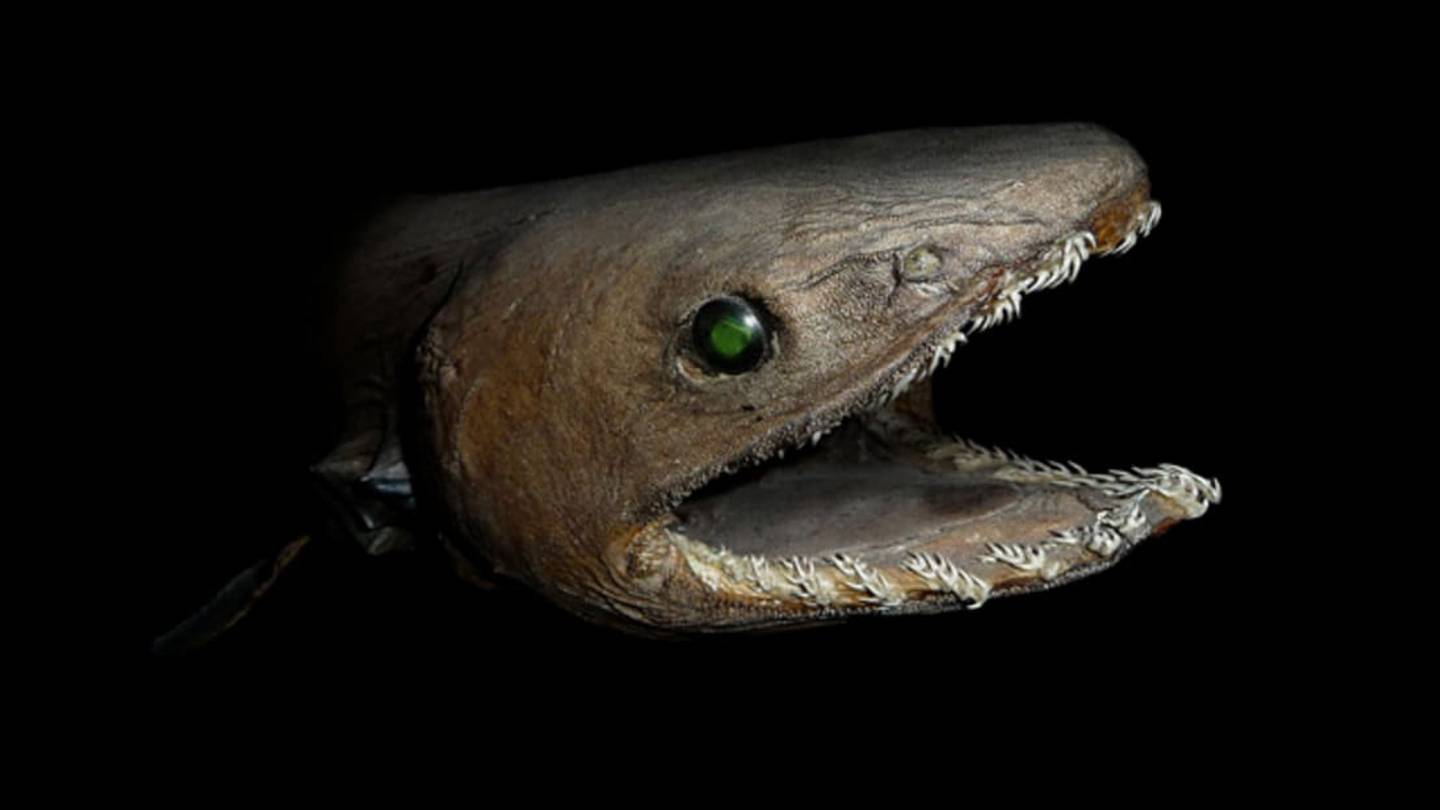
Sometimes called a âliving fossilâ because it has changed so little since prehistoric times, the eel-like frilled sharkâwhich is rarely seen by humansâhas been in the news this week after a snake-like one was found off the coast of Portugal. Hereâs a quick primer.
Its scientific name is Chlamydoselachus anguineus , but this creatureâs common name comes from its gills: Unlike all other sharks, which have separate gills, C. anguineus â first pair of gills go all the way across its throat ; each pair is lined at the edges with red âfringe.â
The sharks were first scientifically described by German ichthyologist Ludwig H.P. Döderlein, who taught at Tokyo University from 1879 to 1881 and brought two specimens captured in Tokyo Bay when he returned to Vienna. His paper describing the sharks was lost, however, so the first description comes from Samuel Garman in the 1884 edition of the Bulletin of Essex Institute . In the remarks after the description, Garman noted that
The frilled sharkâs species name, anguineus, is Latin for âconsisting of snakesâ or âsnaky.â
Biologist David A. Ebert, director of the Pacific Shark Research Center , described a second frilled shark speciesâ Chlamydoselachus africana , which lives off the coast of Africa and is about half as long as its predecessorâin 2009.
The frilled sharkâs mouth is just as terrifying as the maw of a great white: Itâs lined with 25 rows of backward-facing, trident-shaped teethâ300 in all. âThe teeth are constructed for grasping and from their peculiar shape and sharpness it would seem as if nothing that once came within their reach could escape them,â Garman wrote. âEven in the dead specimen the formidable three-pronged teeth make the mouth a troublesome one to explore.âÂ
Ebert can testify to that fact. âI can tell you from snagging my fingers on the teeth, you can only back out one way and thatâs in toward the mouth and then out,â he told WIRED . âIt didnât feel good, I can tell you that.â The shark uses the bright white teeth, which sharply contrast against its brown body, to lure in prey: âBy the time [the prey] realize, Oh, thatâs the teeth of a shark, theyâre too close and the shark is able to ambush them at that point,â Ebert said. âItâs almost like when you drive out of a parking lot exit and they have the spikes sticking out that say, âDo not back up.â Thatâs kind of what happens when these things catch prey items.â
And as if its teeth werenât freaky enough, the frilled shark has spines, called dermal denticles, lining its mouth. So if you happen to see one of these anywhere, itâs better to look and not touch.
Scientists once believed that the frilled shark wriggled through the water like an eel. But according to the ReefQuest Centre for Shark Research, âits body cavity is elongate and packed with a huge liver perfused with low-density oils and hydrocarbons, making the shark almost neutrally buoyant at depth.â
No one has ever observed the frilled shark hunting, but scientists believe that it uses its posterior fins as propulsive surfaces to launch itself at its prey. Its long jaws, which terminate at the back of its head, may allow the animal to gape extra wide and take in prey half as long as its body. Analysis of the stomach contents of captured specimens has revealed that the frilled sharkâs diet is 61 percent cephalopod , 11 percent teleost fishes , and, occasionally, other sharks .
The Food and Agriculture Organization of the United Nations notes that the frilled shark is âwide-ranging but spottily distributedâ; you can see where the shark is found on the map above. It typically resides in depths between 390 and 4200 feet, so people rarely see these sharks unless they venture to the surface, which isnât unheard of (as youâll see below).
On average, males range from 3.2 to 3.6 feet and females from 4.4 to 4.9 feet; the maximum these sharks can reach is 6.4 feet .
A study of frilled sharks in Japan revealed that the animals breed year-round; litters typically consist of six pups, which emerge from eggs while still in the motherâs uterus and are then born live. Scientists think the shark may have the longest gestation period ever: Frilled sharks could gestate for as long as 42 months , nearly twice as long as African elephants carry their young. Scientists theorize that the extreme length has something to do with the sharkâs cold deep sea habitat.
NOAA scientists exploring the â Latitude 31-30 Transect â in the Atlantic Ocean captured a video of a frilled shark âswimming over sea bottom that was covered with tiny sand dunesâ during a submersible dive. âThis species has been, on rare occasion, caught or taken in bottom trawls,â the site notes . âTo the knowledge of everyone on board, however, this was the first time anyone had ever seen the rare species in its natural habitat.â
In January 2007, a Japanese fisherman spotted a strange, eel-like creature with a mouth full of sharp teeth near the surface; he alerted the staff of the Awashima Marine Park in Shizuoka, who captured the animal and transferred it to a seawater pool, where they filmed it. âWe think it may have come close to the surface because it was sick, or else it was weakened because it was in shallow waters,â a park official said . âWe believe moving pictures of a live specimen are extremely rare. They live between 600 and 1000 meters under the water, which is deeper than humans can go.â The shark, a female, died a few hours after its capture.
The frilled shark might have rows upon rows of gnarly teeth, but its cousin , the goblin shark, can thrust its jaw out of its face. Which is more terrifying?
Loading recommendations... Please wait while we load personalized content recommendations