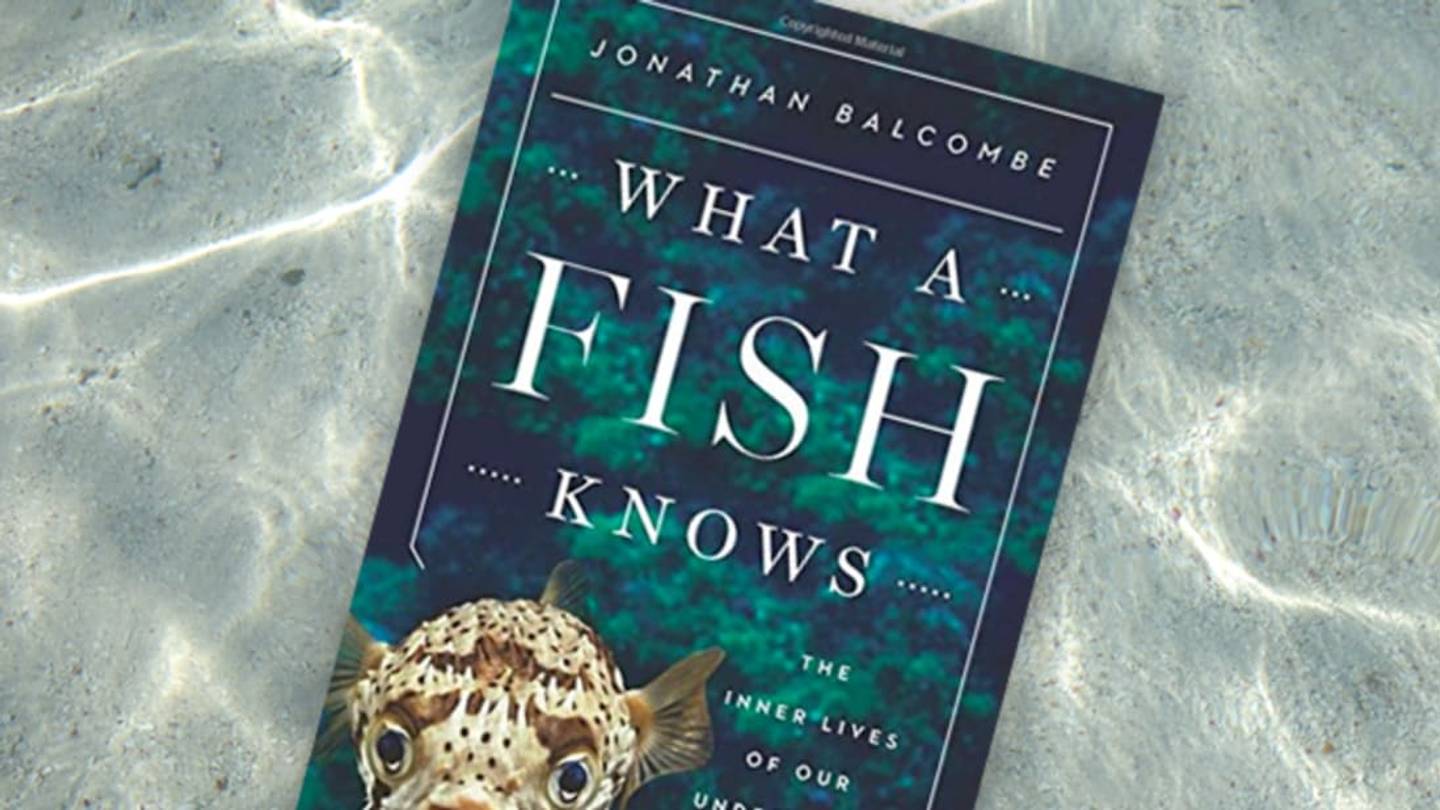
Jonathan Balcombe's new book What a Fish Knows bubbles with astounding fish facts. We talked with him about fishes' feelings, their families, and their fight squads.
Balcombe prefers the plural âfishesâ to âfish,â because, as he says, theyâre ânot things. Theyâre individuals, thinking animals with minds and lives of their own.â Stand in front of a restaurant aquarium for just a few minutes and youâll notice something startling: Just like individual people, some fishes are more aggressive, while others are sneaky; some are shy, and others curious. Balcombe also notes that the category of âfishâ contains a very, very broad range of animals, from whale sharks to eels, seahorses, and goldfish. âThere are 32,000 species,â he says, âand within each of those species there are many, many individuals.â
The relationship between cleaner fish and their clients is mind-blowingly sophisticated. Little cleaner fish set up car-wash-type stations and advertise their services by flashing brightly colored scales. Larger fish queue up, then swim up one at a time to have algae, parasites, and other debris removed from their mouths, scales, and gill covers. Now, fish are covered in a sensitive layer of protective mucus; thatâs what makes them slimy. And that mucus is nutrient-rich and, âas it turns out,â Balcombe says, âpretty tasty.â
But there are consequences for a cleaner fish who nips a clientâs slime coating: The client will startle or jolt. That jolt tells the cleaner fish to knock it off, but it also tells the other fish waiting around and watching that this cleaner is sub-par. Those fish may very well take their business somewhere else. If those fish arenât there, the cleaner may well keep nipping, but the client will likely find a new cleaner next time.
Damselfish. Image Credit: Philippe Bourjon via Wikimedia Commons // CC BY-SA 4.0
Fish parents can be dedicated as any lion, chimpanzee, or human. You know that sensitive, off-limits mucus layer? Some fish let their babies eat it. Some fish actually leave the water to lay their eggs in safe, hidden places. Some wear their eggs like hats to keep them close. Still others will defend their eggs to the death, even against much larger animals. In the book, Balcombe describes fish expert Tierney Thysâs encounter with a fierce 5-inch damselfish guarding a clutch of eggs. When Thys moved in to get a closer look, the fish attacked, darting in, seizing a lock of Thysâs hair in its teeth, and pulling â⦠so hard, that I involuntarily yelped in pain, a cry that was immediately followed by spluttering as I flooded my mask laughing.â
Grouper. Image Credit: Elias Levy via Wikimedia Commons // CC BY 2.0
Like the Avengers, fish of different species team up to combine their powers. For example: Coral groupers will invite moray eels to join them on a hunt. Groupers are great hunters in open water and eels are unstoppable in cracks and crevices, which means that few prey can escape a moray-grouper team. And it gets better: Theyâve learned to communicate across the species barrier. Researchers found that when a grouper finds hidden prey it canât reach, it performs a âheadstand,â pointing to its quarry with its entire body so the eel knows where to go. If the eel is too far away to notice, the grouper may swim over, shake its body to get the eel to follow it, return to the cranny, and point again. Outside of groupers, only two other types of animals are known to point: ravens and primates.
For a long, long time, scientists assumed that fishesâ lack of external ears meant that they were deaf. We now know that they can hear just fine. Some species can hear even better than we can. And not only can they hear noises, but they make them, too. Fish can growl, bark, click, hum, whistle, and croak. Some fish are so noisy that they can be heard on land.
Goby. Image Credit: Sdbeazley via Wikimedia Commons // CC BY 2.0
Studies have shown that individual fish can remember events, tasks, tests, and other fish for months and even years. And the goldfishâs notorious three-second memory is a complete mythâmany pet owners and researchers have trained their fish to do tricks, a feat that relies on a solid memory of stimulus and reward.
And then there are the frillfin gobies, little intertidal fish whose tiny brains can perform astonishingly complex calculations. At low tide, gobies often find themselves trapped in tide pools with hungry predators. With no ability to see the terrain around them, the gobies are able to leap into the air and land, with 97 percent accuracy, in a neighboring pool. How do they do it? Experiments in an artificial tidal zone found that, in high tide, as the waves wash the gobies ashore, they look down at the beach, memorizing the topography. When the tide recedes, the gobiesâ brains translate that aerial map into an eye-level blueprint, telling them not only where they are, but where to jump to find safety.
Cleaner fish bring their clients more than just hygiene. Experiments have shown that stressed out fish are more likely to seek out cleaners, and that the experience of being stroked or touched lowers their cortisol levels. In other words, it feels good.
Many studies have shown that, far from being the mindless, scaly robots we imagine them to be, fish can feel pain as acutely as other animalsâa fact Balcombe says we should keep in mind the next time we visit the grocery store. âItâs pretty awful, the way we treat fish,â he says. âWeâre taking huge, huge numbers of fish from the ocean, and sadly, most of them die of suffocation on the boat deck, are crushed in the net, or suffer decompression injuries. As consumers, weâre all party to that. When we purchase something at the supermarket, weâre essentially saying to the supplier, âDo it again.ââ
Loading recommendations... Please wait while we load personalized content recommendations