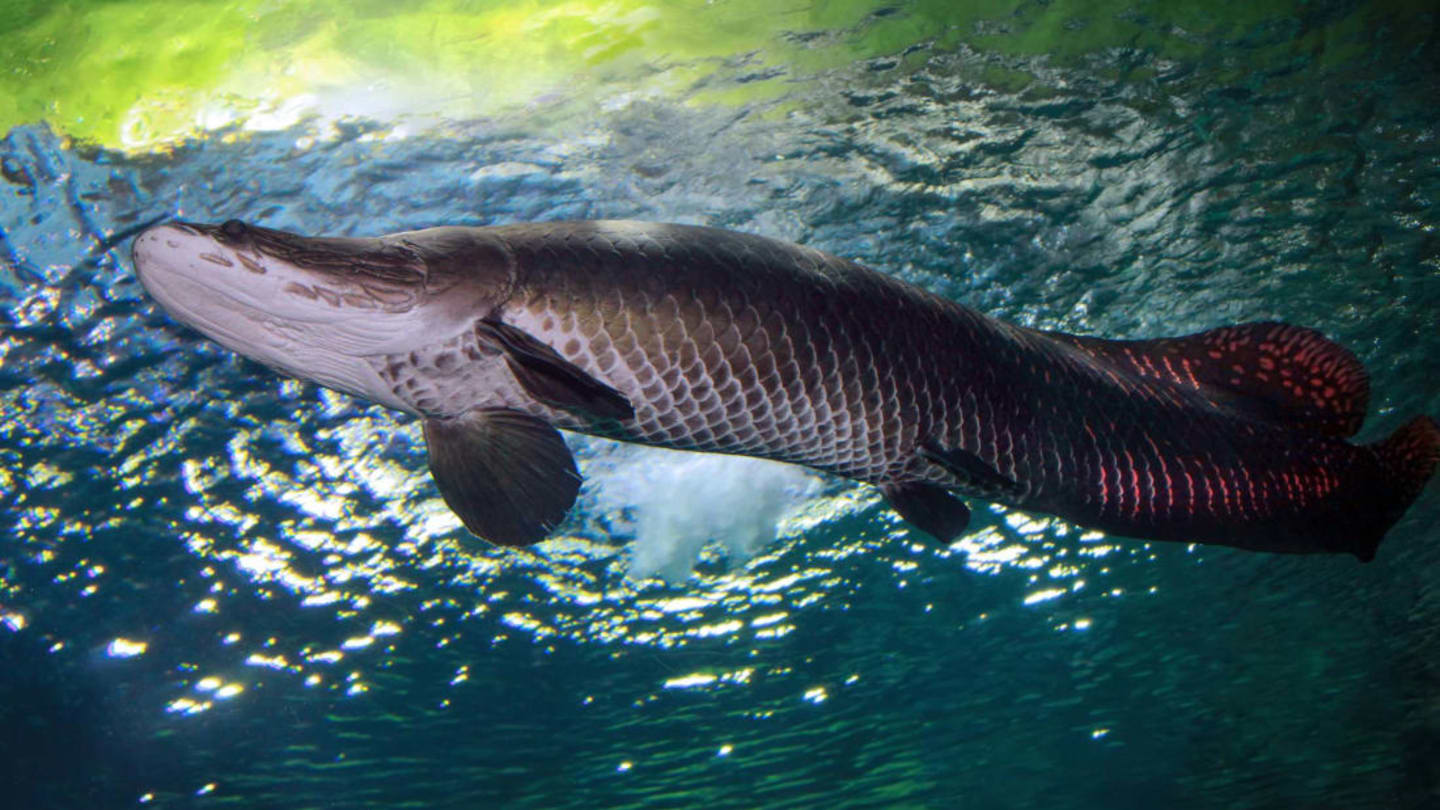
Last month, during a visit to Jaycee Park in Cape Coral, Florida, Leah Gettsâs son spotted a massive dead fish floating in the Caloosahatchee River. âIt was bigger than my 7-year-old, whoâs not a small kid,â Getts told NBC2. She shared a photo of the fish on Facebook, and her followers helped identify it as an arapaimaâa freshwater species native to the Amazon River.
Arapaima ( Arapaima gigas ) canât survive in cold water, so theyâre not known to venture near North America regularly. But parts of southeast Florida may now be warm enough to host them, which could pose a threat to the regionâs existing wildlife. The predatory fish isnât a picky eaterâit primarily feasts on other fish, but it also eats fruit, insects, birds, and even mammals. And since an arapaima can lay thousands of eggs per year, it wouldnât take long for it to become a major invasive species .
The Florida Fish and Wildlife Conservation Commission told the Associated Press that thereâs âno evidence that arapaima have reproduced in the wild in Floridaâ yet, but theyâre asking people to report any sightings of the fish, which you can do here .
In the meantime, here are five fascinating facts about the aquatic behemoth.
Though the specimen found in Floridaâs Caloosahatchee River was only about 5.5 feet long, arapaima can be much larger. Typical ones measure 7 to 8 feet and weigh around 200 pounds, but theyâve also been known to reach nearly 15 feet and tip the scales at around 440 pounds.
The arapaima can stay submerged for roughly 10 to 20 minutes before it needs to surface for air. It breathes not through its gillsâwhich are too small for the jobâbut by opening its mouth and funneling air into a lung-like gas bladder. According to National Geographic , âthe noisy, distinctive gulp it makes sounds like a cough and can be heard from far away.â
The arapaima dwells in several South American countries, so itâs known by more than one name. For Peruvians, itâs paiche . Brazilians call it the pirarucu , from the words for red ( urucu ) and fish ( pira ) in the Tupi language.
The arapaimaâs scaly coat is basically the fish version of a bulletproof vest, which helps protect them from cold-blooded killers like piranhas. The scales comprise two layers: a hard exterior made of minerals, and a flexible interior made of collagen. Unlike human-made bulletproof vests, however, those arenât fused together with a third adhesive layerâthe two layers of each arapaima scale actually grow together. This makes it ideal for pressure absorption and range of motion, which researchers hope can help inform advances in materials science.
Animal Crossing : New Horizons introduced the arapaima to its virtual waters in 2020, along with great white sharks , ribbon eels, and a whole host of other aquatic offerings. Players in the Northern Hemisphere can only find them in rivers from June to September, between the hours of 4 p.m. and 9 a.m. But catching one will earn you a pretty pennyâtheyâre valued at 10,000 bells each, making them one of the most expensive fish in the game.
Loading recommendations... Please wait while we load personalized content recommendations