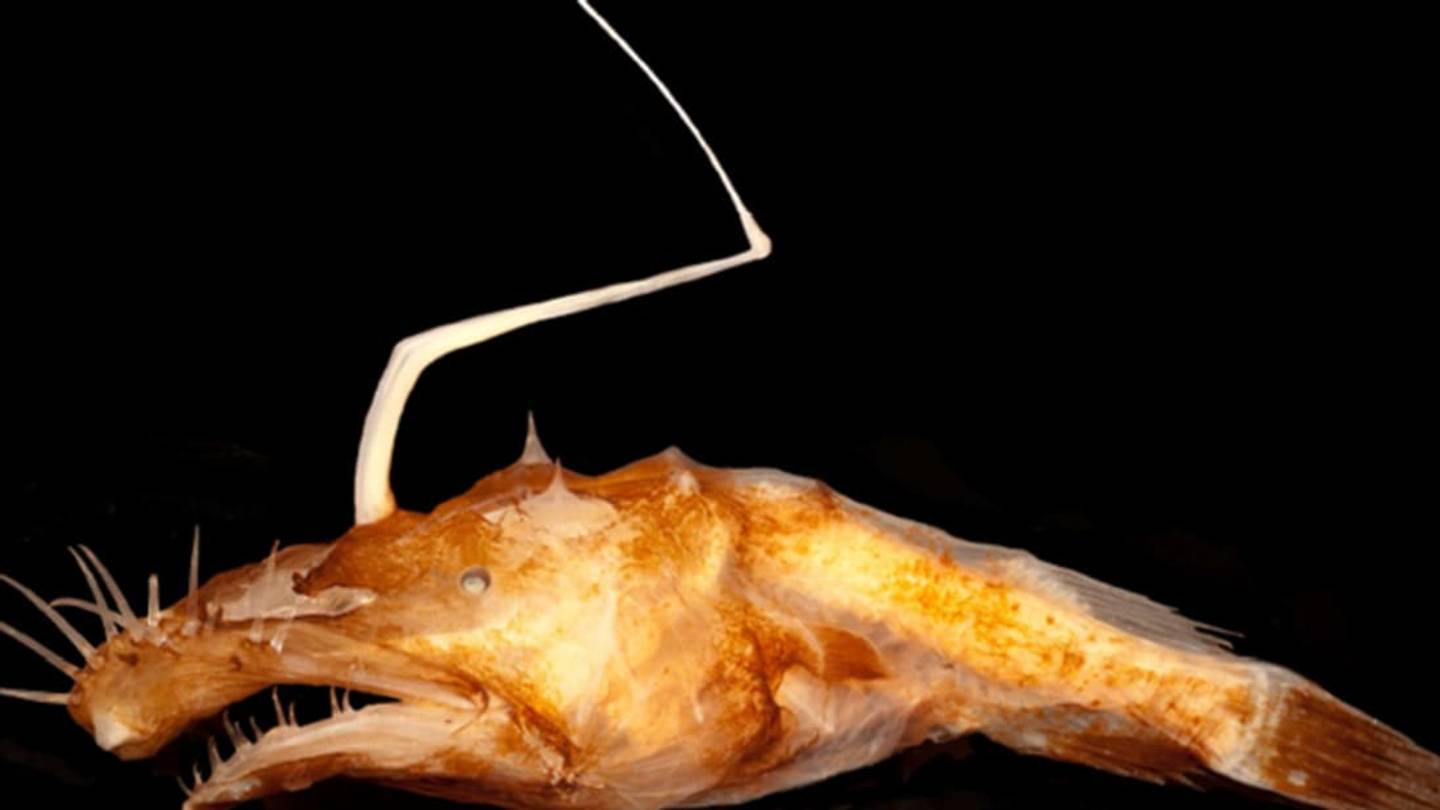
Most deep-sea anglerfish look like creatures from another world, but the newest species, discovered by a researcher at Nova Southeastern University's (NSU) Halmos College of Natural Sciences and Oceanography, is the strangest-looking yet.
Tracey Sutton, Ph.D., discovered the animalâa new species of Ceratioid anglerfish called Lasiognathus dinema âin the northern Gulf of Mexico at depths between 3281 feet and 4921 feet. Sutton and the University of Washingtonâs Theodore Pietsch, Ph.D., formally described the newly discovered fish in the journal Copeia .
Anglerfish live at depths where light from the surface cannot penetrate, and the females attract prey with flashing bioluminescent lures, or escas, attached to their heads. Believing theyâve found a meal, the prey approaches the anglerfishâand becomes a meal itself.
Males are much smaller than females and, in some species, actually attach themselves to the females , losing nonessential parts like eyes and fins, and providing sperm when itâs time to spawn. (John Sparks, a curator in the American Museum of Natural History's Department of Ichthyology, told mental_floss last year that only five of 11 species in the suborder Ceratioidei have this parasite-host relationship, and thereâs no information available yet about how this newest species does the deed.)
According to the paper, this new species, described from three females, is ânot especially similar to any of the five previously described members of the genus.â Especially exciting is the animal's esca, which, the scientists write, is âcylindrical ... bearing three lightly pigmented, strongly curved bony hooks and a pair of filamentous, tapering prolongations,â which are honored in its scientific name: Dinema comes from the Greek di , for two, and nema , for thread.
"Finding this new species reinforces the notion that our inventory of life in the vast ocean interior is far from complete," Sutton said in a press release . "Every research trip is an adventure and another opportunity to learn about our planet and the varied creatures who call it home."
The three type specimens will be housed in the world's largest deep-sea anglerfish collection at the University of Washington.
Loading recommendations... Please wait while we load personalized content recommendations