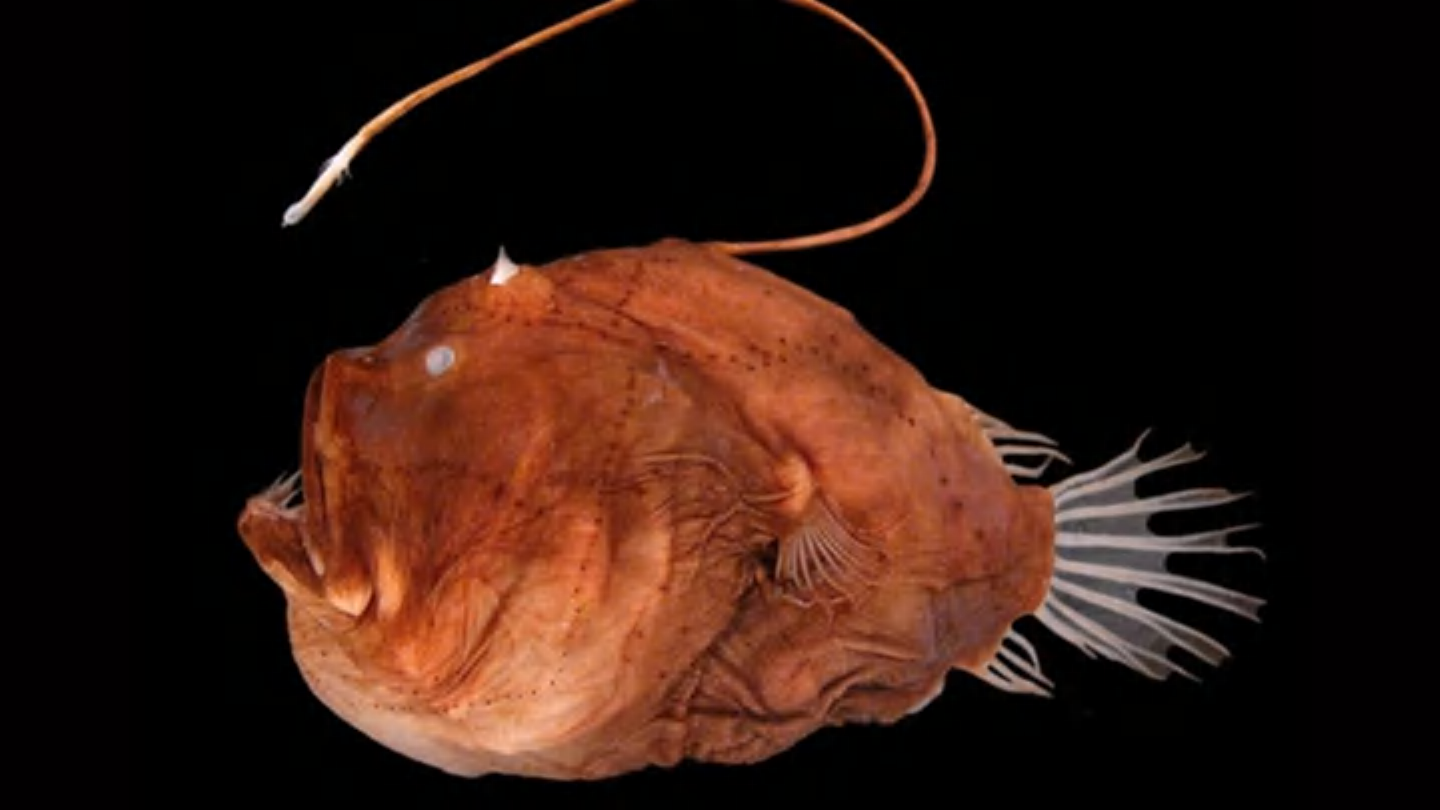
When you think of an anglerfish , you probably imagine something like the creature above: a big mouth, gnarly teeth, a lure bobbing from its head. In short, perfect nightmare fodder.
During the 19th century, when scientists began to discover, describe, and classify anglerfish from a particular branch of the anglerfish family treeâthe suborder Ceratioideiâthatâs what they thought of, too. The problem was that they were only seeing half the picture. The specimens that they were working with were all female, and they had no idea where the males were or what they looked like.
Researchers sometimes found other fish that seemed to be related based on their body structure, but they lacked the fearsome maw and lure typical of ceratioids and were much smallerâsometimes only as long as 6 or 7 millimetersâand got placed into separate taxonomic groups.
It wasnât until the 1920sâalmost a full century after the first ceratioid was entered into the scientific recordâthat things started to become a little clearer. In 1922, Icelandic biologist Bjarni Saemundsson discovered a female ceratioid with two of these smaller fish attached to her belly by their snouts. He assumed it was a mother and her babies, but was puzzled by the arrangement.
âI can form no idea of how, or when, the larvae, or young, become attached to the mother. I cannot believe that the male fastens the egg to the female,â he wrote . âThis remains a puzzle for some future researchers to solve.â
While Saemundsson kicked the problem down the road, it was Charles Tate Regan, working at the British Museum of Natural History in 1924, who picked it up. Regan also found a smaller fish attached to a female ceratioid. When he dissected it, he realized it wasnât a different species or the female anglerâs child. It was her mate.
The âmissingâ males had been there all along, just unrecognized and misclassified, and Regan and other scientists, like Norwegian zoologist Albert Eide Parr, soon figured out why the male ceratioids looked so different. They donât need lures or big mouths and teeth because they donât hunt, and they donât hunt because they have the females. The ceratioid male, Regan wrote , is âmerely an appendage of the female, and entirely dependent on her for nutrition.â In other words, a parasite.
When ceratioid males go looking for love, they follow a species-specific pheromone to a female, who will often aid their search further by flashing her bioluminescent lure. Once the male finds a suitable mate, he bites into her belly and latches on until his body fuses with hers. Their skin joins together, and so do their blood vessels, which allows the male to take all the nutrients he needs from his host/mateâs blood. The two fish essentially become one.
With his body attached to hers like this, the male doesnât have to trouble himself with things like seeing or swimming or eating like a normal fish. The body parts he doesnât need anymoreâeyes, fins, and some internal organsâatrophy, degenerate , and wither away, until heâs little more than a lump of flesh hanging from the female, taking food from her and providing sperm whenever sheâs ready to spawn.
Extreme size differences between the sexes and parasitic mating arenât found in all anglerfish. Throughout the other suborders, there are males that are free-swimming their whole lives, that can hunt on their own and that only attach to the females temporarily to reproduce before moving along. For deep-sea ceratioids that might only rarely bump into each other in the abyss, though, the weird mating ritual is a necessary adaptation to keep mates close at hand and ensure that there will always be more little anglerfish. And for us, itâs something to both marvel and cringe at, a reminder that the natural world is often as strange as any fiction we can imagine.
Naturalist William Beebe put it nicely in 1938, writing , âBut to be driven by impelling odor headlong upon a mate so gigantic, in such immense and forbidding darkness, and willfully eat a hole in her soft side, to feel the gradually increasing transfusion of her blood through oneâs veins, to lose everything that marked one as other than a worm, to become a brainless, senseless thing that was a fishâthis is sheer fiction, beyond all belief unless we have seen the proof of it.â
A version of this article was originally published in 2014 and has been updated for 2023.
Loading recommendations... Please wait while we load personalized content recommendations