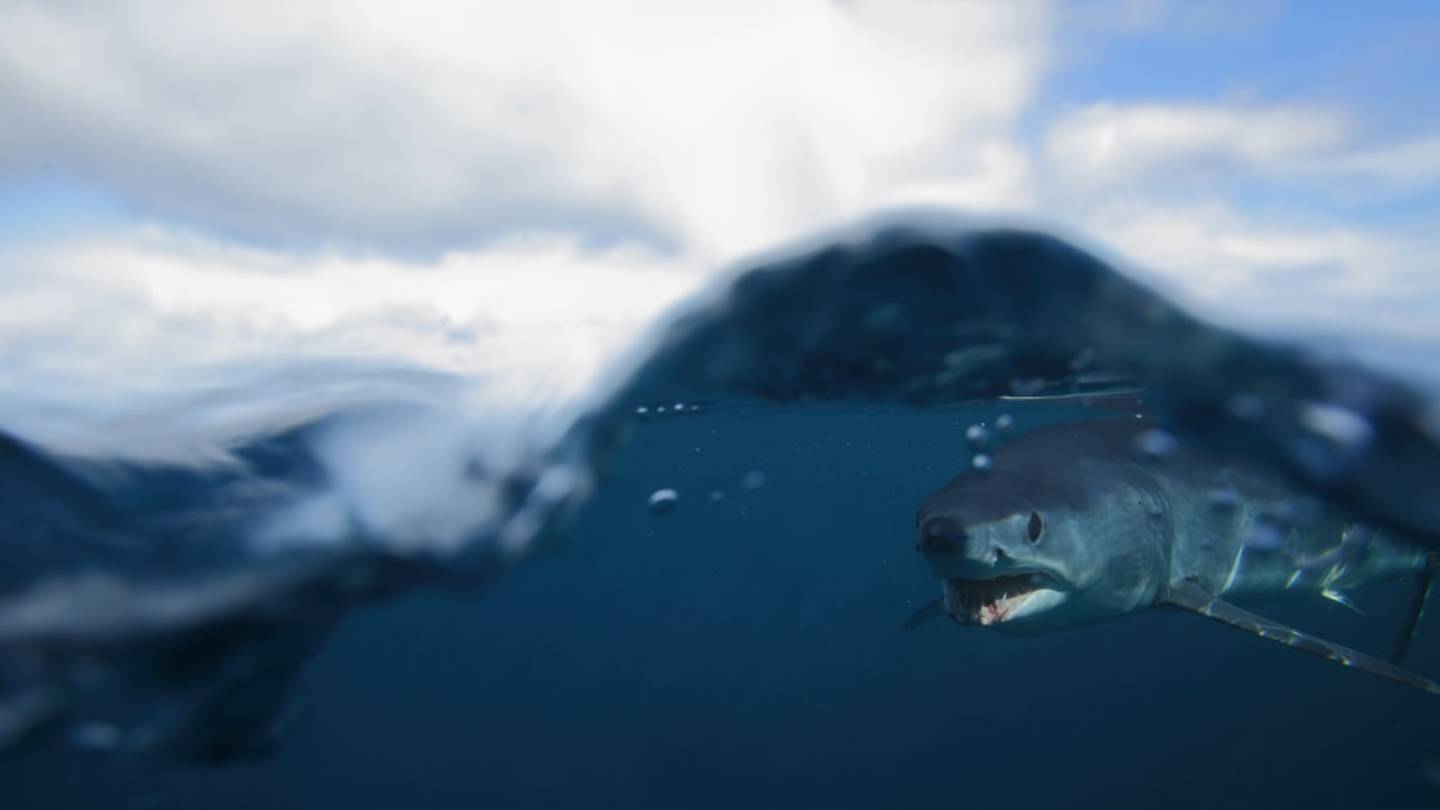
Though dwarfed by the closely related great white shark, makos are impressive fish in their own right: They're speedy, powerful predators that have been featured in famous literature and have a bizarre connection to election forecasting. Read on to learn more.
For over 150 years, marine biologists thought there was only one type of mako shark: the shortfin mako ( Isurus oxyrhinchus ), which got its scientific name in 1810. A second makoâthe longfin mako ( Isurus paucus )âwasn't recognized as its own separate species until 1966 .
Identifying the second species took so long both because the makos look similarâboth are open ocean predators with conical snouts and bluish-grey skin with white underbellies. Theyâre also found in many of the same areas (they prefer warm waters, and typically hang out in tropical or subtropical portions of the Atlantic, Pacific, and Indian Oceans). One way to figure out which is which is by comparing the flanks : The longfin mako is so named because, as the name implies, itâs got much longer pectoral fins. It's also a longer shark overall.
The Lamnidae family includes the salmon shark, the porbeagle, and the great white . In terms of size, a full-grown great white, at 19.6 feet long, is the biggest. Next comes the longfin mako, which has a maximum known length of 14 feet . Even the biggest shortfins reach just 12.8 feet long.
The shortfin mako is built for speed. Its body has a streamlined, bullet-like shape that minimizes water resistance, and its pectoral and dorsal fins are rather short, so they donât create much dragâall features that combine to allow the sharks to slice through the ocean with ease. The scales behind the gills and along its sides are flexible; they can bristle upwards at an angle of over 60 degrees, and thereâs some evidence to indicate that shortfin makos use these scales to manipulate the flow of water around their bodies, reducing drag still further. These adaptations help the shortfin mako reach speeds of at least 31 mph. Unverified estimates put the top speed of adult shortfin makos at 45 mph or more, and a juvenile shark was once estimated at 60 mph (though that measurement might not be 100 percent reliable).
Just how fast the longfin mako can swim is unclear. Fewer researchers have studied this fish in detail, but due to its longer fins, the shark is probably slower .
Shark tooth necklaces and earrings were traditional attire in the culture of the MÄori of New Zealand. Mako is MÄori word that can mean either âsharkâ or âshark tooth.â Longfin makos are not known to occur in New Zealand waters, but shortfins frequent the area, with the fish being especially common around the northern end of the country.
Beginning in December 2004, biologist Gonzalo Mucientes and his colleagues spent four months gathering data on sharks in the southeastern Pacific. Unexpectedly, they found adult shortfin makos practicing sexual segregation . On one side of an imaginary, north-south line between Rapa Nui (Easter Island) and the Pitcairn Islands, the team discovered male shortfins almost exclusively. The other side yielded many more females than males. Another study noticed this same kind of sexual divide among shortfin makos in the north Pacific. Scientists theorized that adult shortfin makos steer clear of the opposite sex for extended periods so the females who arenât looking to reproduce can avoid harassment from males.
When they're bornâafter a gestation period that is believed to last 15 to 18 monthsâshortfin pups are 25 to 28 inches long . According to a 2009 study, males become full-fledged adults at between 7 and 9 years of age, but females don't hit that benchmark until they're between 18 and 21. The species has an estimated lifespan of 29 to 32 yearsâso when a given population of shortfin makos declines, the slow maturation rates can make it difficult for these fish to bounce back.
You might say the shortfin mako enjoys fast food: The shark is a quick carnivore who chases down other high-velocity fish. Bluefish are a favorite meal: In an examination of 399 shortfin mako carcasses, bluefish remains turned up in 67 percent of their stomachs. The sharks will also go after squid, tuna, and billfish, plus the occasional dolphin or porpoise .
They're also known to attack swordfish and sailfish. Unfortunately for the sharks, those fish use their sharp beaks to impale attackers. Shortfin makos with stab or puncture wounds are a common sight; one female shark was found dead with a broken-off sailfish beak lodged in her eye . Reports of similar injuries on longfin makos tell us that this species also has an antagonistic (and probably predatory) relationship with powerful swordfish.
Big, fast, and tenacious, the shortfin mako is a prized game fish around the worldâbut grappling with one is quite the challenge for anglers. âThe feel of most sharks on a fishing line is like hauling on wet laundry or trying to lift a cow,â wrote Jaws author Peter Benchley. âFighting a mako has been compared to riding a bull or wrestling an enraged crocodile.â
It gets even tougher if the fish go airborne. Shortfin makos can reportedly leap up to 20 feet out of the water, often after getting caught on a fishermanâs line. That leads to a lot of weird-but-true headlines about makos who have propelled themselves onto boat decks. In 2013, a hooked shortfin weighing 303 pounds hopped aboard a private fishing vessel off the coast of New Jersey, causing $5000 in damages. Four years later, a 10-footer was released back into Long Island waters after it had burst from the ocean and gotten stuck under the guard rail of a chartered boat.
The shortfin mako puts up a good fight, but thatâs not the only reason why fishermen target them. âTheyâre unlucky enough to be one of the few shark species that is commercially viable for their meat,â wildlife ecologist Michael Byrne told Popular Science . Shortfin mako meat has a swordfish-like taste and has long been used as an ingredient in everything from stews to fish tacos. Longfin mako is sometimes eaten as well, but according to the University of Florida, longfin meat is considered to be lower in quality . However, the longfin is still actively hunted down for its namesake fins, which can fetch high prices as decorative items.
If a species can be fished, it can be overfished. The International Union for Conservation of Nature (IUCN) classifies both mako species as â vulnerable ,â a designation it reserves for animals that might soon become endangered. Many of these sharks get accidentally captured when schools of tuna or swordfish are reeled in by large-scale fishing operations. Also, scientists think the shortfinâs slow maturation rates have contributed to its decline in many areas.
In The Old Man and the Sea âone of his final works, and the novel that won him a Pulitzer in 1953âHemingway wrote a mako shark into a scene with the book's main character, Santiago, a Cuban fisherman who is trying to land an Atlantic blue marlin. He successfully harpoons one, but nearly loses his catch to a mako:
A fight ensues between man and beast. Santiago kills the shark, but not before it rips off 40 pounds of marlin meat, thus guaranteeing that other predators will flock to the corpse.
Who needs polling data when youâve got prognosticating sharks? Researchers at Nova Southeastern University in Fort Lauderdale, Florida, use satellite tags to survey wild sharks. In the fall of 2016, the scientists decided to advertise their program by using tracking data from two makos to try and predict the outcome of that yearâs presidential election . Both fish were named after one of the candidates and it was decided that whichever shark had swum the farthest between September 26 and November 1 would be declared the winner. Within that timeframe, the Donald Trump shark swam 652.44 miles to the Hillary Clinton sharkâs 510.07. The school used the same method to try to determine the outcomes of Floridaâs 2018 Senate and gubernatorial races, crowning Ron DeSantis and Bill Nelson the winners. (DeSantis won; Nelson did not.)
Loading recommendations... Please wait while we load personalized content recommendations