Itâs been 50 years since Steven Spielbergâs Jaws (1975) inspired a fear of sharks in countless people. The movie was based on Peter Benchleyâs 1974 novel of the same name , but both Benchley and Spielberg came to regret their part in making people think that sharks are human-eating monsters. In 2000, Benchley wrote that âthe knowledge we have accumulated about great whites in the past 25 years has convinced me that I couldnât possibly write Jaws today ... not in good conscience anyway.â And in 2022, Spielberg said , âI truly, and to this day, regret the decimation of the shark population because of the book and the film.â
The chances of being killed by a shark are remarkably lowâjust in 1 in 4,332,817 . For comparison, the odds of a bolt of lightning sending you to your grave are 1 in 79,746. But shark attacks do still occasionally happen, so if you see a shark swimming toward you, here are the eight species that are most likely to try to take a (potentially deadly) bite.
(It should be noted that the dataâtaken from the International Shark Attack File , or ISAFâis imperfect due to the difficulty in positively identify the correct species of shark during an attack.)
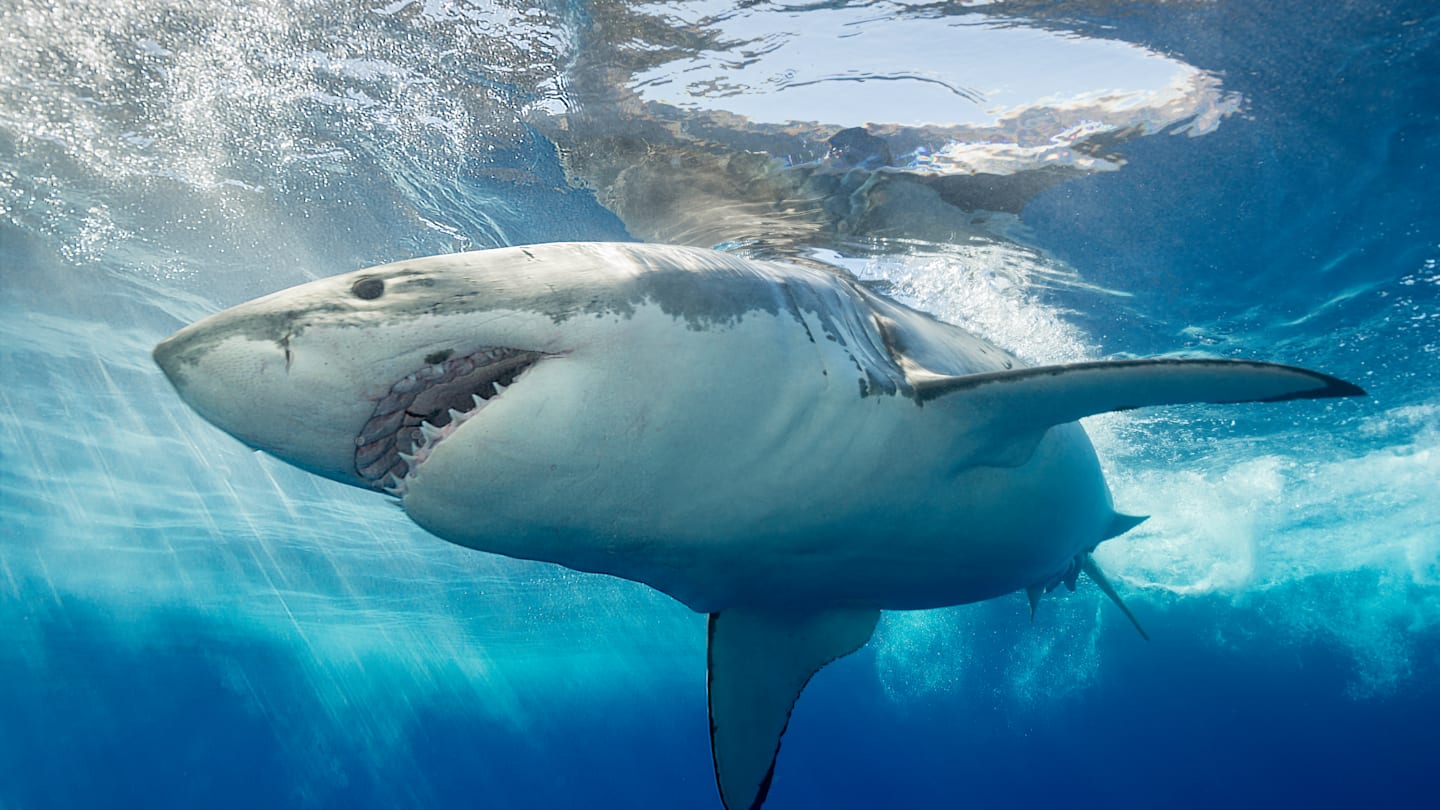
Although Jaws is an unfairly bloodthirsty portrayal of a white shark ( Carcharodon carcharias )âcommonly known as the great whiteâthe numbers do award them the title of most dangerous shark. This species is currently responsible for 59 fatal attacks and 292 non-fatal attacks around the world.
Great whites are big, but not quite as big as Jaws would have you believe. While the shark in the film (called âBruceâ on set) was 25 feet long, the largest real-life white sharks measure around 20 feet (and on average theyâre 10â16 feet ). Aside from the frequency of their attacks and their massive size, the other reason white sharks are so dangerous comes down to their teeth. Their jaws are lined with around 300 serrated triangular teeth that are designed for shearing rather than holding, meaning that when they take a bite, they do a lot of damage.
The tiger shark ( Galeocerdo cuvier ) is very aptly named; their bodies are covered in tiger-like stripes, although as pups they actually have spots and the stripes gradually fade as they reach maturity. Tiger sharks have a reputation for chowing down on pretty much anything that swims past, including sea turtles, stingrays, smaller sharks, and, yes, even the occasional human. They have 39 kills to their name and 103 non-fatal attacks. Tiger sharks also arenât above eating garbage thatâs been thrown into the sea, from rubber tires to license plates ( the scene in Jaws where a license plate is pulled from a dead tiger sharkâs stomach is accurate!).
The majority of sharks live in marine environments, but the bull shark ( Carcharhinus leucas ) can thrive in both saltwater and freshwater, meaning that theyâre just as happy to hunt in lakes and rivers as they are in the sea. This willingness to swim in shallow and/or inland watersâwhere humans are often swimmingâis one of the reasons bull sharks have racked up enough kills to join the âBig Threeâ club (alongside white sharks and tiger sharks). Theyâve attacked humans unprovoked 119 times, 26 of which were fatal.
Although bull sharks are a little bit smaller than great whites on average, pound-for-pound they have a stronger bite. A 2012 study found that while an 8-foot-long white shark has a bite force of 360 pounds, a 9-foot-long bull shark can bite with 478 pounds of force.Â
Requiems ( Carcharhinidae ) are a family of sharks that includes species such as bull, blacktip, and spinner. The small coastal members of this group look very similar; this makes them particularly hard to distinguish, hence why ISAF has a general requiem category. Itâs also thought that because requiem sharks arenât as recognizable as other types of shark, theyâre behind more attacks than theyâre given credit for. Requiems have been involved in 51 attacksâfive of which were fatalâand the blacktip alone (which is thought may be responsible for many of the requiem attacks) is listed as having bitten 35 people, but with no fatalities.
Blue sharks ( Prionace glauca ) are named for the dark blue color of their dorsal side (i.e. their back), but thatâs not their only distinctive feature; they also have a slender body and a long snout. Blues are credited with four fatal attacks and nine non-fatal attacks, but beach-goers donât have to be too worried. Most blue shark encounters happen in the open ocean, so unless youâre involved in a shipwreck or a plane crash at sea, youâre unlikely to meet your maker via a blueâs jaws.
Oceanic whitetips ( Carcharhinus longimanus ) prefer to stay offshore, but because theyâre opportunistic feeders , they can be a danger to any humans who wind up in their waters. The ISAF lists three fatal whitetip attacks and 12 non-fatal, but in reality these figures are likely a fair bit higher because theyâre often the first shark to arrive when a sunken ship or plane crash plunges people into the ocean (causes of death are hard to ascertain in those situations).Â
The oceanic whitetip is thought to be the main culprit behind the largest shark attack in history . On July 30, 1945, a Japanese submarine sunk the American warship USS Indianapolis , leaving around 900 members of the crew floating in the Philippine Sea, where they were soon found by sharks. After roughly four days in the water, just 316 people were rescuedâthe rest died from exposure to the elements, dehydration, swallowing saltwater, and shark attacks. It isnât certain how many were eaten by the sharks; the number may be as low as a few dozen, but it could go as high as 150.
The bronze whaler shark ( Carcharhinus brachyurus ) also goes by a few other names, including copper shark, cocktail shark, and narrowtooth shark. Bronze whalers are sometimes mistaken for other requiem sharksâprimarily the blacktip, dusky, sandbar, and spinnerâbut itâs distinguished by its narrow hook-shaped teeth, absence of body markings, and lack of a ridge between its first and second dorsal fins. Theyâve been involved in 16 unprovoked attacks on humans, one of which was fatal.Â
Shortfin mako ( Isurus oxyrinchus ) are the fastest sharks in the ocean; they can reach speeds of up to 43 mph in short bursts. The bullet-shaped shark has been responsible for 10 attacks, one of which proved fatal. There are actually two types of mako: shortfin and longfin, but the latter isnât known to have caused any fatalities. Shortfin mako are the stars of the so-bad-itâs-good movie Deep Blue Sea (1999), but their size is exaggerated to ramp up the horror. While the makos in the movie are 26 feet longâthis length was specifically chosen to top Jaws âs 25-foot sharkâtheir real-life counterparts range from 6.5 feet to 9.5 feet on average.
Read More About Sharks: