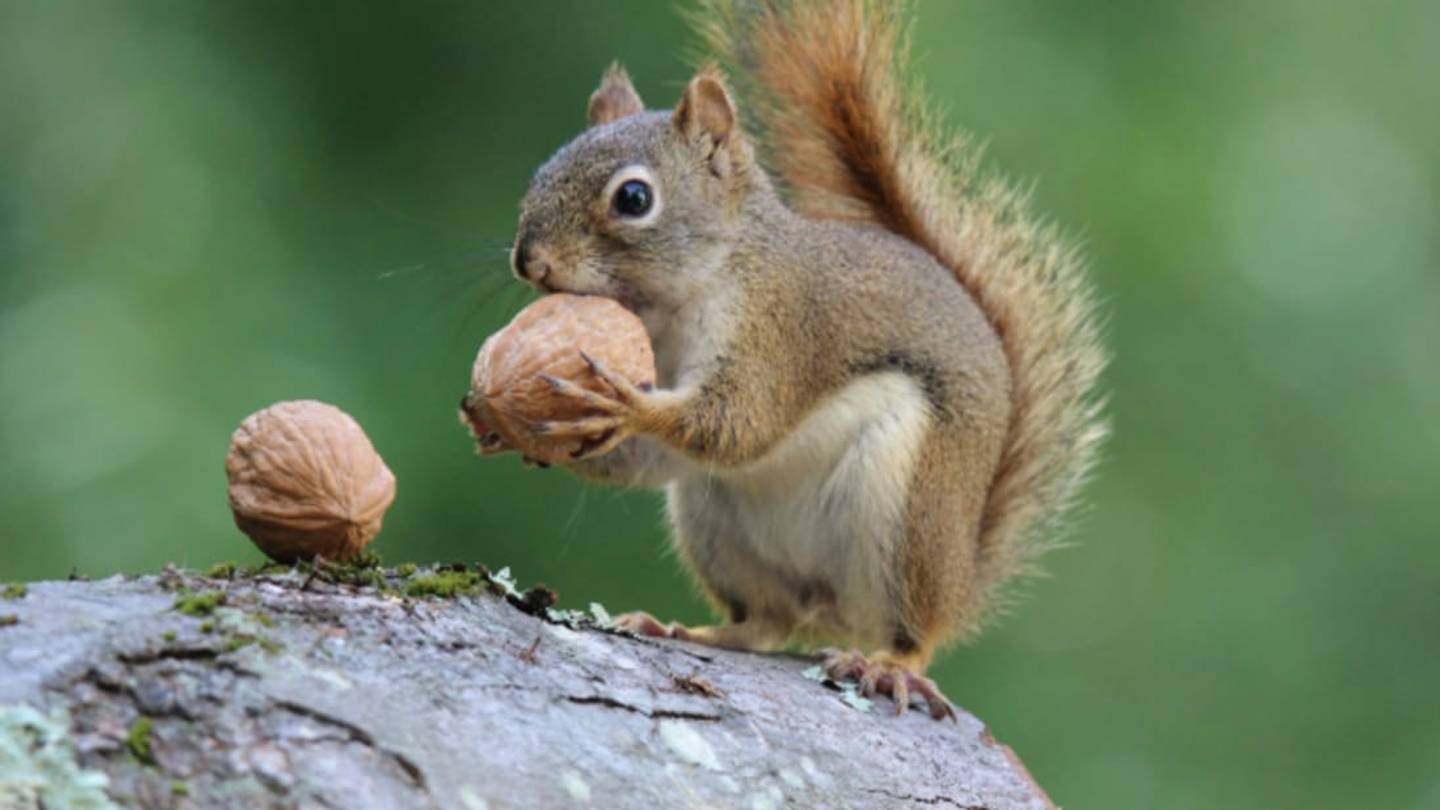
In the fall of 1968, people in the eastern United States experienced a force of nature unlike anything theyâd seen before: grey squirrels, en masse, moving by the thousands out of the woods, crossing mountains, rivers, and highways.
Newspapers published accounts of squirrels swimming acrossâand often drowning inâbodies of water. In some locations, conservation officers reported picking up road kill at a rate of one squirrel per mile. Starvation killed many more.
Where were they all going? And why?
The explanation for this furry migration turned out to be simple: The animals had run out of food. After a bountiful year for acorns and chestnuts in 1967, the squirrel population ballooned. When this was followed by a poor season for these nut-bearing trees, the squirrels were faced with no choice but to search for more fruitful forests.
The most complete account of the migration comes from a wildlife biologist named Vagn Flyger, who at the time was a budding squirrel expert and game officer for the state of Maryland. According to his paper, "The 1968 Squirrel 'Migration' in the Eastern United States" [ PDF ], Flyger was first contacted by a colleague who drove from Maine to Maryland on September 13 that year and noticed an unusually high number of road-killed squirrels on the highway. Within a week, Flyger was also contacted by the Smithsonianâs Center for Short-Lived Phenomena (yes, this was a real institution , and itself short-lived, operating only from 1968 to 1975), which had been tracking news reports from North Carolina.
There were hotspots of activity elsewhere. The New York State Conservation Department collected 122 specimens on highways near Albany and received reports of dozens of them drowned in the Hudson. A September 28 article in the Journal News in White Plains was alarmingly titled "Squirrels Invading Lower Hudson Valley." In an article published October 6 in The Tennessean , the stateâs fish and game commissioner Bob Burch marveled at the âalmost unbelievable number of squirrels,â and informed the public the bag limit has been raised âfrom six to twelve bushytails per dayâ in order to âaid the hunter in keeping this valuable resource from being wasted.â
But North Carolina appears to be the epicenter. The Asheville Citizen Tribune , in a September 17 article headlined "Starvation, Cars, Killing Squirrels by the Thousands" reported on a wildlife resources commission meeting in which regional managers from across the state painted a gory picture. One, near Waynesville, described squirrels âpouringâ out of the Smokies and swimming across Fontana and Cheoah Lakes. Another claimed he counted 40 dead squirrels on a roughly 20-mile stretch of road near Asheville. The story, "Squirrels Starving in Smokiesâ Area," was even picked up by The New York Times on September 22.
In his paper on the investigation (published for the Natural Resources Institute), Flyger described driving to North Carolina and, with the help of a small team âdispatchedâ by the University of Georgia, setting up a âlaboratoryâ in a motel room in Boone to examine specimens that had been shot by game wardens and picked up off highways.
The autopsies showed nothing unusual. There were no indications that the squirrels were heading in a specific directionâsay, north, or west. However, Flyger learned, âbased on discussions with many individuals as well as upon my own observations,â there had been a bumper crop of acorns in 1967, resulting in a corresponding bumper crop of baby squirrels in 1968. By autumn, as the first litter of the year left the nest, they found not enough food to go around.
Flygerâs theory holds up today, according to John Koprowski , renowned squirrel expert and a professor and associate director of the School of Natural Resources and the Environment at the University of Arizona.
âWhen you have a good year of chestnuts, it is a pretty massive amount of food, but when you have a bad year you donât have that food source. So you can imagine animals moving aroundâespecially when you didnât have as many roads, and forests were continuous,â he tells mental_floss .
Koprowski points out that what happened is not an example of a true migration, but rather an emigrationââa one-directional movement out of a place.â
âIt is a strategy of last resort, most likely,â says Koprowksi. âIt really does appear to be a response to local conditions.â
As it turns out, 1968 wasnât the first time that, prompted by scarce resources, grey squirrels had suddenly moved by the thousands. After reading Flygerâs paper as an undergraduate student at Ohio State, Koprowski dug into the phenomenon further and found evidence of similarâand even largerâsquirrel emigrations in the 19th century.
In Texas in 1857, for example, a devastating mid-spring cold snap killed off crops and vegetation across the state, including newly budded nut trees, prompting a squirrel exodus. In one account, a young man named Henry Garrison Askew, traveling by horse and carriage near Dallas, described the horses being spooked by a disturbance in the tall prairie grass. He and his family watched in disbelief as thousands of squirrels crossed the roadâsome of them right over the horses and through the carriageâ in a column that reportedly took a half hour to pass.
John Bachman, in an 1846 book called Viviparous Quadrupeds of North America , describes squirrel emigrations of that era in which squirrels would âcongregate in different districts of the far Northwest, and in irregular troops bend their way instinctively in an eastern direction. Mountains, cleared fields, the narrow bays of our lakes, or our broad rivers, present no unconquerable impediments. Onward they come, devouring on their way everything that is suited to their taste, laying waste the corn and wheat-fields of the farmer ⦠â
Koprowski says these superlative-filled historical accounts donât offer a clear picture of numbers. âThey were often filled descriptors like marvelous or incredible ⦠but not as quantitative as we would be now.â
Itâs likely, Koprowski says, that numbers in the hundreds of thousands or even millions would have been possible, given the landscape at the time. âIt's really hard for us to appreciate the amount of food that was there, and the density of squirrels,â he says.
Is it possible to have emigrations of those kinds again? Likely not, says Koprowski. âOne, weâve changed the forests pretty dramatically, with how weâve fragmented them,â he points out. âThere simply isnât as much habitat for squirrels, or for nut-producing trees that they have historically depended on.â
But itâs fun to imagine. âItâs such a different kind of phenomena,â he says. âYou're like, âWow that's pretty neat.ââ
Loading recommendations... Please wait while we load personalized content recommendations