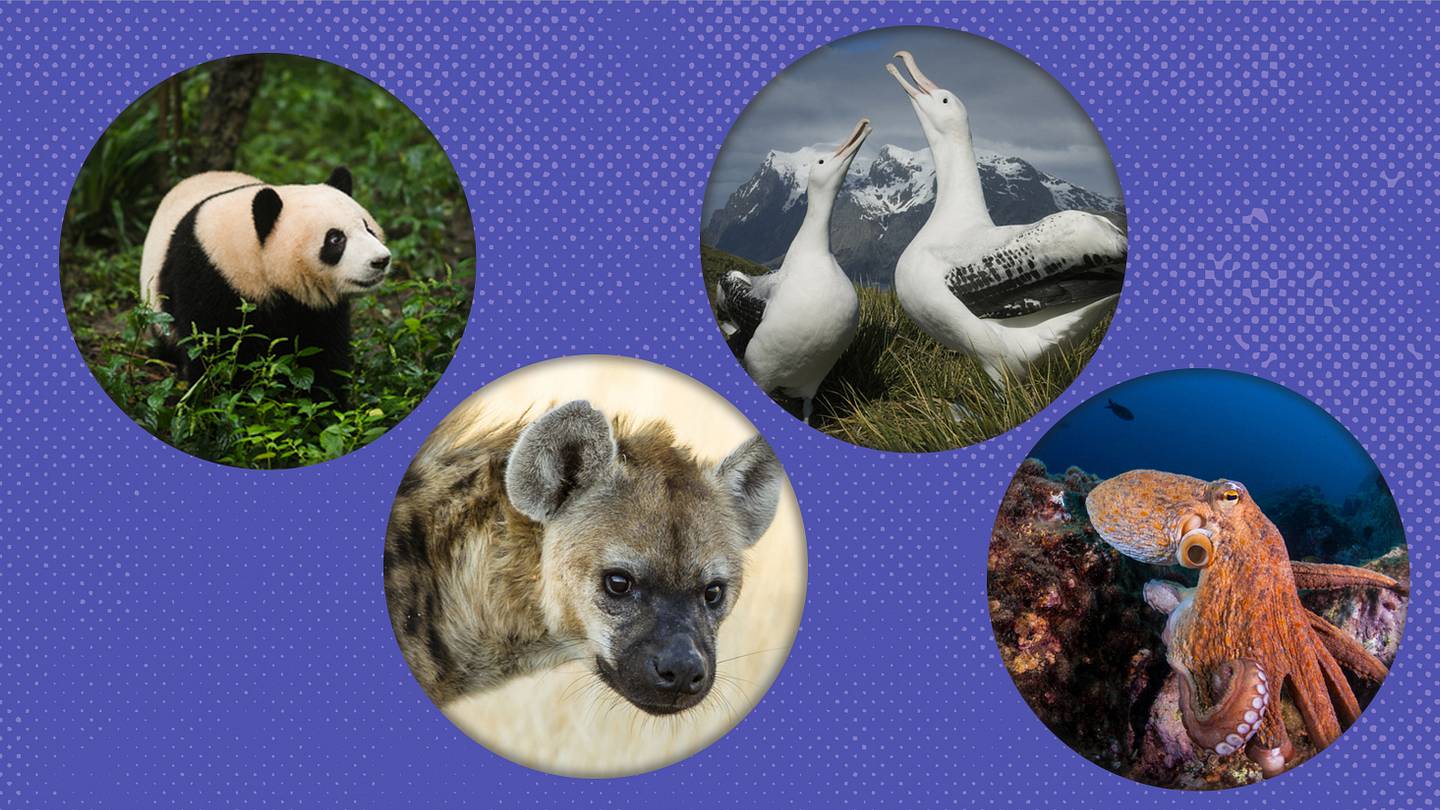
The word animal derives from the Latin anima , meaning âbreathâ or âsoul.â Though animal first appeared in English in the late 14th century, it remained fairly uncommon until the 1600s, when its use as a replacement for the older word beast âwhich once referred to any living creature, but today has wilder, more ferocious connotationsâwon out. Beast , in turn, had been adopted into English from French sometime around the early 1200s. But just as it was eventually superseded by animal , beast itself took over from deer , which was used fairly loosely in Old English to refer to any wild animal.
Put another way, the history of animals and beasts is all a bit confusing. Fortunately, the individual names of different kinds of animals arenât nearly as mixed up. Thatâs not to say they donât have their own stories to tell, though.
No one is entirely sure why penguins are called âpenguinsâ (not helped by the fact that they were once called âarsefeetâ), but the best theory we have is that penguin is a corruption of the Welsh pen gwyn , literally âwhite head.â The name pen gwyn originally applied to the great auk , an enormous flightless black-and-white seabird of the North Atlantic, which is now extinct . Itâs presumed that sailors to the South Atlantic either confused the flightless black-and-white seabirds they saw there for great auks, or just used the same word for both creatures.
This is a strange one: In the 16th century, the Arabic word for a sea eagle, al-ghattas , was borrowed into Spanish and became the Spanish word for a pelican, alcatraz (which is where the island with the prison gets its name). Alcatraz was then borrowed into English and became albatross in the late 17th centuryâbut at each point in history, the word applied to completely different animals. An alternative theory claims that albatross and alcatraz might actually be unrelated, and instead, albatross could be derived from a Portuguese word, alcatruz , for one of the troughs that carried the water around a waterwheel. But even if thatâs the case, the word still probably began life as another name for a pelican, with the bucket of the waterwheel probably alluding to the pelicanâs enormous pouched bill.
Rhinoceros literally means ânose-horned.â The rhinoâ part is the same as in words like rhinoplasty , the medical name for a nose job, while the âceros part is the same root found in words like triceratops and keratin, the tough, fibrous protein that makes up our hair and nails and rhino horns.
The English word ostrich is a corruption of the Latin avis struthio â avis meaning âbirdâ and struthio being the Latin word for the ostrich itself. In turn, struthio comes from the Greek name for the ostrich, strouthos meagle , which literally means âbig sparrow.â
Hippopotamus literally means âriver horseâ in Greek. It might not look much like a horse , but it certainly lives in riversâand letâs be honest, a hippo look more like a horse than an ostrich looks like a sparrow.
Raccoon is derived from an Algonquin word that means âhe scratches with his hands.â Before that was adopted into English, raccoons were known as âwash-bearsâ (and still are in several other languages, including Dutch and German), which refers to their perceived habit of washing their food before eating it.
Moose , too, is thought to be an Algonquin word, meaning âhe strips it off,â a reference to the animalâs fondness for tearing bark off trees.
Our word tiger goes all the way back to Ancient Greek, but the Greeks had borrowed the word from Asia, and itâs a mystery where the word actually originated. One theory is that it comes from tighri , a word from Avestan (an ancient Iranian language) that means âarrowâ or âsharp object,â but thatâs only conjecture. Speaking of big cats â¦
Confusingly, leopard literally means âlion-pantherâ or âlion-leopard.â Variations of the word pard have been used to mean â leopard â or âpantherâ since the days of Ancient Greek, while leon was the Greek, and eventually Latin, word for a lion. The word lion itself, meanwhile, is so old that its origins probably lie in the impossibly ancient languages from which Egyptian hieroglyphics derived. Another confusing big cat name is â¦
It derives from chita , which is the Hindi word for âleopardâ and probably comes from a Sanskrit word literally meaning âspotted.â
In Greek mythology, Python was an enormous dragon-like serpent that was slain by the legendary hero Apollo. Apollo left the serpentâs corpse to rot in the heat of the sun, and the site of its death eventually became the site of the oracle of Delphi (known as Pytho , to the ancient Greeks). Ultimately, the name python itself derives from a Greek word literally meaning âto rot.â
The anaconda âs name is a lot harder to explain. Although anacondas are only found in South America, itâs likely that the name was brought there from elsewhere. One likely theory claims that it once referred to an enormous snake of Southeast Asia that was known by a Tamil name, anaikkonda , literally meaning âhaving killed an elephant.â
The name hyena traces back to the Greek word for a pig or a boar , hys , which apparently refers to the spiny hairs on the animalâs back.
Walrus was borrowed into English in the 18th century from Dutch, but it may have its origins in the Old Norse word rosmhvalr , which came from another name for walrus, morse . Before then, walruses were known as sea-elephants, sea-oxen, sea-cows, and even sea-horses.
Panda was borrowed into English in the early 1800s, when it originally referred exclusively to what weâd now call a red panda ; in reference to the giant black-and-white panda, the word only dates back to the beginning of the 20th century, when the animal was erroneously thought to be related to the red panda. Either way, panda is thought to come from a Nepali word, Nigálya-pónya , that might mean something like âcane-eating cat-bear.â
Octopus means âeight-footedâ and not, despite what many people think, âeight-armedâ or âeight-legged.â Also contrary to popular belief, the plural of octopus isnât octopi . It would be if octopus were a Latin word (in which case its plural would follow the same rules as words like fungi and alumni ), but octopus is derived from Ancient Greek roots. So to be absolutely, pedantically correct, the plural of octopus should be octopodes âbut why complicate things? Feel free just to call more than one octopus a group of octopuses .
No one is entirely sure why tortoises are called âtortoises,â although itâs fair to say that none of the theories we have to choose from is particularly flattering. On one hand, tortoise might be a derivative of a Latin word, tartaruchus , meaning âof the underworld.â On the other hand, it might come from the Latin tortus, meaning âtwistedâ (which is also where the adjective tortuous derives from). The actual Latin name for the tortoise, testudo , was much simpler, however: It simply means âshelled.â
The name meerkat was borrowed into English from Afrikaans, the Dutch-origin language spoken in South Africa. In its native Dutch however, meerkat is another name for the guenon, a type of monkey found in sub-Saharan Africa. How did the two words become confused? No one knows.
Thereâs an old folk etymology that claims kangaroo means âI donât know.â According to the story, on his arrival in Australia, Captain Cook asked an Aboriginal Australian what the bizarre-looking creatures bounding around in the distance were. He replied, in his native language, âI donât knowââwhich, to Captain Cook, sounded something like âkangaroo.â Itâs a neat story, but likely an apocryphal one, not least because the chances of a Aboriginal Australian not knowing what a kangaroo was are pretty slim. Instead, itâs likely kangaroo likely derives from a local Guugu Yimidhirr word, perhaps simply meaning âlarge animal.â
And lastly, staying in Australia, the duck-billed platypus âs name literally means âflat-footed.â Bonus fact: Because of its bizarre appearance, the platypus was also once known as the duck-mole.
Read More Stories About Animals:
A version of this story was published in 2016; it has been updated for 2024.