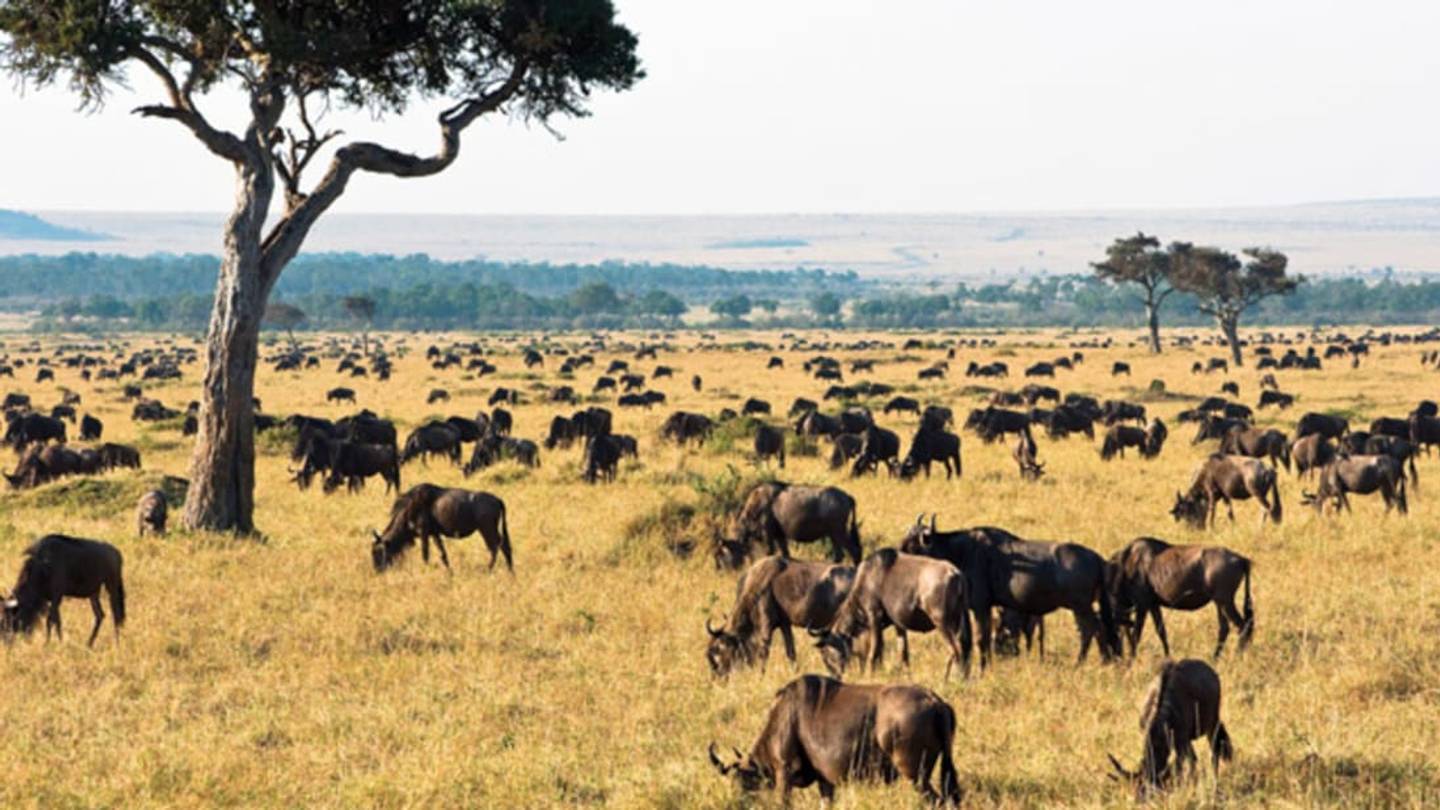
There are rules for a walking safari, our guide Roelof tells us softly, sternly. The sun beats down on the stiff yellow grass of the Maasai Maraâthe part of the Serengeti that spills across Tanzaniaâs northern border into Kenya. Itâs one of the many Africas people like me donât know by name but recognize instantly: all brush and blue sky, and occasional lone-silhouetted trees.
Itâs also hot. Really hot. The big catsâcheetah, leopard, lionâhave all taken cover, giving the grazing animals scattered across the plains time to relax.
Maybe itâs because I donât know any better; or because the guide giving me instruction cradles a rifle in his hands, a band of brassy bullets cinched around his waist. Or perhaps itâs because my friend James and I have another experienced guide, Zarek, walking behind us. But Iâm not concerned about safety. Instead of listening to Roelofâs rules, I let my mind wander: I worry whether Iâve brought enough water. I worry that I havenât read enough about Kenya before coming here. I think about how much Iâve already seen today: a lioness parading her scruffy cubs past our vehicle; loads of giraffe, gazelle, and warthogs; and a troop of elephants converging at a watering hole. Iâm absorbed in the little things: looking at the flowers and birdâs nests and giant mounds built by feisty termites, who, I will later learn, can air condition the habitat and rattle in unison to scare off predators.
But Roelof is whispering at me now, so I try to listen. These are the rules I remember: Walk single-file behind the guide with the gun. Whisper; donât talk. When you sense danger, snap your fingers. When there is danger, listen for instructions. And no matter what, donât run. Never run.
Two hours later, when my heart is pounding and weâre scrambling up a cliff, itâs this last rule that will prove the hardest to follow.
Most people who book  a safari in Kenya head for the Maasai Mara National Reserveâthe roughly 580 square miles of protected park a short drive from where Iâm standing. The rangers there work hard to prevent poaching of wildlife, and the Maasaiâthe local seminomadic people the park is named forâare restricted from grazing their livestock there. The result is untrampled land with excellent wildlife viewing. The problem is the tourists: When there are sightingsâsay, a cheetah feasting on a killâitâs not uncommon for 30 oversized vehicles, all packed with snapping cameras, to converge on the scene.
Iâm here in Kenya because Iâm interested in whatâs happening on the outskirts of the Reserve. The area where Iâm staying is called Mara Naboisho. Itâs one of eight or so conservancies that abut the National Reserve to the north. Seventy percent of Kenyaâs wildlife live outside of the parks, so migrations of zebra and wildebeest travel through these areas regularly. Or at least they used to. As the Maasai population grew and families started fencing their land, the wildlife dwindled.
But that began to change in the 2000s, when local Maasai came up with a radical plan: Instead of selling their properties to the wheat farms and development projects that were squeezing them from the north, they decided to work with conservationists to band their properties together, remove the fences, and lease the land to responsible ecotourism partners.
It sounds laughably optimistic, but this âcommunity-based conservationâ proved to be a surprising win-win. The Maasai could draw income from the leases; conservationists could work to protect the land; the community at large could continue to use the unfenced property for grazing, and tourism partners could run small-footprint camps (Naboisho has seven camps, with space for no more than 120 tourists, across a 50,000-acre reserve). And because the conservancies have essentially doubled the contiguous protected land outside the National Reserve, the animals roam free across a far wider territory.
Meanwhile, tourists like me who arenât interested in ultra-luxury, colonial-style camps get a quieter, richer safari experience, plus the added satisfaction of knowing that the project supports the local economy. On my many drives through Naboisho, we see a few Maasai men tending to their cattle, but we rarely find ourselves with more than one other vehicle. While walking isnât allowed at the National Reserve, here in the conservancy weâre not tethered to the car. On foot, human company is even more spare, so you find places that feel undiscovered, like the valley weâre about to enter.
At the start of the walk, James gives me a tip: Keep an eye on the guideâs rifle. Gun in left hand, nothing to worry about. Gun in right hand, be cautious. If you hear it cock, things are serious.
I laugh. James has been on dozens of safaris and knows the drill. But to me, the gun feels like a formality: Aside from a few birds, we have the valley to ourselves. The only sound I pick up is the soft hum of the whistling thorn acacias.
Roelof and Zarek hear more. Neither is MaasaiâRoelof is a blond South African; Zarek is a Kenyan of Punjabi and American descent. But they know this land well and are as enthusiastic about seeing a hyenaâs scat (which is completely white from all the bones they consume) as they are to show us the pair of eagles soaring above, teaching a juvenile to hunt. The joy is infectious: Iâm an indoor kid, but Iâm becoming a convert.
I forget about the gun. My mind is focused on a set of fresh animal tracks in front of me. When Roelof quizzes us on what type of creature it is, I take my best guess: âA big cat?â
âOh, the biggest!â he responds.
He circles the paw print with a stick and says, âWeâll never see the beast, but you can just imagine...â
Naboisho wasn't the first  conservancy in the Mara. But what makes this place so special is how hard the community pulled together to create it. Much of its success, I learn, is thanks to a Maasai man named Dickson Kaelo.
Kaelo is a legendâheâs young and charismatic and has a masterâs degree in conservation. He realized early on that to get all of Naboishoâs 502 landowning families to rally around the idea of a conservancy, heâd have to show them the advantages firsthand. He and the Naboisho leaders selected individuals from the communityâenterprising women, twentysomething schoolteachers, and other influencersâ and toured them through reclaimed lands in Tanzania and Kenya, pointing out how other tribes had used their land.
Dickson also worked with potential tourism partners to spread out job opportunities, so it wasnât just the Maasai lease holders who were benefiting from the money coming in, but also the people living on the conservancyâs fringes. And, perhaps most importantly, he ensured that the small board that makes all the big decisions on behalf of Naboisho will always be half Maasai.
The campaign took four years, but when the community finally had its chance to sign over the parcels for leasing, more than 400 families gathered under a big tree to make it official. Before long, another 100 families would join them. Now, Naboisho is being held up as a case study in the conservancy world. Arguably even more stunning than this show of unity is the speed with which the wildlife has come back. And that includes the lions.
Because we're talking about lions, I have a lot of questions. I learn that the cats are always crafting new ways to hunt. When wildebeest are scarce, lions in the Mara will work in teams to take down a hippo. In Namibia, where lions prowl the beaches of the Skeleton Coast, theyâll feast on seals and cormorants and even beached whales. In Botswana, they take advantage of the airports, chasing giraffes onto the tarmac so they lose footing and slip. But here in the conservancy, where lions have been coexisting with the Maasai, the creatures mostly keep their distance from people.
Of course, that hasnât always been the case. A day later, when another guide, Senchura, takes us to meet his father, Sakaiwua Kaleku, Iâm still obsessed with the topic. After the formalitiesâweâve presented him with a bright red checkered cloth and asked after his wives (three are nearby, tending the dozen or so kids)âhe tells us how âthe lions used to be everywhere.â
Iâve been waiting to hear about the moran âthe period when Maasai boys on the brink of manhood would fight lions and steal cattle to prove their worth to the village. Sakaiwua talks about how bonding his experience was: He and the others saw their role as âthe eyes of the community,â constantly keeping watch for the tribe. He said that two of his friends were badly hurt by a lion and that once, during a cattle raid, he had to bandage a bleeding friend with his own clothes, then carry him homeâ running naked through the night. Sakaiwua was one of the last generations to enter the moran; heâll be one of the last generations to have multiple wives. Heâs advising his own sons to take one wife, maybe two.
When I ask how things have changed, his response is positive. Heâs thrilled that the land has been rejuvenated and that itâs being preserved for grazing. The Maasai connection to their cattle is deep. When I talk to one of the Naboisho conservancy board members, Gerard Beaton, he tells me about a sociologist who created a Monopoly -style game to understand Maasai culture: No matter how the points in the game were weighted, or how the rules changed, the Maasai players attempted to hoard all the gameâs cattle.
Sakaiwua welcomes the tourists because he knows Naboisho is being saved for future generations. His kids will be able to live here if they want instead of taking jobs in Nairobi. But what makes him proudest is that all of his children are going to school. Because Senchura has graduated from the guiding school at the conservancy and is employed at one of the camps, heâs able to fund an education for his brothers and sisters.
As we continue our walk , Roelof and Zarek tell me that this yearâs tourism numbers are down. They blame the hysteria over ebola, even though the virus was contained in western Africa, thousands of miles away. One family told Roelof their travel doctor refused to give them shots, explaining that they could get the same experience at Disneyâs Animal Kingdom.
But what I see is nothing like Disney World. The four of us have this valley to ourselves, and it all feels so still. I try to absorb everything. I feel the silk of a wolf spiderâs web. I crush wild jasmine and take in the scent. I learn that certain types of acacia thorns are strong enough to puncture a car tire.
And then, as weâre walking down a slope, the snapping starts. Zarek is quickly clicking his fingers to get Roelofâs attention. Heâs just seen a dik-dik dart across the opposing hill, and when he trains his eye on what itâs running from, he spots a young male lion, about 30 meters away from us.
It sees us. We stand motionless, and I smile at our luck. The lion, muscular but still growing into his frame, looks unsure of what to do. Then he moves up the hill and disappears into the brush.
Just then a second lion emerges, this one bigger, with a full mane. He pauses, staring right at us. Then he starts walking our way, and as he does, a third lion, hidden in the bush, roars. I donât remember everything that happens next, but I know the gun shifted hands. I know Roelof pushed me and that he whispered forcefully, âGo, go.â
We move quickly. Zarek scissors a path, I follow close behindâlaughing but also a little panicked. I start wondering if Iâm breathing too quickly or too loud. The thorny branches that Iâd carefully avoided before are now clawing at my pant legs, but Iâm thinking about speed, not comfort. Still, this is fun.
When we finally stop, Roelof and Zarek are serious, but unshaken. They say that the lions look like theyâve just eaten. The guides could also tell the animals had wandered over from the National Reserveâthey werenât accustomed to seeing people on foot. The second lionâthe one that was pursuing usânever made it close enough to be a problem; the concern now is about the first lion. Heâs young and skittish, unpredictable. And heâs still lurking somewhere up the hill, in the direction of our camp.
As we trudge out of the valley, Roelof in front with the gun in his right hand, Iâm fully on edge: Every sound is startling; every shrub feels suspicious. We walk purposefully as Roelof and Zarek chart a path unlikely for a lion to take, but my heart is racing.
Itâs only when we finally reach the valleyâs lip and can see the plain before us that my anxiety lets up. Later that night, nerves further calmed by gin and tonic, I ask Roelof how close he thought the lion was.
âAbout 20 meters,â he says. âSo, when do you shoot?â
â10 meters,â he says. âAnd you only really get one shot.â
A few hours ago, that knowledge would have terrified me. But here, in the glow of the campfire, it feels comfortably distant. Itâs already a story I can imagine telling friends over drinks after I get home.
Safari-goers like me will always evangelize their experiences. But will enough people visit the conservancies to sustain this project? In Maa, a Maasai language, naboisho means âcoming together.â Along with the Maasai and the wildlife and the conservationists, Naboisho needs a steady stream of tourists to survive. That stream has slowed in the past few years, and if it doesnât improve, camps will close and local jobs for Maasai men and women will disappear. The wildlife may disappear, too.
So the brainstorming on how to diversify the income has begun. Thereâs talk of a âbeef schemeâ to brand and sell Maasai beef to supplement the economy. There are questions about whether some farming on this land would affect the wildlife.
But even as Naboishoâs partners worry, they continue to dream big: Theyâve already identified another chunk of leasable properties that would complete the circle for a secondary wildebeest migration. As they describe the sceneâthe massive herds, this restored land, an even greater Maasai community that will benefitâI sense the urgency. I so want it to be possible. And if just a few more people can come here and experience this place the way I have, maybe it will.
Loading recommendations... Please wait while we load personalized content recommendations