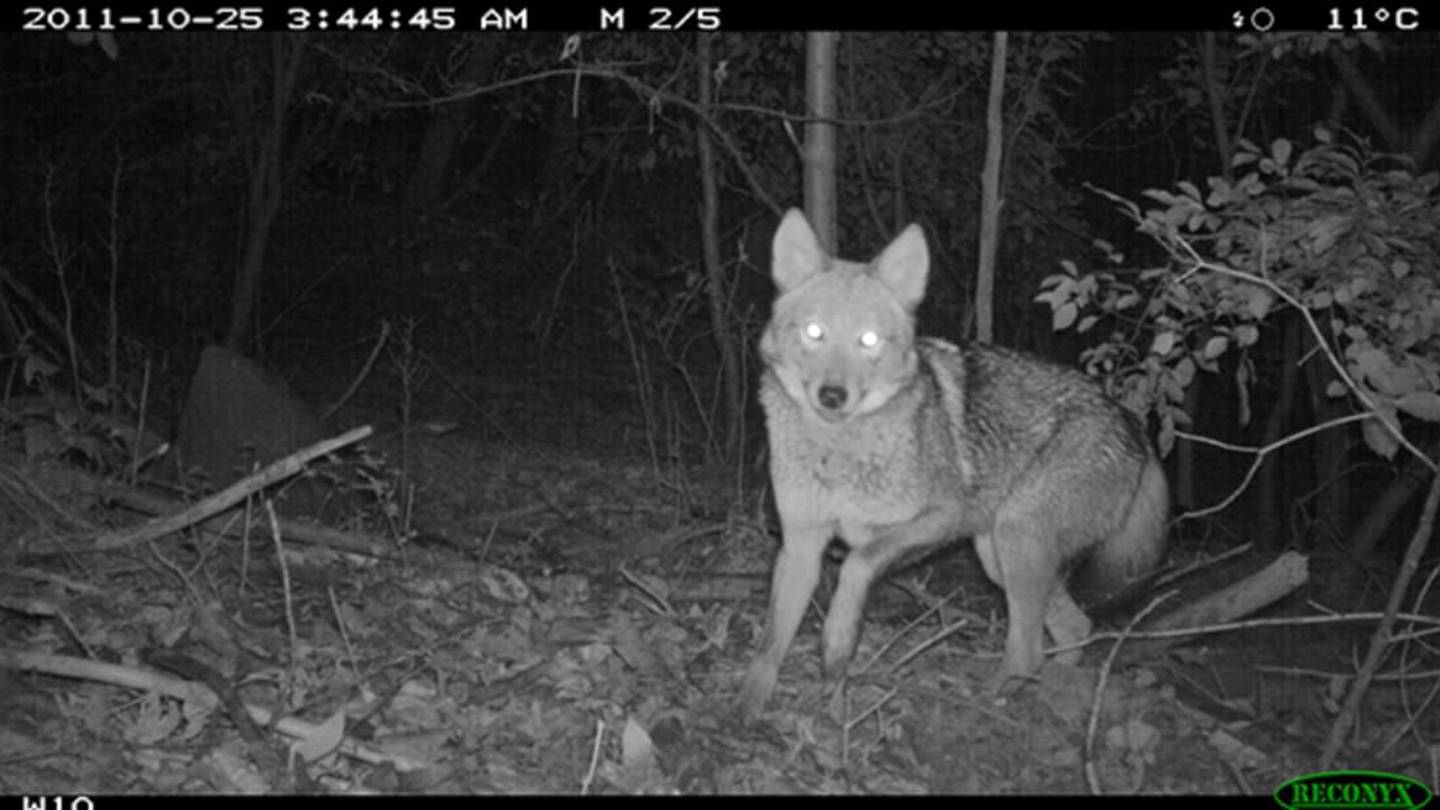
Ten years ago, Jessica Carrero was walking in the Bronxâs Van Cortlandt Park when what looked like a dog burst out of the woods and ran down the trail in front of her. But as she watched the animal, the New York City Department of Parks and Recreation ranger could tell that it was no dog. âIt didn't have a collar and it didn't move in a way that dogs move,â she says. âIt wasn't nervous or excitedâit seemed to move with a sense of purpose, knowing exactly where it was going.â A year earlier, sheâd very briefly seen a similar looking animal in Pelham Bay Park. At the time, she wondered, Could that be a coyote? Then she second guessed herself. Back then, âit wasnât confirmed that [coyotes were living] here,â she says. âI thought, âThat had to be a stray dog. Coyotes just arenât in New York City.ââ But with this sighting, there could be no doubt: Though the animals' presence in the Bronx had not yet been confirmed, Carrero was looking at a Canis latrans .
Since that day 10 years ago, coyotes have firmly established themselves in New York City; theyâve been spotted everywhere from the Upper West Side to Battery Park City, from the rooftop of a Queens bar to Rikers Island , and theyâre breeding in the Bronxâs parks. And Carreroâwho was born and raised in the Bronx and has been with the park service for 15 yearsâhas had plenty of confirmed encounters with the animals. She isnât just on call to help relocate coyotes from residential backyards to wooded park landsâsheâs also spotted them on the trails of parks in the Bronx. Once, she saw three pups playing in Pelham Bay Park; another time, she and two workers scared two coyotes away from a rabbit the canids had likely been hunting. âWe saved the rabbitâs life,â she says, chuckling.
Many of her colleagues havenât ever spotted a coyote, but Carrero estimates that sheâs seen the animals nine times during her tenure with the park service. âI just have good luck,â she says.
Nine might not seem like all that many given the fact that Carrero and her colleagues spend most of their time walking the parks, but it suddenly becomes a lot when you compare it to the number of sightings scientists Mark Weckel and Chris Nagy have had between the two of them: five. (Two for Weckel, three for Nagy.) Which is a shame, considering that the pair spend their time studying New York Cityâs burgeoning coyote population as co-founders of the Gotham Coyote Project .
Founded in 2011, the project started with a simple question: Where are coyotes? The scope has expanded since then, says Weckel, whose day job is manager of the Science Research Mentoring Program at the American Museum of Natural History . Nagy is director of research at the Mianus River Gorge .
âFrom that time,â Weckel says, âweâve expanded to questions like: How many are there? What are their genetic relationships? What impact could they have on the ecology of New York City?â
To answer those questions, the project has recruited scientists from universities and museums and enlisted the help of interns and volunteers. Theyâre in constant communication with Carrero and the Parks Department, and twice a year, they set up trail cams in New York City parks where coyotes have been sighted in the hopes of catching a glimpse of the elusive animals. But eyewitness reports and trail cam photos can only tell scientists so muchânamely, where coyotes are. To answer the tougher questionsâhow the animals are related, and what theyâre eatingâthe scientists rely on poop.
Gotham Coyote Project
 Up to about 200 years ago, the coyote inhabited the western part of North America, from southern Canada to northern Mexico and from the Mississippi west to California. But as humans cleared forests for fields and eliminated apex predators like the eastern wolf and eastern cougar, the coyote expanded its range in all directions, adapting to, and thriving in, every new environment. Their new territory, stretching from Alaska as far south as Panama and to the eastern seaboard, marks a range expansion of at least 40 percent .
By the 1980s, the animals were breeding in New York Stateâeverywhere except New York City and Long Island. And in the mid-â90s, coyotes made their move.
New York City consists of five boroughs: the Bronx, Manhattan, Staten Island, Brooklyn, and Queens. Staten Island and Manhattan are islands, and both Brooklyn and Queens are located on Long Island; the Bronx is the sole borough attached to the mainland United States, so it makes sense that first modern coyote sighting in New York City would be there. It occurred in February 1995, when the animalâa femaleâran out onto the Major Deegan Expressway in the Bronx and was hit by a car (a statue was later erected in her honor). Another coyote was found shot in Van Cortlandt Park the next week, and yet another popped up not long after in Woodlawn Cemetery . By 2011, the coyote had established breeding populations in the Bronx, and these days, they pop up around the city to major fanfare.
Now, thereâs just one last large landmass left to conquer: Long Island (including Brooklyn and Queens). Individuals have made the journeyâeither crossing bridges, using tunnels, or swimming across bodies of water to get thereâbut there arenât currently any breeding populations in the area. Yet.
That fact, which came to Weckelâs attention when he was a graduate student at the City University of New York, directly inspired the Gotham Coyote Project. When the native New Yorker realized that no one was studying these coyotes, he jumped at the chance to do it: âYou very rarely get a chance to understand what the first few individuals of a new population are doing.â
The group decided to find out as much about the animals as possible using one resource that was readily available to them. To find coyote poop, you have to go to where the coyotes areâso on a hot July morning, mental_floss headed up to Van Cortlandt Park to help Nagy and four interns in the search.
Potential coyote poop picked up in Van Cortland Park. Photo by Erin McCarthy.
 From far away, coyote scat doesnât look all that different from dog poop. But get closer, and youâll start to see some discrepancies. Dog poop is homogenous, but coyote scat might contain sticks and stones, seeds and broken bonesâand it might be more than a little fuzzy thanks to the fur from its kills.
We meet up with Nagy, the interns, and Nagyâs dog, Ethanâa small black-and-tan pup that he and a friend trained to sniff for scatânear Van Cortlandtâs horse stables, then take a short car ride to the section of the park Nagy wants to search. We walk in together, then split up into pairs to cover more ground.
Coyotes often poop right next to the trails people useâno need to tromp off into the woods to find scatâand most people who walk by piles in Van Cortlandt Park arenât giving them a second glance. But we walk with our eyes trained on the ground, closely examining every brownish lump we find. It rained the night before, making soft objects indistinct; more than once, the potential poop turns out to be a rotten stick.
In theory, when Ethan picks up the right scent, he dwells over the spot. He usually finds at least one scat while on the hunt. âIf I was doing this from scratch, Iâd go to the pound and just get the most hyperactive OCD dog,â Nagy says. âUsually you just run a tennis ball up and down a fence, and if they go absolutely crazy for it, thatâs your dog. My dogâs a little harder to please. He knows what weâre there for, and he does itâas long as thereâs not a squirrel around.â
As temperatures soar into the 90s, it becomes too hot for Ethan to do his work. Heâs panting, not sniffing with his nose, and every chipmunk (there are a lot of them in the Bronx) is a distraction. No amount of treats will get him back on task. After four hours of searchingâduring which we cover more than five milesâwe pack it up and head back to the park entrance.
Nagy and Ethan came up empty, but one of the interns has a good eye for poop; she finds two samples. (Nagy has calculated that it takes around eight human hours to find a single scat, as compared to a dogâs four.) On a paper bag, she writes the parkâs initials, the scatâs GPS coordinates, and her initials. After some discussion about how to scoop up the poopâNagy has forgotten plastic glovesâanother intern uses a second paper bag to pick it up and deposit it in the marked-up bag. Finally, she drops in a couple of packets of dessicant, which will dry the sample out.
Nagy puts the samples in his backpack. From here, heâll deposit them in a cool, dry area under his porch until he has time to take them up to the lab. Then he calls it a day; itâs simply too hot to search anymore.
In the lab at Fordham University, Carol Henger adds lysis buffer to a test tube containing fecal material. Photo by Linelle Abueg.
When any creature defecates, it leaves behind cells on the surface of its waste. In those cells is DNA, which will reveal to researchers how New York Cityâs coyotes are related. This is where Carol Henger comes in. The Fordham University Ph.D. student can often be found in the lab, carefully scraping cells off coyote poop and analyzing them for DNA.
A former zookeeperâshe cared for primates at the Bronx Zoo for 10 yearsâHenger had no idea there were coyotes in New York City when she decided to pursue a doctorate in biology. During the course of researching schools, she came across the website of her current advisor, Jason Munshi-South. âHe had a clip where he was giving a TED Talk and he mentioned coyotes were in New York City,â she says. âI was surprised. And I was like, âI have to study this.ââ Munshi-South was helping the Gotham Coyote Project collect scat to analyze it for DNA. Henger wanted in.
The scat comes to Henger in paper bags marked with details of where the samples were collected. If the scat is frozenâas it might be if the sample was moist when it was collectedâit goes in the freezer. If itâs dry, she pops it into the filing cabinet she has converted for that purpose. âYou really want to make sure a sample is dried out before you store it, or else it can get moldy,â she says.
When itâs time to process a sample, Henger removes it from storage and, using disposable plastic forceps, takes it out of the bag and places it on a sterilized petri dish. Next, she uses a scalpel to scrape off a tiny area of the outside of the scat. âI look for darker portions of the scat,â Henger says. âAnything furry will be prey DNA; dark areas have high fecal content,â which is where the coyoteâs cells would be. She puts the scraping in a small test tube and fills it with lysis buffer, a solution that breaks open cells so scientists can analyze their compounds. After shaking the sample a bit, she puts it in an incubator and waits for the cells to open upâa process that, depending on the age of the specimen, can take anywhere from one to 12 hours. (To guard against contamination, everything from the petri dishes to the scalpel is single use and either thrown away or sterilized after it touches the scat. Henger also wipes down her work bench between processing scats.)
Once the cells are broken open, Henger adds Proteinase K, an enzyme that degrades the protein. âIt can get in the way of extracting DNA,â she says. Centrifuging the sample will allow her to remove the liquid containing the proteins.
Finally, she adds an elution buffer, a solvent that binds to the DNA, and then stores that sample until itâs time for analysis. âI take a little bit of DNA from the tube, and then I add primers to it,â Henger says. âPrimers are short segments of DNA, and theyâll bind to other strands of DNA in the coyote samples.â Next, she adds polymerase, an enzyme that starts a chain reaction. The primers will amplify 11 different markersâtwo of which indicate the sex of the animalâin the DNA (she uses another set of markers to determine whether the scat came from a coyote or just a domestic dog or red fox). âThose markers are variable among individuals,â Henger says, âand that gives me a unique genotype for each coyote.â
Henger has processed approximately 200 New York City scat samples since summer 2010, and the research is still ongoing; some of the processed samples, for example, didnât reveal enough genetic information to identify individual coyotes. Still, she says, there are some preliminary findings. âLooking at 2010 to 2016, the samples that were collected those years, I have 20 individual genotypes,â she says. âMost of thoseâaround 14âcame from Pelham Bay Park, which is our most heavily sampled park just because itâs the biggest.â There are 35 identified individual coyotes in all: Most come from parks in the Bronx (Pelham Bay, Riverdale, Van Cortlandt, Ferry Point Park, Pugsley Creek), one sample comes from Inwood, and the rest come from Queens.
According to her DNA analysis, the coyotes are highly related. For example, the sole coyote resident of a small park in Queensâa male the researchers have nicknamed Frankie, who was first spotted in the park in 2009âshares DNA with male coyotes whose scat was collected in Pelham Bay Park and Pugsley Creek (around 16 miles and 18 miles from the park in Queens, respectively). âHe is second-order related (shares 25 percent of his DNA) to two male coyotes,â Henger says. âFirst-order relatedness indicates a parent-offspring or full sibling relationshipâwe canât tell if itâs parent/offspring or sibling. Second-order relatedness indicates a half-sibling, an aunt or uncle to a niece or nephew, or a grandparent-grandchild relationship.â
There is a lot of first-order relatedness within parks and across parks, âwhich makes me think of offspring dispersing to a different park, trying to set up their new territory,â Henger says. âThe fact that weâre seeing them moving through the city to get to different parks is a good sign, because it means they are able to moveâtheyâre not getting stuck in this high level of urbanization.â They have high genetic diversity, too, which indicates that outside coyotes are coming in and keeping the gene pool fresh.
These coyotes are hybrids that carry wolf genes, although Nagy and Weckel prefer the term âNortheastern coyoteâ over the more popular âcoywolfâ portmanteau. That phrasing âmakes it seem very simple, as if the animal youâre talking about is half coyote, half wolf, and itâs not,â Weckel says. But the animals arenât a subspecies of wolf: According to The New York Times , a recent study confirmed that the gray wolf is the only true wolf species in North America. The âtwo other purported species, the Eastern wolf and the red wolf, are mixes of gray wolf and coyote DNA.â
In the future, Henger would like to collaborate with researchers outside of New York City to figure out where the coyotes came from. âMy hypothesis,â she says, âis that a lot of these guys came from an initial population that settled in Pelham Bay, probably from Westchesterââmore than 20 miles north of Pelham Bayââand then theyâve been dispersing from there to other parks.â She also plans to use the data sheâs compiling to create a landscape model that will help her determine which corridors the coyotes are using to get around. âThat would be important in terms of conservation,â she says. âWe may want to conserve that area of connectivity from development.â
When Henger is finished with the scat, its journey isnât over. Next up is an hour-long subway ride to the American Museum of Natural History, where scientists and their interns will process the poop. They start by making what they call scat tea.
Hair, bone, and other prey items isolated from coyote scat in test tubes at the American Museum of Natural History. Photo by Erin McCarthy.
 Poop can give us DNA, which shows coyote relatednessâbut thatâs not all it can tell us. Analyzing the contents of poop also reveals what this new population is eating. Figuring that out falls to Neil Duncan , collections manager of the mammalogy department at AMNH, and four high school students with the museumâs Science Research Mentoring Program (SRMP). âTheyâre spending hours and hours that I donât always have,â he says. âWith four people working, itâs an extra day every week of research that I wouldnât get to do.â
The studentsâall of them young womenâwere not aware theyâd be dealing with poop when they signed up for the program, but it didnât freak them out. âI thought it was cool because it was about coyotes in New York City,â 18-year-old Olivia Asher tells mental_floss when we pop by the museum to take a look at their research. âThe unpleasant part doesnât outweigh the cool part of it.â
And so they've spent the school year donning latex gloves and processing poop. First, they place the scatâeach of which has an identifying number that corresponds to a data sheetâin the foot of a nylon stocking. (Asher pulls out a box of Lâeggs Everyday Knee Highs. âThey canât be the leg, they have to just be the foot,â she explains; cutting the stockings would fray them and make them difficult to use.) Next, the stocking scat is dunked in a bucket of water, massaged to break up the poop, and âsteepedâ by placing it in a bucket of water, where it's left to soak overnight, creating the so-called âscat tea.â The next day, they remove the prey matter from the stocking and put it in a sieve to run it under water, which, according to 17-year-old Rita Rozovskiy, âisolates the prey items and eliminates the fecal matrix.â Translation: The poop melts away, leaving just what the coyote ate behind.
The team separates classes of prey items into separate vialsâhair in one, bone fragments in another, and so onânumbered to identify which scat it came from. They then try to identify the prey items; to do it, they rely heavily on AMNHâs collection of study skins and skeletons. Looking at the scale (exterior) and medullary (interior) patterns of hair helps them identify some species, while looking at the incisors and molars in the scat helps them ID others. Bone fragments help them narrow down the size class of the species they are looking for. But just one identifier wouldnât do; they can't declare a prey item identified until they have multiple lines of evidence.
It is difficult, painstaking work. Identifying scale patterns, for example, requires the students to slather nail polish on a slide, drop in a hair, and wait for a moment; after carefully removing the hair, they look at the scale pattern under a microscope and use a guide to figure out what animal it is. Asher spent nearly a month trying to identify a single hair that turned out to be from a coyote. But, according to Duncan, her time wasn't wastedâit was all part of the scientific process. He said that the students asked each other, âYes, itâs coyote, but do you think it ate a coyote?â The answer: probably not. âLook at the evidence: Itâs a single hair,â he says. âIt wasnât a clump of hair. Whether it was play, grooming behaviorâwho knows.â
The team processed 49 scat samples over the course of the school year, and although their results are preliminary, and by no means complete, so far theyâve found that New York Cityâs coyotes enjoy a very diverse diet. Mostly, theyâre eating small mammals like squirrels, muskrats, meadow voles, and rabbits, which make up 19 percent of what was found in the scat, followed by birds (17 percent) and deer (14 percent; deer was only found in scat collected in Pelham Bay Park, which has a robust deer population). Fruit and seed were found in 13 percent of the scats.
âSurprisingly, trash was not a big portion of the diet, [which] we expected because thereâs a lot of trash in New York,â 17-year-old Sandra Lewocki explains. But analysis of diet studies conducted in other urban areas reveals that anthropogenic items arenât a big part of any urban coyoteâs diet. The comparison also revealed that New York Cityâs coyotes appear to eat more birds than other urban coyotes do.
The team hasnât found any rats, either, but as Duncan points out, âit certainly doesnât mean that theyâre not in there.â He told the students that, once they positively identified the hair of one species, they should go through all of their samples and pull out similar looking hairs. âSo these large numbers of muskrats or squirrels are part of our surveying technique,â he says. âI think rats will come, we just havenât found any yet.â
Duncan will continue to do prey analysis with Asherâwho stayed on after her internship ended last summerâand two new SRMP students. âWhatâs going to be interesting is, as we find out the diet of these coyotes in Queens, and if they move into Brooklyn and thereon to Long Island, [weâll see] how the diet is going to differ across these more urban geographic areas,â he says. âI think thatâs going to be a significant part of the story.â
Make no mistake: Though Long Island has not yet been colonized by coyotes, colonization is inevitable. (There is currently one resident in Queens; a family pack that was spotted near LaGuardia Airport this summer was captured and euthanized by Port Authority officials, to public outcry.) Thanks to high birth rates and their incredible ability to adapt to situations and landscapes, attempts to eradicate the animals end in failure. We couldnât get rid of them if we triedâand Americans have tried.
According to National Geographic , in the 1920s, the Bureau of Biological Surveyâwhich had pretty much gotten rid of wolvesâbegan a campaign to eradicate coyotes using poison. Between 1947 and 1956, the agency killed about 6.5 million coyotes in the West. As Dan Flores, author of Coyote America: A Natural and Supernatural History , explained, âWhen theyâre persecuted, they tend to abandon the pack strategy and scatter across the landscape in singles and pairs. And the poison campaign was one of the things that kept scattering them across North America.â Normal litter sizes, he said, are five or six pups, but âWhen their populations are suppressed, their litters get up as high as 12 to 16 pups. You can reduce the numbers of coyotes in a given area by 70 percent but the next summer their population will be back to the original number.â
There are already five coyote breeding sites in the Bronxâagain, the only part of New York City connected to mainland New Yorkâwhich was the easy part. Whatâs ahead is much harder: Theyâll have to traverse train tracks, scamper over bridges, and swim rivers and the Long Island Sound to settle new territory and begin breeding. But itâs just a matter of time until one (or more) of them completes the odyssey. âItâs just a numbers game,â Nagy says. âItâs hard enough for one coyote to make it. Then it needs to find a suitable place to set up territory, and then another coyote has to do [the same thing], and that coyote has to be the opposite sex and find its way to the exact same place that that first coyote went to. So itâs tricky, but it will happen. This is the story thatâs been played out across the whole continent.â
When it does happen, the scientists will look back at all the data theyâve gathered to see how things change. âAs coyotes eventually make their way into Long Island, weâll see, presumably, some sort of change in the whole community,â Nagy says.
Take, for example, how the coyotes will affect the red fox population. Foxes eat small rodents that harbor Lyme disease; if the coyotes push the smaller foxes out, will there be more rodents and more Lyme disease? âQueens and Long Island give you a pretty good experimental setup in the field,â Nagy says, âwhere you can measure all sorts of things before coyotes got there and afterwards and in the future and see what changes.â
As the coyotes conquer more and more territory,
weâll have to learn to live alongside themâand educating the public about how to do that falls to Carrero and her colleagues at the Parks Department. âPeople think theyâre dangerous, or that theyâre a lot bigger than they are,â Carrero says. âWe explain to people that theyâre predators, [but] theyâre not going to pick a fight theyâre not going to win. You explain that theyâre maybe 40 pounds at most. You explain that research has been done for stomach content analysis, and most of it is rodents. Once the fear goes away, people usually just want to see one and ask me where they can.â
Some people are surprised when they see a coyote in an urban environment, but others display that very New York attitude: indifference. On a recent call, Carrero supervised the release of a coyote that had been trapped in someoneâs backyard. After it was tranquilized and cleared by a vet, Carrero and crew took the coyote to a park for the release, angling the cage toward a wooded area. âWith their coloration, they just need to go in 10 yards, and they vanish,â Carrero says. âWe pointed him at this beautifully camouflaged forest, and he just went right through a small patch of trees where there was an obvious open area on the other side and ran between the only two groups of people in the park!â
When Carrero went over to see if they had any questions about what had just happened, the people did have one question: Why did she have handcuffs? âThatâs the only thing they asked me!â she says, laughing. (Park Rangers are also Special Patrolmen; theyâre deputized by the NYPD to make arrests.) âI donât know if maybe they thought it was a stray dogââperhaps like she did, all those years agoââor maybe theyâre used to seeing them in the area. But nobody said anything.â
The Gotham Coyote Project has relied on the publicâs help to track coyotes. If you think youâve seen one of these animals, report it here .
Loading recommendations... Please wait while we load personalized content recommendations