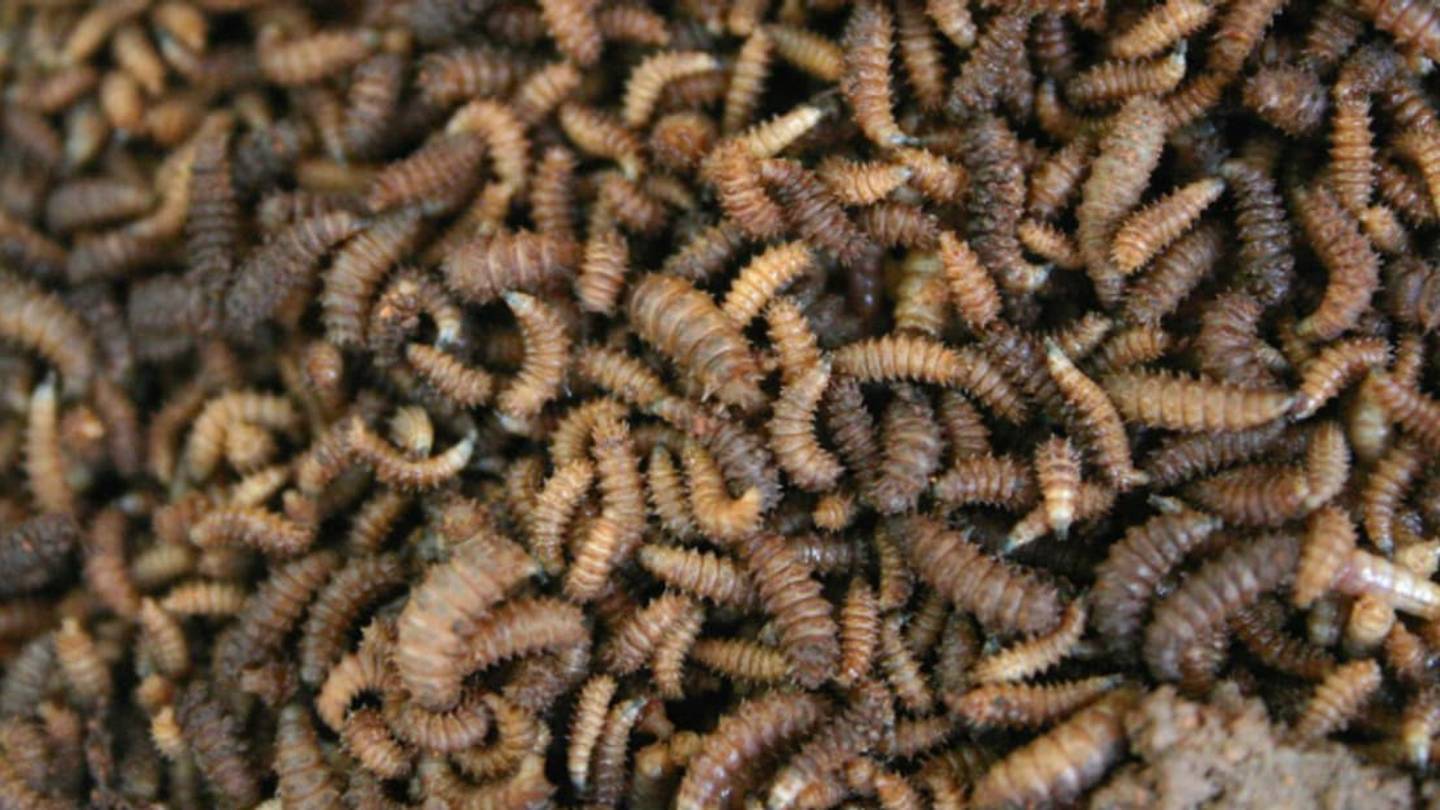
Few things trigger revulsion like the sight of maggots writhing through rotting food or decomposing road kill. But maggots, which are the larval stage of flies and other related insects, are actually one of natureâs unsung heroes. Along with bacteria and other insects, they quickly break down dead things. Maggots provide other beneficial services as well, from helping solve crimes to healing wounds.
Of course, not all maggots perform such brilliant feats; some, for example, are pests that eat crops. But they donât deserve the universally bad rap theyâve been given. So the next time your stomach lurches at the sight of maggots squirming, here are 15 examples to help you remember what amazing creatures they actually are.
Flies generally lay their eggs on things that will make a good food source for their offspring, so when maggot larvae hatch they can get to work feasting right away. Over several days they will eat, poop, grow, and sometimes even molt. At that point, the typically creamy colored maggots will pupate, meaning theyâll squirm off to a reasonably dry place, stop moving, and grow a dark shell.
Inside that shell, they transform from a mushy mass to a fully formed insect. In about 10 days, maggots will emerge from the pupal casing as hairy, bug-eyed flies and scamper off to mate, starting the cycle all over again.
They have no legs, but their front ends have mouths with hooks that help them grab at decaying flesh and other delectable food items. Despite their endless appetites, however, they lack a sophisticated digestive system. So as they move through a corpse or rotten food, they secrete fluid containing digestive enzymes to help them dissolve their foul meal.
In 2013, researchers from the University of Lausanne published a study reporting that fruit fly maggotsânormally vegetariansâactually have cannibalistic tendencies. Once a maggot is injured, itâs fair game for a feeding frenzy. Why would a normally vegetarian species do such a thing? Scientists donât have clear answers yet, but their research studying maggots could help answer basic evolutionary questions about cannibalism.
Maggots feed in massive groups, and all those digestive juices and movement can really heat up their immediate environment. They deal with this by retreating to cooler spots when the temperature becomes uncomfortably hot. But research suggests that if you put enough maggots in a confined space and wait, eventually the temperature will rise to the point that theyâll start to dieâsomewhere between 104F° and 122F° .
Maggots arenât the most sophisticated creatures, but research shows some have the ability to smell particular aromas, as well as react to light. Fruit fly maggots canât see distinct images, but they have eye-like photoreceptors known as Bolwig organs that help them detect brightness. More recently, researchers discovered they also have light-sensing cells  along their body. Both help to protect them from too much light, which can be deadly for young fruit flies.
Meanwhile, other researchers have focused on studying maggotsâ sense of smell . According to Matthew Cobb, a biologist at the University of Manchester in the UK, maggots have just 21 odor-receptor neurons , compared to 1300 in flies and millions in more complex animals like rats and people. In spite of this, maggots are still able to detect a surprising number of odors.
Science has come a long way since the 18th century. Then, people commonly accepted the theory of spontaneous generationâa belief that life could develop from non-living things, despite the fact that some two centuries earlier, in 1668, Italian physician Francesco Redi conducted a low-tech but effective experiment that showed otherwise. Redi demonstrated that maggots turned into flies, which laid eggs that turned into more maggots. He observed that maggots only appeared on meat thatâs left uncovered, allowing flies to lay eggs that later hatched.
We all know from our favorite TV shows that establishing the time of death is a fundamental part of a murder investigation. The time of colonizationâas in, the moment at which flies arrive and begin feeding and laying eggs in decomposing fleshâhelps forensic entomologists more accurately assess time of death .
It only takes a few minutes for some species of flies to begin arriving and laying eggs. So by noting the various species present and studying the age of the maggot offspring squirming around in a body, itâs possible to determine the minimum amount of time thatâs passed since death.
Surprisingly, some species are quite effective at helping wounds heal and inhibiting infection. So-called maggot debridement therapy isnât a new technology; itâs been observed for centuries that soldiers injured in battle often healed faster when their wounds were infested with maggots. Orthopedic surgeon William Baer , who had observed this himself in World War I, presented a groundbreaking study in 1929 showing that children with osteomyelitis (bone infection) and soft tissue wounds could be successfully treated with maggot therapy.
During the subsequent decade, thousands of doctors used maggot therapy. But the rise of antibiotics, coupled with challenges in obtaining medical-grade maggots grown in completely sterile conditions, saw the treatment dwindle. Thatâs changing, however, with the rise of antibiotic resistance and an increased prevalence of chronic diseases like diabetes that lead to non-healing wounds. Today, maggot therapy is making somewhat of a comeback.
Maggots used in debridement therapy feed exclusively on rotting flesh. They help clear out the dead, bacteria-infested tissue of a wound so that healthy tissue can thrive and the wound can close. They leave healthy flesh alone. But thereâs more to it than that. Maggots help curb inflammation by suppressing a part of the bodyâs immune system response .
Inhibiting the immune system might sound counterintuitive, but it turns out that maggots secrete a fluid capable of breaking down proteins that can trigger an overactive immune response. That overreaction by the immune system can lead to chronic inflammation, which in turn slows down healing and can increase the likelihood of infection.
In 2004, the U.S. Food and Drug Administration approved the use of medical maggots. They are typically placed in small, permeable packages and applied to the wound so that they can do their thing without crawling away (or into the body).
If youâve ever waited too long to take the trash out in the middle of summer, you may have lifted up the lid and been repulsed at the sight of maggots writhing through last weekâs leftovers. But they are actually excellent for creating rich, nutrient-laden compost.
Black soldier flies (rising stars of the maggot worldâsee below) are particularly speedy eaters. They work their way through organic food and animal waste so quickly that bacteria donât stand a chance. This cuts down on odors produced by bacteria. So, bonus: your compost wonât smell as bad when these maggots are at work en masse.
From Colorado to South Africa , the maggot market is heating upâand helping to solve the problem of overfishing. Right now, the protein in most feed for commercial chickens, pork, and fish farms comes from ocean fisheries like sardines and herring, many of which are collapsing. Thatâs a huge problem, because other marine species depend on these tiny fish as their major food source. So instead of making commercial animal feed from fish meal, some forward-looking entrepreneurs are turning to farming maggots.
On a maggot farm, female black soldier flies lay about 500 eggs apiece [ PDF ]. This produces an army of hungry maggots that eat their way through mounds of food waste. And boy, do they eat fast. Once these plump maggots reach the pupa stage, they can be harvestedâcrushed, dried, and turned into animal feed. Besides protecting marine life, this keeps more food waste out of landfills, decreasing methane emissions and water pollution.
Ever enjoyed a dusting of Pecorino cheese on your pasta? On the Mediterranean island of Sardinia, a sheep cheese called casu marzu starts out in much the same way as Pecorino (a cheese made from sheep's milk). But then, three weeks into the curing process, the top crust is cut off, and the ripening aroma beckons to âcheese skipperâ flies to come and lay their eggs.
A few weeks later, maggots hatch and begin working their way through the stinky cheese. And thatâs where the magicâif you can call it thatâhappens. The maggots break it down with their digestive enzymes, making a special contribution to the cheeseâs texture and flavor. And thatâs when itâs ready to eat . The flavor of casu marzu has been described as something like a strong gorgonzola or Stilton. The European Union has outlawed it, but a handful of farms on the island still make it in the traditional way.
In the tropics of Central and South America, Dermatobia hominis botflies frequently lay their tiny eggs on mosquitos. When a host mosquito lands on a warm human, body heat triggers the eggs to drop onto the skin. After they hatch, the itty bitty larvae worm their way deep under the skin and grow tiny spines that allow them to hang on tight. The parasites also release a painkilling agent to make their presence less noticeable. Sounds fun, doesnât it?
It gets worse. Harvard entomologist Piotr Naskrecki got infected with botflies while leading a nature photography workshop in Belize. It wasnât the first time, either, so he knew what to expect. As Naskrecki describes in his blog , he decided to let two of the larvae develop under his skin. He knew in a few weeks the larvae would grow to the size of a peanut, and pop out of his body to continue their transformation as pupae. You know, no big deal.
His reward was getting to photograph and film the invaders as they emerged from his skin, and document their transformation into flies. If your stomach is still feeling steady, you can watch the video here .
Rat-tailed maggots âhowâs that for a nameâare capable of surviving in very dirty water, like that found in stagnant ponds, lakes, and drainage areas. They get their name from their very long tails, which are actually a sort of tube that allows them to breathe under water. They are the larval stage of a drone fly, which is also known as the bee fly because of its resemblance to a honey bee.
The larvaeâs tough outer covering may help protect them from bacteria present in the dirty water. But recently, scientists have discovered that thereâs something else going on: the surface of their bodies is actually covered in nanopillars , spiny projections that make it difficult for bacteria in the water to congregate on the larvae. The researchers theorize that these may inhibit bacterial infection , which would explain why the maggots thrive in stagnant, dirty water where other species cannot.
Not all maggots feed exclusively on dead flesh. In the Galapagos Islands, the larvae of an invasive parasitic fly called Philornis downsi are threatening local bird populations. At least 16 of 20 species endemic to the Galapagos are in trouble because of the fly, including the famed Darwinâs mangrove finch . The flies can lay a couple hundred eggs in a bird nest. When the maggots hatch, they crawl up into baby birdsâ orifices and suck their blood. Eventually the chicks die, and the maggots then feed on their corpses.
A team of scientists is working on eradicating P. downsi in the Galapagos by breeding masses of sterile male flies that can be released on the islands. As the sterile males mate with females, the population of flies should begin to drop.
Loading recommendations... Please wait while we load personalized content recommendations