If butterflies are the beauty queens of the insect world, moths are their drab and pesky cousinsâor so you may have thought .
Itâs true that most moths are nocturnal, so youâre more likely to see them flitting around light sources at night than you would butterflies (which are generally diurnal). Itâs also true that some moth larvae feast on the natural fibers of clothes. But the vast majority of moths arenât chewing through your favorite sweater or pummeling your porch lampâand many are just as stunning as butterflies.
Here are 15 especially magnificent moth species from across the globe.Â
The luna moth ( Actias luna ) is a saturniid (a member of the Saturniidae family) found in North America. Scientists believe that it spins its ribbon-like hindwing tips to divert bat attacks: The echolocating predators target the tips, which the moths can live without, rather than more essential body parts.
The cecropia moth ( Hyalophora cecropia ) is another saturniid. Itâs North Americaâs largest moth, boasting a wingspan of up to 6 inches.Â
Moths are commonly nocturnal âbut the Madagascan sunset moth ( Chrysiridia rhipheus ), a member of the Uraniidae family, is active during the day . As its name suggests, you can find it in Madagascar.
The sunset moth isnât the only stunner flying around Madagascar. The island is also home to Antherina suraka , a saturniid known as the Madagascar bullseye moth .
Another Madagascar saturniid deserves a mention, too: the Madagascan moon moth, or Argema mittrei . ( Argema is Greek for âspeckled eye.â) Itâs sometimes called the âcomet mothâ because its lengthy hindwing tails resemble comet tails.
The Sphingidae familyâalso known as hawk moths , sphinx moths, or sphingidsâincludes the oleander hawk moth ( Daphnis nerii ). Though its main host plant is oleander , it enjoys the nectar of many other flowers, from honeysuckle to petunias.
The garden tiger moth ( Arctia caja ) belongs to the Erebidae family. Many kinds of tiger moths originate as extravagantly hairy caterpillars known as woolly bears, and the garden tiger moth is no exception: Its caterpillar looks like a tiny, mutant porcupine.
Some erebids are more impressive with their wings furledâthe white ermine moth ( Spilosoma lubricipeda ) is one of them. True to its name, it looks like itâs sporting a white ermine fur coat fit for royalty.
Eupackardia calleta , or the calleta silk moth, is a saturniid found in Mexico, Guatemala, and the American Southwest. Adults donât eat at allânot uncommon for mothsâbut calleta caterpillars enjoy a good Mexican jumping bean (among other food).
The Spanish moon moth ( Graellsia isabellae ), yet another saturniid, lives mostly in the mountains of France and Spain. Itâs so closely related to moths in the Actias genus that some people think it should be reclassified as Actias itself.
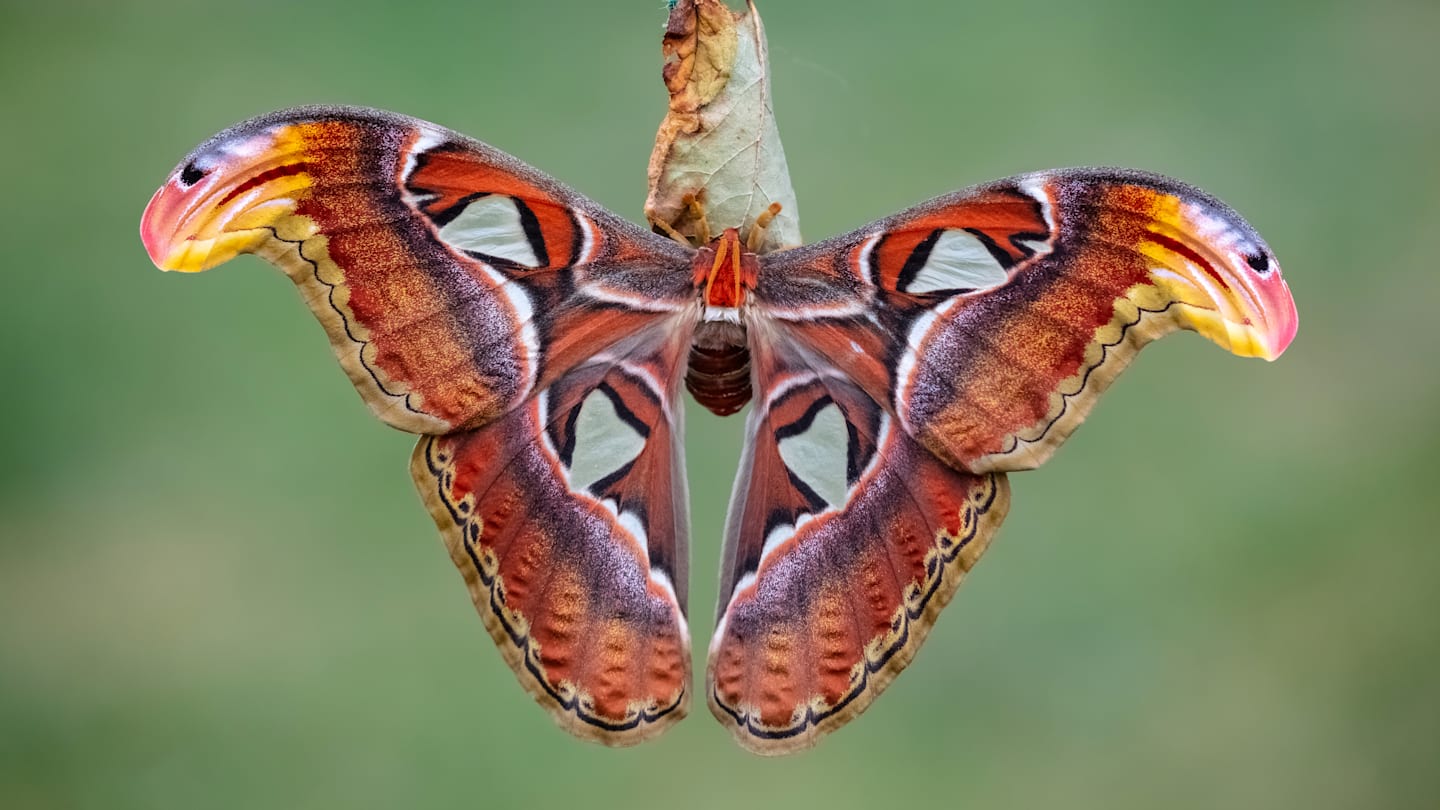
With a wingspan of up to 10 inches, the Atlas moth ( Attacus atlas ) is one of the worldâs largest moths. This saturniidâs upper wing tips look curiously like the side view of a cobra headâwhich some entomologists think could be an evolutionary defense against predators. Both creatures are endemic to Asia.
The elephant hawk moth ( Deilephila elpenor ) is a sphingid whose name was inspired by its caterpillar, which resembles an elephantâs trunk.
The Polyphemus moth ( Antheraea polyphemus ) is a large North American saturniid with captivating eyespots on its hindwings. Eighteenth-century Dutch entomologist Pieter Cramer named it after the Cyclops Polyphemus , son of Poseidon.
North Americaâs Promethea moth ( Callosamia promethea ) has a link to Greek mythology, too: Prometheus was the Titan who stole fire from the gods and gave it to humans. Eighteenth-century British entomologist Dru Drury may have chosen the name because Promethea moths, like Titans, are quite largeâtheir wingspans may reach nearly 4 inches.Â
The white-lined sphinx moth ( Hyles lineata ) is a North American sphingid sometimes mistaken for a hummingbird as it hovers over flowers, using its long proboscis to suck out nectar.
Learn More About Insects: