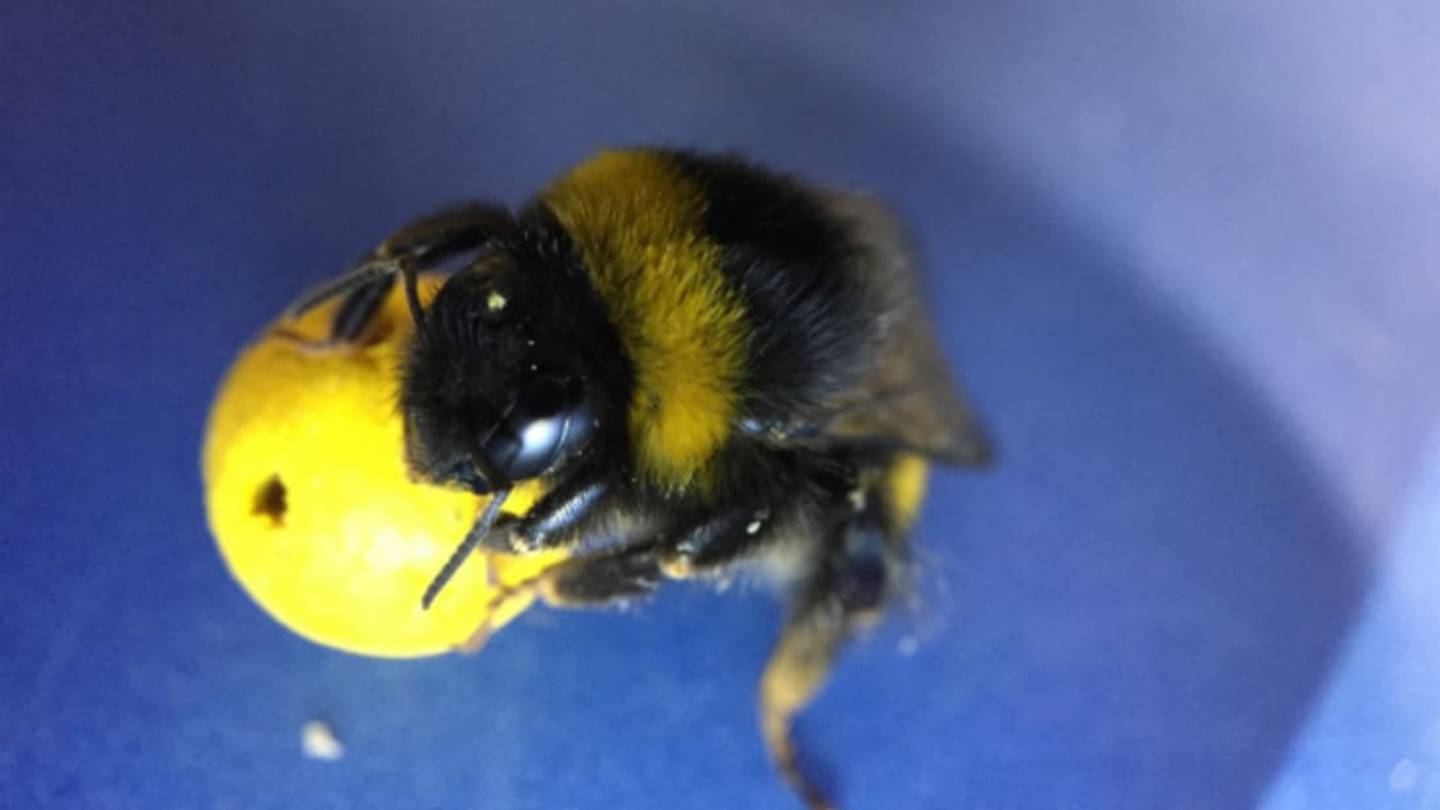
Beauty, brains, and buddy-system learning: It seems bumblebees have it all. Scientists say bees can teach each other to move a tiny ball into a tiny goalâeven though soccer is most definitely not a skill bees would ever need in the wild. A report on the beesâ sweet skills was published in the journal Science .
Humans have historically written off other animals as unintelligent, in part because they donât behave the same way we do. But a growing body of research suggests that itâs our tests, not our test subjects, that need to get smarter. The more thoughtful our experiments become, the more weâve realized that animals like apes , birds , fish , and even bugs have impressive cognitive abilities of their own.
Previous studies have shown that bees can learn new behaviors and teach them to one another, but these studies have mostly focused on behaviors that might come in handy for bees foraging in the wild. Researchers at Queen Mary University of London wondered if these learning abilities extended to new, non-survival-related activitiesâlike, say, pushing a ball into a goal.
They set up a minuscule field and created three different scenarios. In the first, uninitiated bees watched other, trained bees (letâs call them coaches) score goals and get a sweet rewardâa sucrose solution. In the second, a âghost demonstratorâ (actually a magnet) moved the ball. In the third, the bees received no demonstrations.
The new bees proved eager learners, picking up the game from both coaches and ghosts. Bees who had bee coaches were more likely to succeed, but those with magnets eventually got the idea, too. Whatâs more, they sometimes played better than their teachers, selecting balls nearer to the net to ensure a more efficient goalâand quicker access to the reward.
"The bees solved the task in a different way than what was demonstrated,â co-lead author Olli J. Loukola said in a statement, âsuggesting that observer bees did not simply copy what they saw, but improved on it. This shows an impressive amount of cognitive flexibility, especially for an insect."
These itsy-bitsy soccer games are as important as they are adorable, said project supervisor and co-lead author Lars Chittka. "Our study puts the final nail in the coffin of the idea that small brains constrain insects to have limited behavioural flexibility and only simple learning abilities."
Loading recommendations... Please wait while we load personalized content recommendations