For years, people hungered for the perfect red. The color has a long human history: Mesoamerican scribes used it to record their history, while the Old Testament paints it as the color of sin. In Europe, monarchs draped themselves in rich reds to showcase their wealth. And though the best baroque painters sought to incorporate these deep tones into their work, they often struggled to recreate the fiery shades found in natureâat least until Europeans found out about the cochineal insect, a creature that creates a red dye so incredible that the continent nearly went to war over it.
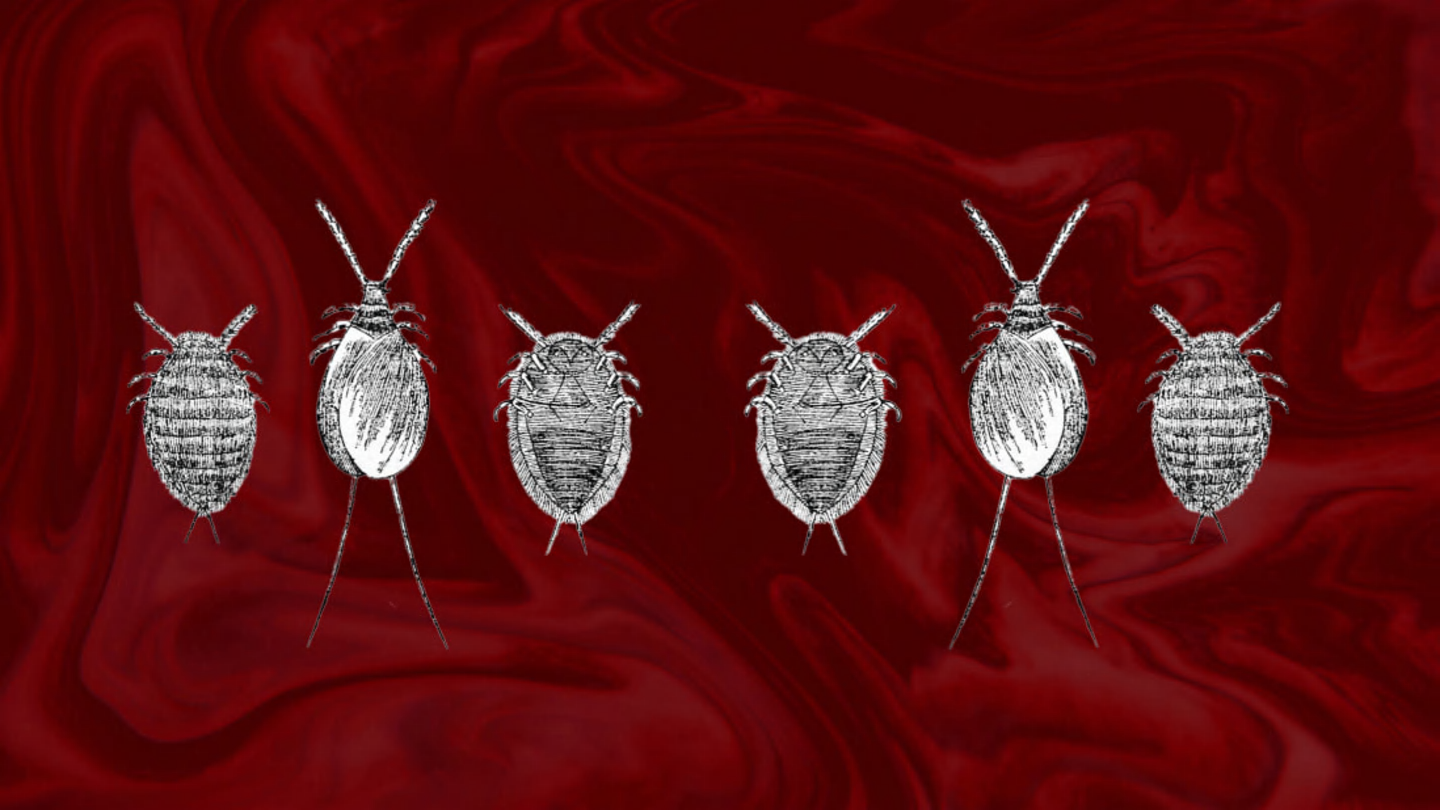
At first appearance, the cochineal insect doesn't look very remarkable. It's a tiny bug, with no visible legs or antennae, that lives in prickly pears in the arid regions of the Americas. Adult males never eat, and die shortly after fertilizing a femaleâs eggs. The females, meanwhile, insert their needle-like mouths directly into the cactus and spend their whole lives slurping prickly pear juice and covering themselves in a white, fluffy protective wax.
Itâs the female cochineal insects that captured the worldâs attention. Their scales produce a large amount of carminic acidâso much, in fact, âthat it amounts to almost 20 percent of their dried body weight,â Richard Zack , professor and associate dean of Entomology at Washington State University, tells Mental Floss. Itâs this defensive chemical that makes the cochineal insects so alluring to the people who seek to harvest it.
Mesoamericans realized thousands of years ago that pinching these insects produced blood-red stains on their fingers. Much like we raise bees for honey today, they began farming the cochineal insects for dye.
âWe usually think of domestication as being cows and pigs and such,â Amy Butler Greenfield , historian and author of the book A Perfect Red , tells Mental Floss. âBut it turns out that the indigenous people of the Americas became quite good at domesticating insects.â According to Greenfield, in Mexicoâs southern highlands (the area now known as Oaxaca), the Zapotec and Mixtec people bred the insects for the color, potency, and amount of dye they produced.
The cochineal farmers would scrape the insects off the cactus using stiff brushes, then dry them in the sun or ovens before the scales are ground and turned into dye scales. It took 70,000 dried insects to make a pound of dye. This unique red colored textiles, furs, feathers, baskets, and pots. It was also used in medicines, cosmetics, and as ink by historical scribes.
When the Spanish conquistadors invaded Mesoamerica, it didnât take long for them to notice the dazzling color.
Historians donât know exactly when the Spanish invaders learned the cochineal insect was responsible for creating this dye. âWe have accounts of conquistadorsâthe Spanishâcoming into Tenochtitlán, the central city of the Aztec empire. And one of the things in the marketplaces that they were really struck by were the range of dyes,â Greenfield says. âSo thatâs probably when they first saw cochineal.â
Shortly after the Aztec city of Tenochtitlán fell in 1520, the Spanish started shipping the dried insect scales back to Spain. Soon, bright red fabrics spread throughout Europe . The dye's popularity increased after the colorful products reached Venice in the early 1540s, thanks to the Venetians' fondness for vibrant hues. It wasn't long before Europe's royalty began to covet the red fabrics dyed from the cochineal insect.
At that time, producing silk and vividly dyed cloth was an incredibly lucrative business. Selling cloth was a mammoth industry, comparable to the tech industry todayâbut merely producing raw materials such as wool didn't fetch a major profit. To really make money, manufacturers needed to get their hands on the dyes.
Spain, realizing it had a precious product, cornered the market on cochineal red. It became one of their most valuable exports from Mexico, second only to silver . They even put laws on the books to protect cochinealâand the mysterious bug that created it. âYou couldnât take gold or silver or cochineal out of Spain, without authorization, on pain of death,â Greenfield says.
The country also had strong censorship policies to control information about cochineal and keep it from other countries. For years, Europeans remained unaware that the dye came from an insect. Many wondered if the dried cochineal that formed dyes was some sort of plant or animal. Once the secret source of Spainâs coveted dye eventually got out, it wasnât long before Europeâs monarchies were plotting ways to fightâand killâfor it.
In 1585, two merchant families, the Capponis of Florence and the Maluendas of Burgos, created a cochineal cartel that spanned most of Europe, stealing much of the continentâs supply at the time and raiding incoming shipments.
England, meanwhile, used pirates. Between 1570â1577, at least 13 different English raiding parties sailed to the Caribbean in search of cochineal, with dozens more following in the coming decades. The famous English poet John Donne was on one of these voyages when a ship carrying cochineal exports from Mexico was raided; he mentioned the insect in one of his poems, writing
France opted for spies instead of pirates, sending them several times to try to steal live cochineal insects over the centuries. Only one ever succeeded: Nicolas-Joseph Thiery de Mononville, a botanist who set sail for Mexico in 1776 to pilfer the coveted cochineals. Though he was able to smuggle some insects to France, he was unable to keep them alive.
The Frenchman wasn't the only one who struggled to farm the cochineal. The indigenous people who cultivated the insect back in the Americas had spent centuries developing their methods. The Spanish, despite originally wanting to farm the cochineal on plantations, soon realized that wasn't a viable option. To farm the insects, someone had to have an in-depth knowledge of its needsâand the very particular climate of North and South America's deserts .Â
This wound up benefiting the indigenous people who had farmed them for so long. Because the dye was such a valuable commodity for the Spanish Empire, the monarchy allowed the families who had been harvesting the insects for generations to remain on their ancestral farms. âIf you look at those regions that were producing cochineal, there is higher cultural survival and higher language survival there,â Greenfield says, âand I think that this insect really is crucial to that cultural survival for them.â
In Europe, the craze for the cochineal color lasted centuries. The vibrant hue was a great way of telegraphing a personâs power; soldiers and royals donned garments colored with its signature scarlet. But as Spain lost exclusive control of the cochineal insects and more countries were able to produce the dye, demand slowly began to fall. The invention of synthetic dyes âwhich were far cheaper and easier to produceâfurther hastened the color's decline.Â
But cochineal red never really went away, and has even experienced a revival in the 20th century: Today, the insect is farmed mostly in Peru , and its signature red dye is still found in cosmetics and food coloring. Its use in modern times is not without trouble; in 2012, when Starbucks made headlines for using it to color their Strawberry and Creme Frappuccino, some vegetarians were unhappy to discover the fruity drink included insects.
Loading recommendations... Please wait while we load personalized content recommendations