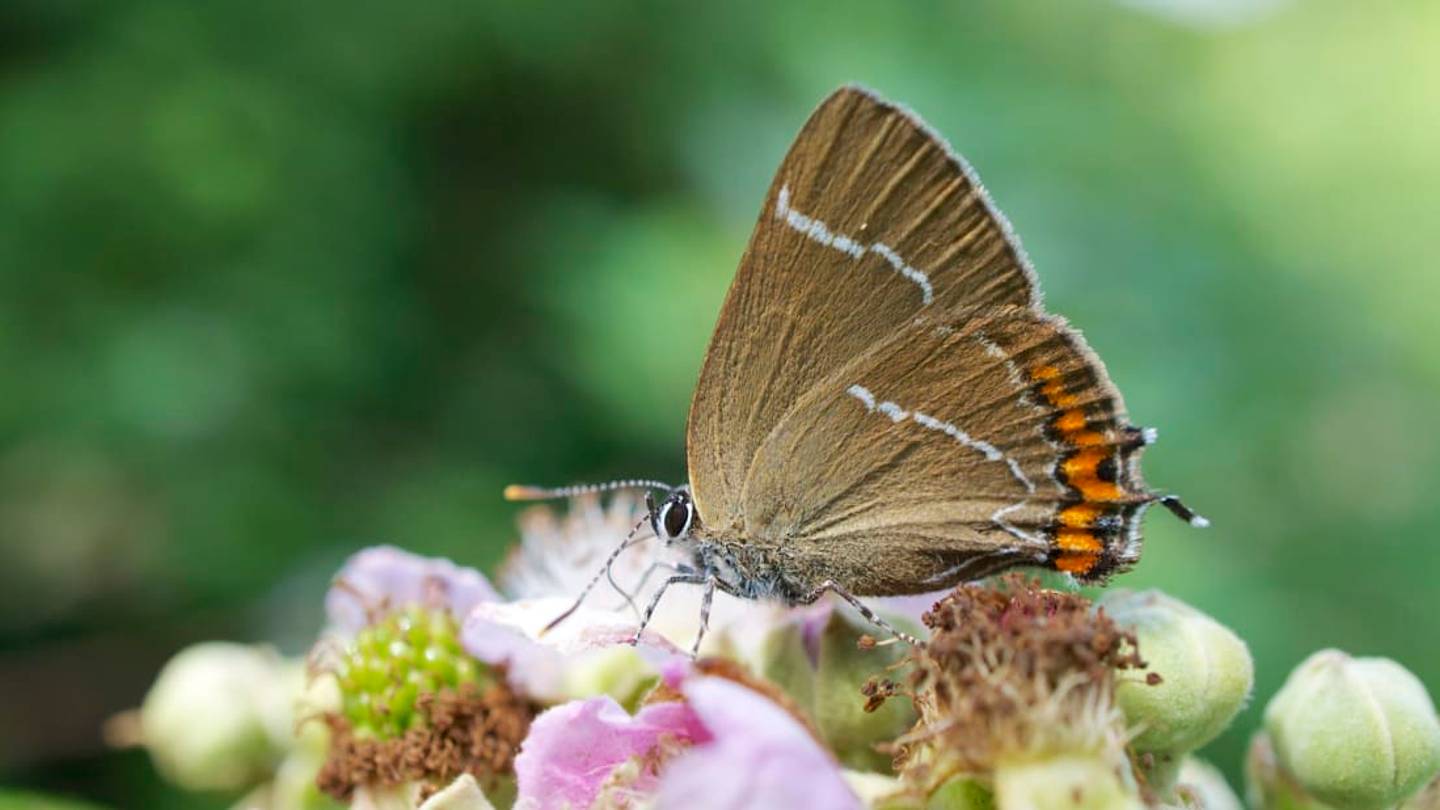
Conditions werenât looking too promising for the white-letter hairstreak, an elusive butterfly thatâs native to the UK. Threatened by habitat loss, the butterfly's numbers have dwindled by 96 percent since the 1970s, and the insect hasnât even been spotted in Scotland since 1884. So you can imagine the surprise lepidopterists felt when a white-letter hairstreak was seen feeding in a field in Berwickshire, Scotland earlier in August, according to The Guardian .
A man named Iain Cowe noticed the butterfly and managed to capture it on camera. âIt is not every day that something as special as this is found when out and about on a regular butterfly foray,â Cowe said in a statement provided by the UK's Butterfly Conservation. âIt was a very ragged and worn individual found feeding on ragwort in the grassy edge of an arable field.â
The white-letter hairstreak is a small brown butterfly with a white âWâ-shaped streak on the underside of its wings and a small orange spot on its hindwings. Itâs not easily sighted, as it tends to spend most of its life feeding and breeding in treetops.
The butterflyâs preferred habitat is the elm tree, but an outbreak of Dutch elm diseaseâfirst noted the 1970sâforced the white-letter hairstreak to find new homes and food sources as millions of Britain's elm trees died. The threatened species has slowly spread north, and experts are now hopeful that Scotland could be a good home for the insect. (Dutch elm disease does exist in Scotland, but the nation also has a good amount of disease-resistant Wych elms.)
If a breeding colony is confirmed, the white-letter hairstreak will bump Scotlandâs number of butterfly species that live and breed in the country up to 34. âWe donât have many butterfly species in Scotland so one more is very nice to have,â Paul Kirkland, director of Butterfly Conservation Scotland, said in a statement.
Prior to 1884, the only confirmed sighting of a white-letter hairstreak in Scotland was in 1859. However, the insectâs newfound presence in Scotland comes at a cost: The UKâs butterflies are moving north due to climate change, and the white-letter hairstreakâs arrival is âalmost certainly due to the warming climate,â Kirkland said.
Loading recommendations... Please wait while we load personalized content recommendations