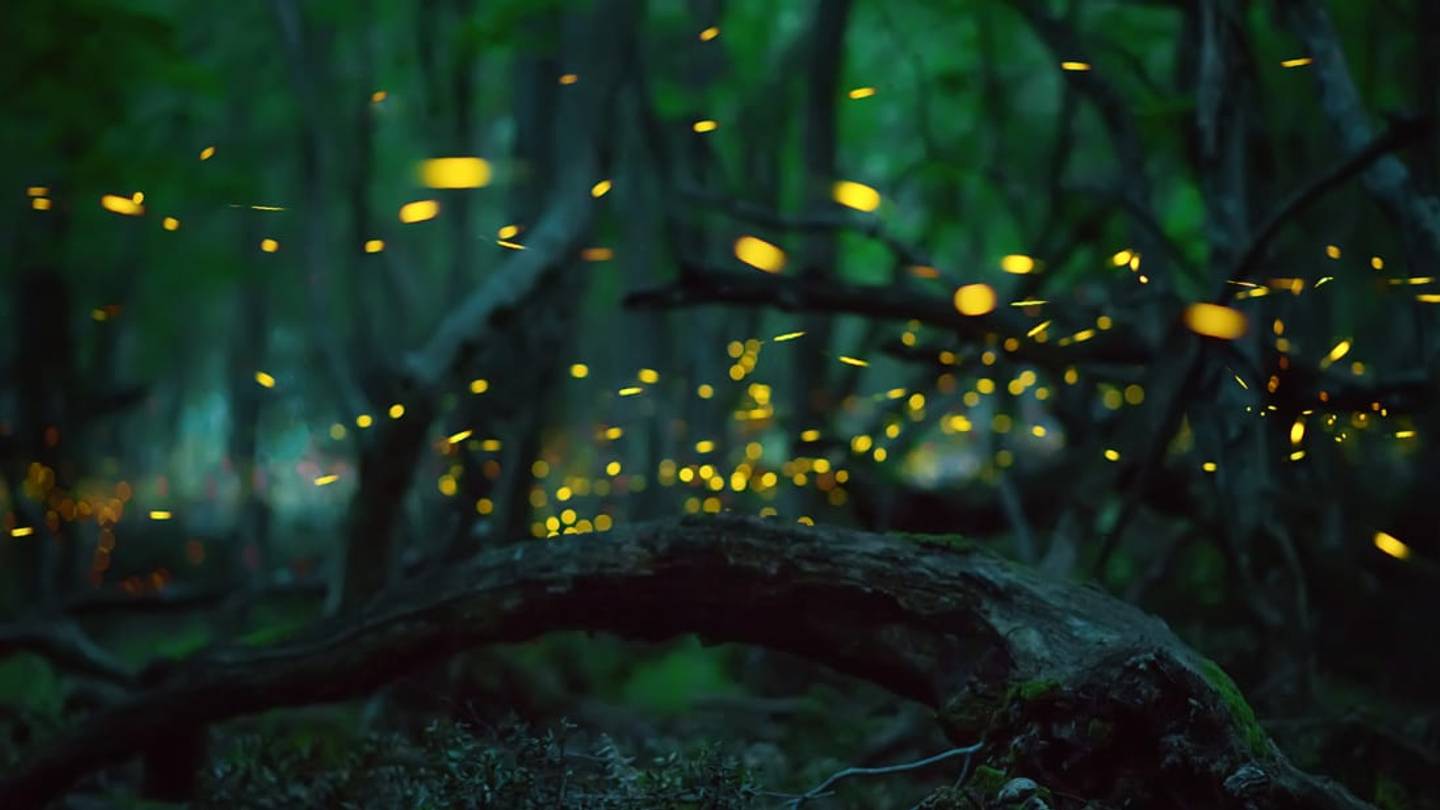
Today, the rare Smoky Mountain fireflies are a tourist attraction. Twenty years ago, science didnât believe they existed. Â
At exactly 9:27 P.M., when dusk slips into darkness in the Great Smoky Mountains National Park, the âlight showâ begins. Itâs June, and for two weeks in Elkmont, Tennessee, the fireflies pool their efforts. Instead of scattershot blips of light in the summer sky, the firefliesâthousands of themâpulse this way for hours, together in eerie, quiet harmony. Itâs as if the trees were strung up with Christmas lights: bright for three seconds, dark for six, and then bright again, over and over. It continues this way for hours.
As a child, Lynn Faust would huddle with her family on the cabin porch to watch the spectacle. Theyâd sit, mesmerized by the âdrumbeat with no sound.â And though theyâd appreciated the show for generations, Faust never thought the event was newsworthy. âIâd assumed there was only one kind of firefly and thought they did a nice show in the Smokies,â she says.
The natural world has long enchanted Faust. In college, she majored in forensic anthropology and minored in forestry. In her twenties, she circumnavigated the globe for three years, visiting islands you could only get to by boat, learning about cultures before they disappeared, pursuing underwater photography. Today, at 60, sheâs a naturalist who writes scientific papers and field guides about fireflies. But she wasnât always obsessed with the insect. In fact, her academic interest began only in the â90s, when she read an article by Steven Strogatz, a Cornell mathematician, in which he marveled at a species of Southeast Asian firefly that synchronized its flashes. Highlighting how rare this phenomenon was, Strogatz noted that there were no synchronous fireflies in the Western Hemisphere.
This struck Faust as odd. It contradicted the light shows she had seen growing up. As she dug deeper, Faust found that while there had been more than 100 years of colloquial accounts of North American fireflies flashing in sync, scientists discounted those reports, attributing them to lore or optical illusion. Faust knew the truth: that her Tennessse fireflies were every bit as special as the species in Asia. But how could she prove it?
Fireflies âor lightning bugsâmay be the closest thing nature has to a magic trick: lighting the world from the inside out. Technically, they are bioluminescent beetles. Their glow comes from an internal chemical reaction that combines oxygen and calcium with a series of enzymes, including a key light-producing one called luciferin. The bugs flash for lots of reasons: to communicate, to attract mates, to scare off predators. But for creatures so striking, theyâre also common. There are roughly 2,000 species worldwide and 125 or more in North America alone, where catching them is a childhood rite of passage.
More than 20 years ago, Faust wrote a letter to Strogatz after reading his article. He connected her with Jonathan Copeland, a biologist and professor at Georgia Southern University who was studying firefly behavior in Malaysia and Indonesia. Copeland was skeptical of Faustâs tale. Reports of synchrony had crossed his desk before but had never panned out. âThe dogma said they do not synchronize in North America,â he says.
Still, he indulged Faust, asking her to describe what sheâd witnessed by drawing a âmusical score.â As a child, Copeland, a tuba player, dreamed of playing with the Boston Symphony. Ever since, music dominated his approach to the natural world. In grad school, heâd studied and documented the rhythmic lunge and strike patterns of praying mantises. He took a similar slant on firefly behavior and found that if people charted the synchronic rhythms they were witnessing, he could separate a bogus account from a real one. Putting pencil to paper, Faust was nervous. âTo look at it scientifically is very different from sitting in your rocking chair with a blanket and enjoying it,â she says. âI didnât want to sound like a complete idiot.â
When her note arrived, âit looked like synchrony on paper,â says Copeland. In June 1993, he was intrigued enough to make the eight-hour drive to Elkmont. He pulled into the cabinâs driveway as dusk fell, no trace of the insects to be seen, and promptly fell asleepâonly to wake up to flashes of light all around him. âIt was completely obviousâno doubt about it!â he remembers. He rushed to find a pay phone to call his colleague Andy Moiseff. âIt must have been about midnight,â he says. âI said, âAndy, Andy, youâve got to see this, theyâre flashing synchronously!â Andy laughed and said, âProve it,â like any good scientist.â The following summer, thatâs exactly what Copeland, Faust, and Moiseff, a professor of physiology at the University of Connecticut, set out to do. It was an unlikely partnership, but the trio made a formidable team. Copeland is a neuroethologistâhe studies the neural basis for animal behavior. Faust, an unflappable outdoorswoman and keen observer, knows the area and its wildlife like home. And Moiseff is a computer whiz, with a proclivity for dreaming up theories and building devices to test them.
The three hauled lab equipment, microscopes, video cameras, computers, and insect specimens to sites throughout the Smokies. They started in Elkmont but quickly branched out to determine how widespread the phenomenon was. They hauled bugs back to the lab to do frame-by-frame analyses of the flashes. In the wild, âthey were obviously in sync,â Copeland says. But when they repeated the test with individual fireflies in one-gallon freezer bags, the behavior changed. If an insect couldnât see another, they no longer flashed synchronously. By 1995, the team had the data they needed.
âThis was red-hot news in the firefly community,â says Copeland. There are four synchronous species of firefly known in Asia, and they are smaller than the teamâs species, Photinus carolinus . âTheir flash is wimpy in intensity, but what they lack in flash intensity, they make up in numbers,â Copeland says. They usually remain stationary in trees along the river, unlike carolinus , which fly around in the woods. âOurs are more complicated,â says Faust.
Proving synchrony existed in fireflies in the Western Hemisphere was exciting, but it raised questions about why they flashed this way. And how was that different from what their cohorts did in Asia or, for that matter, from the way their asynchronous relatives behaved in North America and even elsewhere in the park? For the next two decades, Copeland and Moiseff would study the fireflies with Faust each summer, determined to understand these magical creatures. But just as they were getting close, everything in Elkmont changed.
In the beginning , the team had the woods to themselves. âIn the old days, there would be the three of us and the odd stranger who was fishing,â says Moiseff. In fact, when Faust first informed park officials about the light show, they didnât believe her. In 1992, her family had to give up its cabin when the government took control of the resort communityâs leases. By then, Faust had noticed that the firefly behavior seemed to be localized: The light show didnât appear to be taking place even half a mile away from this settled location. She hypothesized that the synchronous behavior could be linked to the unusual conditions near the homes. But when she pointed it out, parks officials assumed her claims were a trumped-up attempt to keep her cabin.
Finally, in 1996, park administrators sent a ranger to the researchersâ campsite to investigate. âIt was a funny night,â Faust recalls. âWe had this ancient computer set up on the porch and Christmas lights strung across the hill to see if we could control the rhythm of the firefly flashes with the lights going off and on. He was like, âWhere are they?â And suddenly, there they were. The guy goes, âOh, my God.â He said that about six times,â says Faust. The next night they had 20 rangers watching.
By the early 2000s, word had spread. According to one of the parkâs supervisory rangers, Kent Cave, âThere were fender benders, road rage, crowds of people.â The Smoky Mountain fireflies had become a bona fide tourist attraction. In 2006, the park instituted a trolley service from a parking lot to the viewing area for peak nights, closing access to individual cars. âPeople were driving up. They might have driven five hours from Alabama or down from Lexington and couldnât get in,â says Cave.
Today, tourists reserve parking spots in advance online. After the yearâs peak firefly emergence has been predicted, reservations for the June viewings go live in late April. The spaces go in minutes. The light show has become the biggest of the parkâs special events, with as many as 12,000 attendees in recent years. But as Cave puts it, âOur biggest headache is predicting when these little buggers are gonna flash.â Thereâs a system for that too. âThe pressure of me telling people when to come see the fireflies began 20 years ago,â Faust says. âLike anything in nature, itâs not entirely predictable, but Iâve developed a mathematical way of figuring it out.â
Today, park entomologist Becky Nichols relies on Faustâs degree-day model to determine when the fireflies will emerge. The equation is specific to Photinus carolinus and relies on temperature data Faust and Nichols begin collecting in early March. âYou take the high and the low temperatures and plug them into a formula to figure out the larvaeâs accumulation of growth,â explains Nichols. âThe issue in the past was that we didnât have good temperature data.â Tiny temperature loggers fixed to trees for air temperature and to the ground for soil temperature have remedied that problem. Faust has her own data logger down the road as well, and the two women compare results as the numbers climb, hoping to come up with the same prediction independently.
Though theyâre gratified that the public appreciates the light show, its popularity is bittersweet. The event is too crowded for the scientists to continue studying at the site, so theyâve decamped to other areas in the Appalachian Mountains. As Copeland says ruefully, âWe canât work there anymore because itâs a tourist attraction, and weâre largely responsible for that.â
So why do Photinus carolinus flash together? No one has quite figured it out, Faust says. But there are theories. In a 2010 paper published in Science , Moiseff and Copeland suggest that synchrony keeps the female firefly from getting confused when searching for a mate. In an experiment using an electronic simulator with light-emitting diodes, they found that uncoordinated stimuliâtoo many lights coming from too many places at different timesâinhibited the female fireflyâs response. When flashes were coordinated, the females could clearly send their messages back to the males. Faust agree that synchrony in carolinus is related to mating.
Moiseff, whoâs most interested in the fireflyâs brain and nerve cells, wonders what it is about the insectâs eyes that helps it process information. Some data has shown that under the right circumstances, a firefly can determine where a flash is coming from. What this could suggest, he says, is that the insectâs brain might break information into different pathways for processingâsomething that primates and people do, but we donât think of bugs doing. Itâs a problem heâs still studying: âHow does a simple nervous system accommodate that? Whatâs the mechanism?â
Moiseff also points out that Photinus âs synchrony is important not because the phenomenon is so rare but because it changes our perspective on the many ways in which living things interact. With just one proven case in the U.S., the gates opened wide for discovering others. In 1998, Copeland and Moiseff showed that a species on the Georgia and South Carolina coast, Photuris frontalis , was also synchronous. Additionally, the species Photinus pyralis , Copeland says, is âweakly synchronic.â Once you find other species doing this, âall of a sudden theyâre not a freak of nature. Instead, they have a solution to a specific environmental need,â says Moiseff.
The last few years, Moiseff and Copeland have kept their firefly studies closer to home. âFor the first 10 years, my spouse was very supportive,â says Copeland of his work in Tennessee. âThen she started asking questions about the significance.â He retires from his position at Georgia Southern this year, and, joking aside, considers identifying Photinus âs synchrony to be one of the highlights of his life. âI grew up as a suburban kid afraid of the dark, and I found myself [alone] in the woods with fireflies,â he says. âSerendipityâand a mind set that gets you away from cable TVâplays a role in science.â
Faust, for her part, is still involved with fireflies. Sheâs working on a field guide that will include images from her collection of more than 60,000 photos. And her family cabin still stands proudly in the same spot where she first saw the light show. But it isnât quite the same. The cabin now belongs to the park, and she and her family no longer curl up on that porch under thick blankets, waiting for the pulsing spectacle to begin. One thing hasnât changed, though: No matter how many times Faust has seen the show, Photinus carolinus âs return each summer is still a thrill. âThe biggest kick is trying to predict the first night,â she says. âTo see that first one and think, âWow, that happened again.ââ
This story originally appeared in an issue of mental_floss  magazine. Subscribe here .
Loading recommendations... Please wait while we load personalized content recommendations