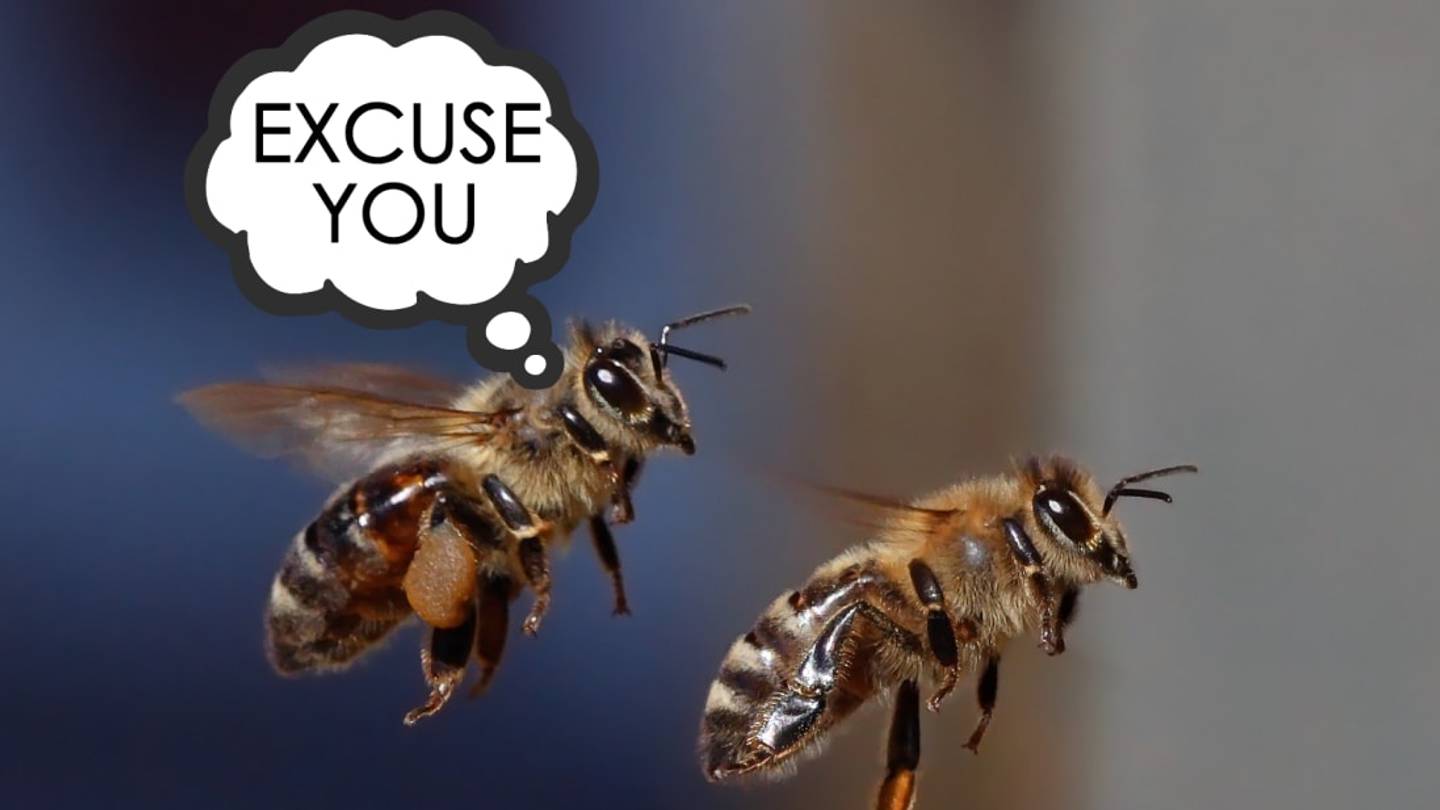
British scientists say startled honeybees emit a teeny whoop! Â noise when jostled or head-butted by another bee. The team described their findings the journal .
Bee societies are astoundingly sophisticated and complex; theyâre strict hierarchies in which every bee knows its job and its place. To keep this social machine humming along, bees rely on multiple forms of communication: chemical signaling , electrical impulses , gestures (like their waggle dance ), and sound.
One of the most common sounds is a quick little wing-buzz used often in crowded colonies. Bees seem to make this noise when they ask another bee for food and as they interfere with another beeâs waggle danceâa move that tells the second bee to change its plans. Because the buzz seems to be used to abort the waggle dance and any foraging that might follow, scientists call the noise the âstopâ signal.
To learn more about the signal, researchers at the UKâs Nottingham Trent University set up accelerometers and cameras inside honeybee hives and left them there for a year. (This particular sound is inaudible to the naked human ear and can only be picked up with monitoring devices.)
The resulting recordings were surprisingly packed with these little buzzes. So packed, in fact, that lead author Martin Bencsik began to suspect weâd misinterpreted its meaning. âThereâs no way a bee was trying to inhibit another one that frequently,â he told New Scientist , âand thereâs no way a bee would request food that frequently.â
So what is the buzz about?
Surprise, it seems. Video footage from inside the hives showed that bees mostly emitted that little sound after another bee had knocked into them, the same way you might say âwhoa!â when a stranger suddenly jostles you on a crowded sidewalk. Bencsik and his colleagues propose that instead of calling the noise a âstopâ signal, we should call it a little âwhoopâ instead.
The authors suggest that bees, like people, may complain more when times are hardâwhich means that we might be able to use the frequency of their little whoops to calculate their colonyâs stress level.
The findings are âawe-inspiring,â entomologist and educator Gwen Pearson told Mental Floss. âHoneybees [were] domesticated centuries ago, but we are still trying to understand how they work.â
Loading recommendations... Please wait while we load personalized content recommendations