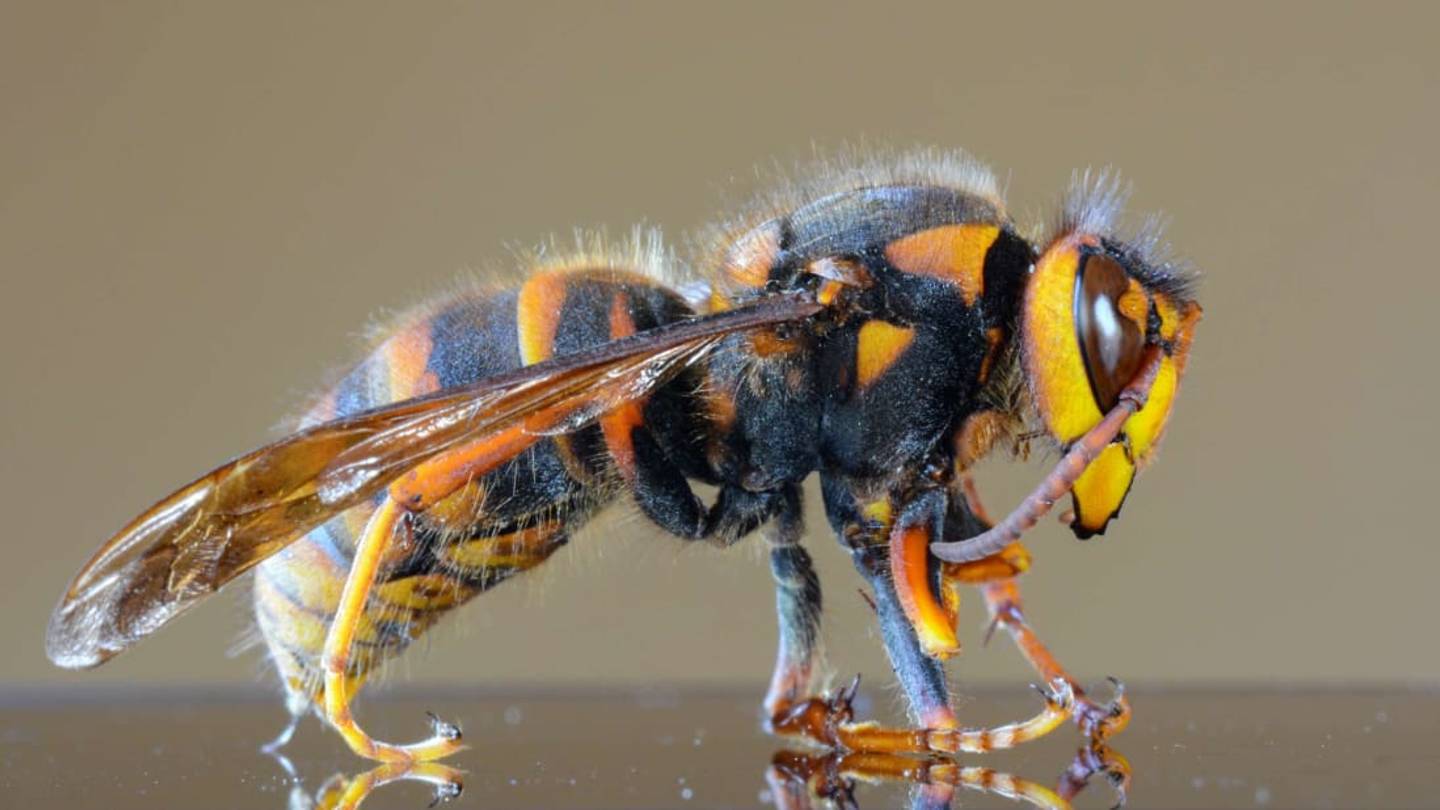
In the last few days, itâs been widely reported that a menacing insect known as the âmurder hornetâ has now made its way to the U.S. from its native Asia, causing alarm among people both with and without entomophobia (fear of insects). While its supersized stinger and crab-like facial pincers make it seem like something straight out of a horror film, thereâs no need to don a bulletproof suit for your next stroll in the garden. Here are five things to know about these beasts.
At 1.5 to 2 inches long, Asian giant hornets, or Vespa mandarinia , are the largest hornet species in the world. Theyâre characterized by orange and black tiger-like stripes, and according to the Washington State Department of Agriculture (WSDA), their nests are most commonly found in the ground.
Jun-ichi Takahashi, a researcher Kyoto Sangyo University in Japan, told The New York Times that scientists nicknamed the insects âmurder hornetsâ because they sometimes attack in groups, and the venom from multiple stings can be lethal enough to kill a humanâbut they donât usually target humans unless they feel threatened. (In other words, donât try to swat away a giant hornet.)
While a single sting may not be fatal, itâs still significantly more painful than a regular bee or hornet sting, and the hornet's stingerânearly one-fourth of an inch longâis big enough to rip through a beekeeping suit. âIt was like having red-hot thumbtacks being driven into my flesh,â Conrad Bérubé, a Canadian entomologist and beekeeper who was stung while eradicating a nest found on Vancouver Island, told The New York Times . The next day, he experienced flu-like aches in his legs.
The most common victim of a murder hornetâs homicidal tendencies is the honeybee. The hornets use their long, spiked mandibles to tear the heads off bees , and they carry the beesâ thoraxes back to their nests to feed their young. In mere hours, a few hornets can completely destroy an entire beehive.
In December 2019, four sightings of Asian giant hornets, which are native to Japan, China, and other parts of Asia, were reported in Washington stateâmarking the first time the species had ever been seen in the U.S. They were also spotted in British Columbia, Canada, last year. After conducting genetic tests on specimens, scientists determined that the hornets from British Columbia had no relation to one from Washington, suggesting that the species was introduced into North America on at least two separate occasions.
Because the giant hornets kill bees in such large numbers, entomologists , beekeepers, and other researchers are worried about the devastating effect they could have on the already dwindling bee population if they were to become an established invasive species in the U.S. To prevent that from happening, theyâre trying to locate giant hornets and exterminate their nests as quickly as possible.
âThis is our window to keep it from establishing,â Chris Looney, a WSDA entomologist, told The New York Times . âIf we canât do it in the next couple of years, it probably canât be done.â
Beekeepers are setting up hornet traps near beehives, hoping to catch one of the predators so they can track it back to its nest. Since the hornets' activity inside their nests can raise the temperature to 86°F, scientists are also looking into the possibility of using thermal imaging to locate them.
[h/t The New York Times ]
Loading recommendations... Please wait while we load personalized content recommendations