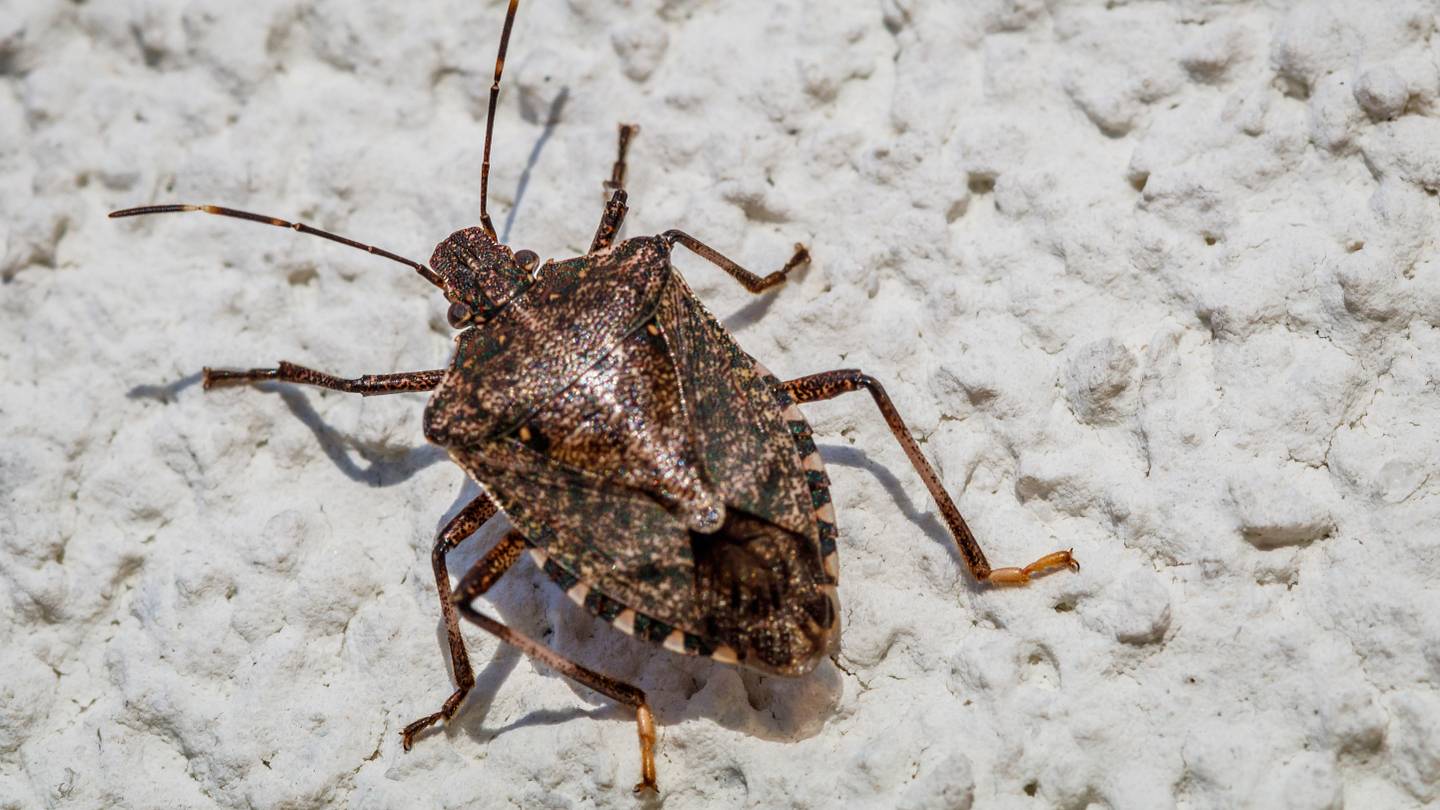
There are about 5000 species of stink bugs, shield-shaped insects that belong to the family Pentatomidae. One of the most notorious stink bugs is the brown marmorated stink bug ( Halyomorpha halys StÃ¥l), a.k.a. BMSB, which The New Yorker called âthe most destructive, the most annoying, and possibly the ugliestâ of all the stink bugs, an invasive species thatâs taking North America by storm ⦠and not in a good way. Hereâs what you should know.
The first BMSB specimens in the U.S. were collected in Allentown, Pennsylvania, in 1998, but the bugs likely arrived from their native East Asia a few years prior to that. (They may have come to the states in a shipping container , but no oneâs sure.) Since then, theyâve spread as many as 47 states as well as parts of Canada.
âItâs an incredible hitchhiker,â Dr. Tracy Leskey, an entomologist with the Agriculture Departmentâs Appalachian Fruit Research Laboratory , told The New York Times of the BMSB. Less than 10 years after it was identified in the States, it was in Switzerland and other parts of Europe, too.
When the bugs were delivered to Karen Bernhard, an entomologist at Pennsylvania State Universityâs Extension Service, she had no idea what they wereâand neither did anyone else. (Many assumed it was the native Euschistus servus .) It wasnât until 2001, when Bernhard sent specimens to Richard Hoebeke, an entomologist specializing in invasive species who was then working at Cornell, that they were identified as brown marmorated stink bugs.
After they hatch, the black-and-red nymphs go through five molts, growing into mottled, dull-brown bugsâup to .66 inches longâwith white banded antennae and legs, alternating dark and light bands on the abdomen, and smooth, rounded shoulders. All of these features distinguish them from lookalikes like the brown, rough, and one-spotted stink bugs. BMSBs can live for up to eight months .
Skunk. Old socks. Coriander. These are just some of the things the stink of the brown marmorated stink bug has been compared to. The two main chemicals responsible for the BMSBâs stinky spray are trans-2-octenal and trans-2-decenal. The latter is what gives cilantro its smell.
The chemicals in the spray might have a purpose besides scaring away predators: According to a 2016 study , they âinhibit the growth of bacteriaâ; the results of the study âsuggest that brown marmorated stink bug aldehydes are indeed antibacterial agents and serve a multifunctional role for this insect.â
Brown marmorated stink bugs chow down on more than 100 types of crops. According to StopBMSB.org, apples, Asian pears, green beans, sweet corn, peaches, tomatoes, peppers, and Swiss chard are among the crops BMSBs pose the most risk to. Apricots, blueberries, broccoli, cauliflower, sweet potatoes, and turnips are also on the menu (though theyâre less at risk).
To feed, the bugs pierce the skin of the plants with their mouthparts and drink the fluids, which in fruits like apples âresults in a characteristic distortion referred to as âcat facing,â that renders the fruit unmarketable as a fresh product,â according to a Penn State Extension article on the bugs. In 2010, mid-Atlantic farmers estimated that BMSBs caused $37 million in damage to apple crops alone. Some farmers of apples and other crops reported total losses that year. Â
Come winter, BMSBs are looking for a warm place to shack up so they can enter diapause, a hibernation-like state that lasts until spring (a.k.a. mating season). Outdoors, theyâll overwinter in dead trees âbut often, they find their way into peoplesâ homes through open windows and doorways, in the gaps around window air conditioning units, down chimneys, and basically any crack they can find.
According to The New Yorker , âStudies have shown that, despite their relative heft, stink bugs can crawl through any crevice larger than 7 millimeters, which means that, no matter how much caulk and weather-stripping and patience you possess, it is virtually impossible to stink bug-proof a home.â But that doesnât mean you shouldnât try; experts recommend placing screens over windows and vents and making liberal use of caulk to patch cracks.
Once a stink bug has found a warm spot it likes, it will release an aggregation pheromone (which can linger for up to a year) that draws other BMSBs to the same area, where theyâll gather in sometimes staggering numbers: One study found more than 26,000 of them living in a Maryland home.
The good news is, beyond being a smelly nuisance, they wonât mate in your home or cause structural damage (though they might clog chimneys ... or your pipes).
Some suggested stink bug removal approaches include knocking the bugs into soapy water, placing fly traps or double-sided tape in entryways, and spraying various concoctions (like garlic water) around your house. Vacuuming them up is also an option, though as the Penn State Extension article notes , âthe vacuum may acquire the smell of stink bugs for a period of time,â so it might be best to avoid that tactic if your vacuum doesnât have a bag you can easily toss.
A study showed that traps baited with the aggregation pheromone are only effective half of the year. And though foggers will kill stink bugs around your house, âit will not prevent more of the insects from emerging shortly after the room is aeratedâ and therefore âis not considered a good solution to long-term management of the problem.â Even expensive professional extermination efforts can be for naught.
Research by Virginia Tech has suggested that the most effective method of removal is to line a roasting pan with foil, fill it with soapy water, and place it in a dark room with a light above it to attract the bugs. According to a press release, this methodâwhich was tested in 16 homes over a period of two yearsââeliminated 14 times more stink bugs than store-bought traps that cost up to $50.â
In the home, stink bugs are lethargic, buzzing around clumsily thanks to diapause. But in the wild, theyâre good fliers: Research has shown that, in flight mill tests, the bugs can fly 1.2 miles in a 24-hour period, and in field observations, they fly in a straight line at 6.7 mph. You can see one flying in slow motion above.
BMSBs donât sting or biteâtheir main defensive mechanism is their stinky spray. But some people can have allergic reactions, including rhinitis, conjunctivitis, or dermatitis, to the spray. The bugs arenât toxic, so they wonât hurt your petsâthough the chemicals in their spray might make your pets vomit or drool .
Not only do these pests feed on grapes, but they can end up in the mix as grapes are turned into wine, where the bugs give off stress compounds that affect the quality of the vino. Researchers at Oregon State University placed live and dead stink bugs on wine grapes and measured the stress compounds the insects released as they and the grapes were squeezed during the winemaking process. According to a press release, âThey found that pressing was a key step in the release of two of the most common stress compoundsâtridecane, which is odorless, and (E)-2-decenal, which produces an undesirable musty-like, coriander or cilantro aroma.â Red wine was more affected than white, maybe because the grapes are pressed at different points in the production process. The researchers found that more than three stink bugs per grape cluster resulted in contaminated wine.
Scientists at Rutgers University discovered in 2018 that they could detect the eDNA (or environmental DNAâthings like skin flakes, scales, exoskeletons, or fecal matter) of brown marmorated stink bugs in the water farmers used to wash their produce before the crops go to market. They visited two farmsâone in New Jersey with a known stink bug infestation and another that was just outside the bugsâ range in New Hampshireâwhere they both tested water and set traps for the bugs. As expected, they found stink bug DNA at the Jersey farm ⦠and they found it at the New Hampshire farm, too. There, on the last day of testing, an immature stink bug ended up in a trapâvisual confirmation of what their data was telling them. They hope that farmers can use the test to detect stink bugs before thereâs a full-fledged infestation.
In the U.S. the BMSB has few predatorsâso when scientists were looking for a way to combat the pests, they went to Asia . There, the stink bugs are kept in check by samurai wasps ( Trissolcus japonicus ), a tiny, stingerless parasite that lays its eggs in the stink bugsâ eggs, where its larvae eat the contents before emerging as wasps to continue the cycle. Sixty to 90 percent of BMSB eggs in Asia are parasitized by the wasps.
Scientists brought some of the wasps back and began testing to see if they would be a good candidate for release in the states. But before they could release any, the wasps showed up on their own, in Maryland in 2014. (Genetic testing showed that they werenât escaped wasps that the scientists had been studying.) According to Science , âAlthough in laboratory tests it has parasitized some eggs laid by native species, [the wasp] has shown a strong preference for brown marmorated stink bug eggs.â Still, scientists are proceeding with caution: Though they can release the wasps in states where theyâve already been found, there are rules and regulations to follow and permissions to get before they can be released anywhere new.
A version of this story originally ran in 2018; it has been updated for 2023.
Loading recommendations... Please wait while we load personalized content recommendations