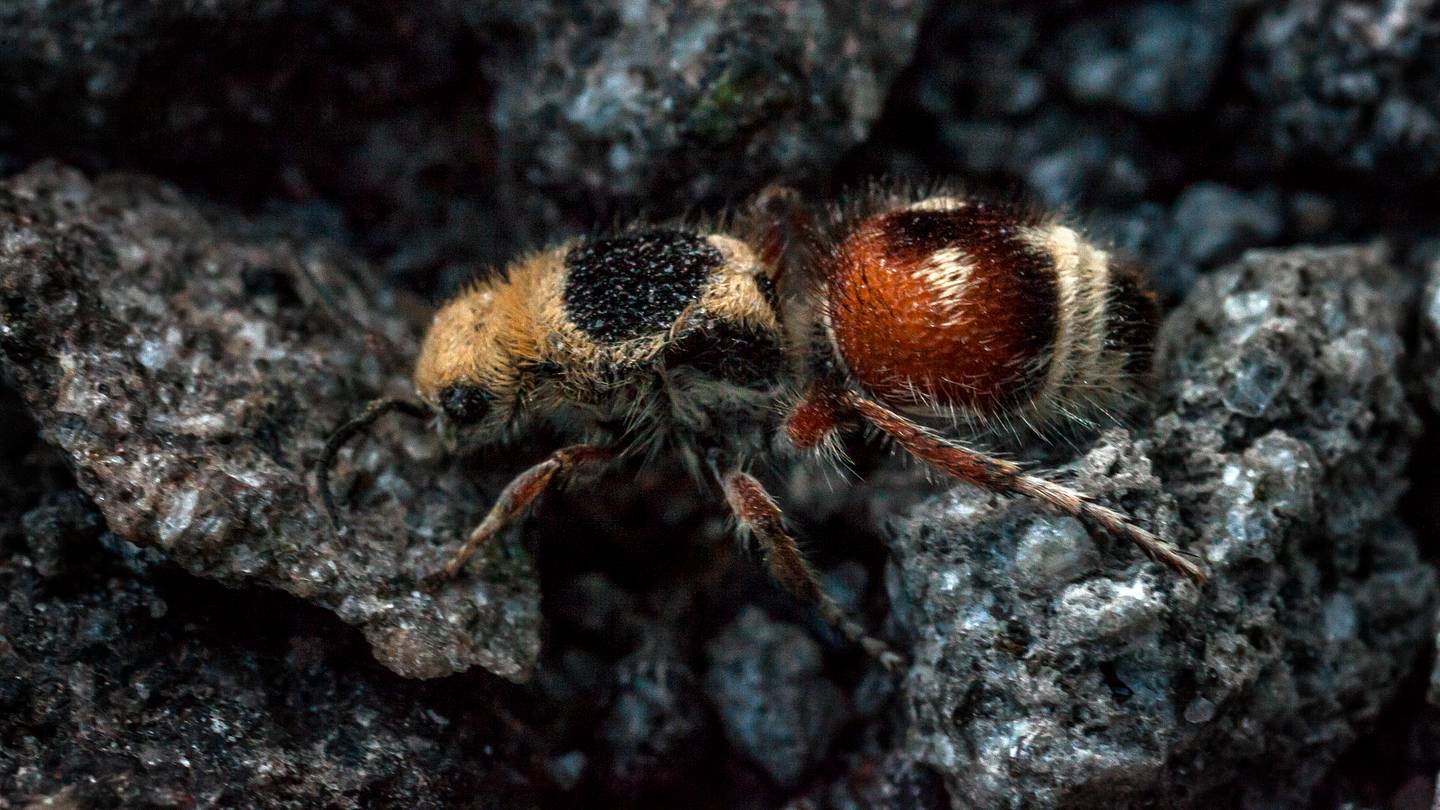
Wasps arenât normally admired for their looks, but one speciesâ Traumatomutilla bifurca , a Brazilian velvet ant âis unlike any other. It has ultra-dark markings that reflect less than 1 percent of visible light. Â
There are about 8000 velvet ant species in the wasp family Mutillidae, named after their resemblance to large hairy ants. Smithsonian reports that scientists recently discovered the Brazilian velvet ant bears some of the darkest coloration in the insect world. A study published in the Beilstein Journal of Nanotechnology suggests that the black parts of the females are âultra-black,â absorbing nearly all visible light.
Ultra-black isnât just a matter of having a lot of melanin. Upon closer examination of the waspâs exoskeleton, scientists found thin, stacked platelets that arenât present in other animals with super dark coloring. They believe the structure of the insectâs hair and platelets are the main causes of its matte black appearance. As The New York Times puts it, âBecause the insectâs exoskeleton has so many different features, light has a higher chance of being absorbed than it would on a smoother black surface.â
The velvet ant is the first known ultra-black species of the order Hymenoptera, which includes over 150,000 species of ants, wasps, sawflies, and bees. Itâs a rare coloring in the wild, with just a handful of species wielding it for different reasons. Some deep sea fish are ultra-black to blend in with the darkness of the sea. In contrast, the bird of paradise and peacock spider developed the feature to make their other colors stand out more to potential mates. The reasons behind the female velvet antsâ ultra-black coloring have yet to be uncovered. Researchers found little evidence of its effect on the insectâs mating habits, and they believe it may serve as a warning to predators.Â
Read More About Insects:Â