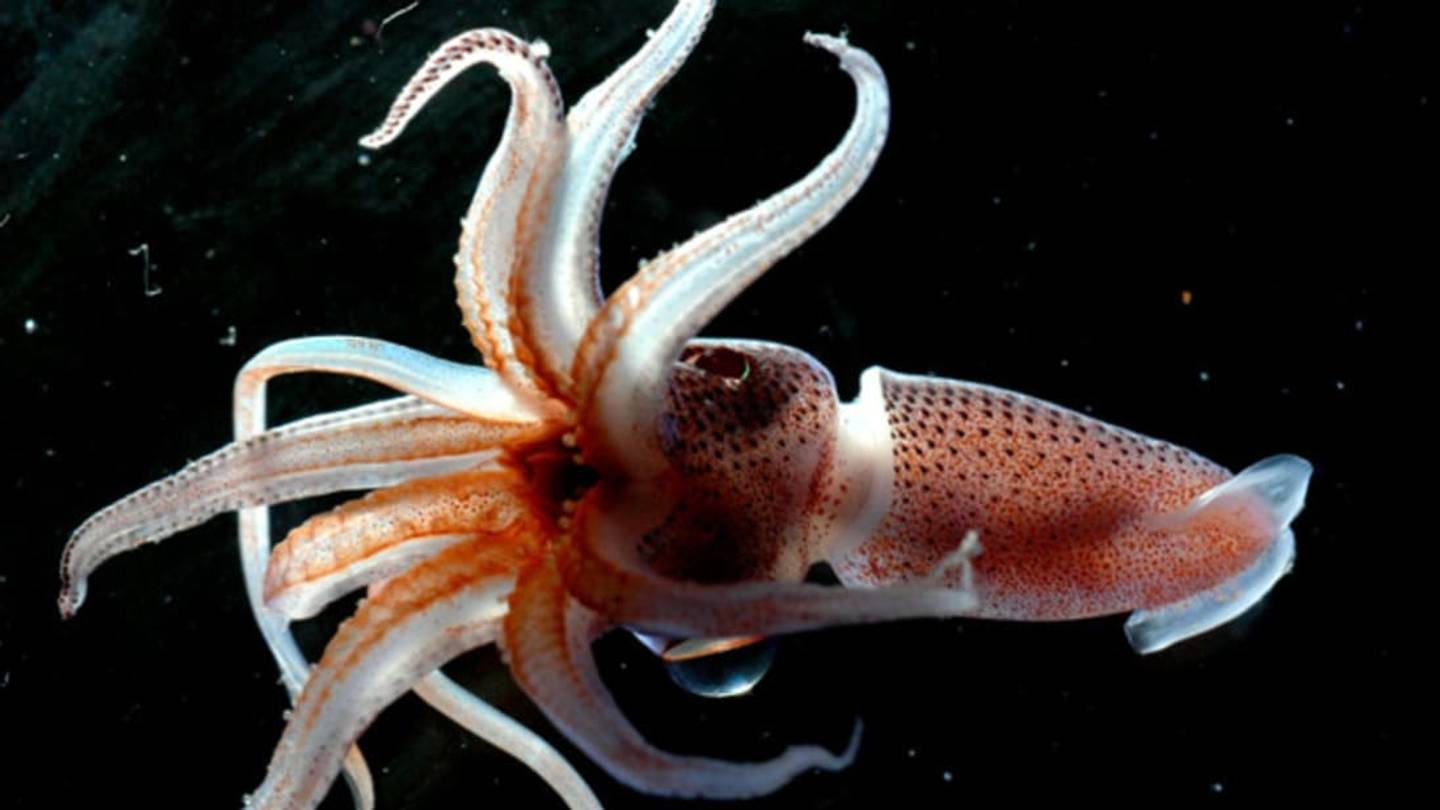
Sometimes, evolution has a field day. Invertebrates donât come much wilder than squids, yet most people have only ever heard of the âgiantâ variety. So strap on a scuba tank, and letâs take a look at eleven equally-amazing cephalopods you might not know about.
Most animals are symmetrical. But the eyes of these deep-sea invertebrates are almost comically disproportionate : the left is usually over twice as big as the right and bulges out of the squid's head.Â
Several unwary fishermen and divers have been attacked over the years off the shores of southwestern North America by 6-foot, multi-armed predators nicknamed âred devils.â In recent decades, theyâve starred in an onslaught of sensationalist basic cable documentaries with titles like Man-Eating Super Squid . Despite this publicity, itâs inaccurate to merely write off Dosidicus gigas as a âkilling machineâ and the creatures are now hugely important to marine conservation efforts.
Tentacled and nearly transparent , itâs incredible to think that life on our own planet can look so alien. Stranger still are the organs known as photophores which emit tiny patches of light on some species as they navigate the inky depths.
If you thought the last entry looked like something out of a Steven Spielberg flick, check out the eerie footage above, captured by the crew of an oil drill back in 2007. It was filmed a mile and a half below the surface and features a member of the rarely-seen Magnapinna genus noted for having bent âelbowsâ on each arm.
No itâs not the giant squid (Architeuthis sp.). Itâs even bigger⦠at least mass-wise. Although some internet sources have grossly overestimated the colossal squidâs length , adult specimens can weigh in at half a ton and boast the largest eyes in the animal kingdom . And oh yeah, their tentacles come with swiveling hooks for good measure.
This one scores points in the âsneakinessâ category. A fairly large squid, the Bush-Club is named for a pair of long, skinny tentacles with fish-shaped bulbs on each tip. These are held far away from the body and seem to move on their own, doubtlessly attracting hapless prey in the process.Â
Cephalopods and Monacan royalty might sound like an odd pairing. But Prince Albert I was an amateur teuthologist (squid scientist) whose hobbies included sifting through the âprecious regurgitationsâ of sperm whales for specimens. The distinctive âscalesâ which cover much of this speciesâ flesh caught his eye and it was later named for the elite house of Grimaldi to which he belonged.
Thousands of tiny suckers give a pair of slender feeding tentacles a flypaper-like consistency with which a member of this genus may snag its next meal (usually a sand-dwelling crustacean).
True, its common name isnât particularly exciting. But apart from being widely used as calamari, the market squid is turning heads because of its remarkable color-changing ability thatâs inspired engineers to investigate technological adaptations. However, Doryteuthis opalescens is just one of several cephalopods that can blend into its environment so effectively.
Itâs a bird! Itâs a plane! Itâs a⦠squid? The Japanese flying squid launches itself into the air and can glide over a distance of 65 feet thanks to an incredible water-based jet propulsion system .
In lieu of vertebrate sex organs, cephalopod mating usually involves males latching sperm packets onto the sides of their partners, to be fertilized later. But because their vision is impaired by living so far below the reach of sunlight, Octopoteuthis canât always discern which gender is which . As one researcher put it, males therefore âroutinely and indiscriminately mates with both [sexes]â, hoping at least a few of them will have been females.Â
Loading recommendations... Please wait while we load personalized content recommendations