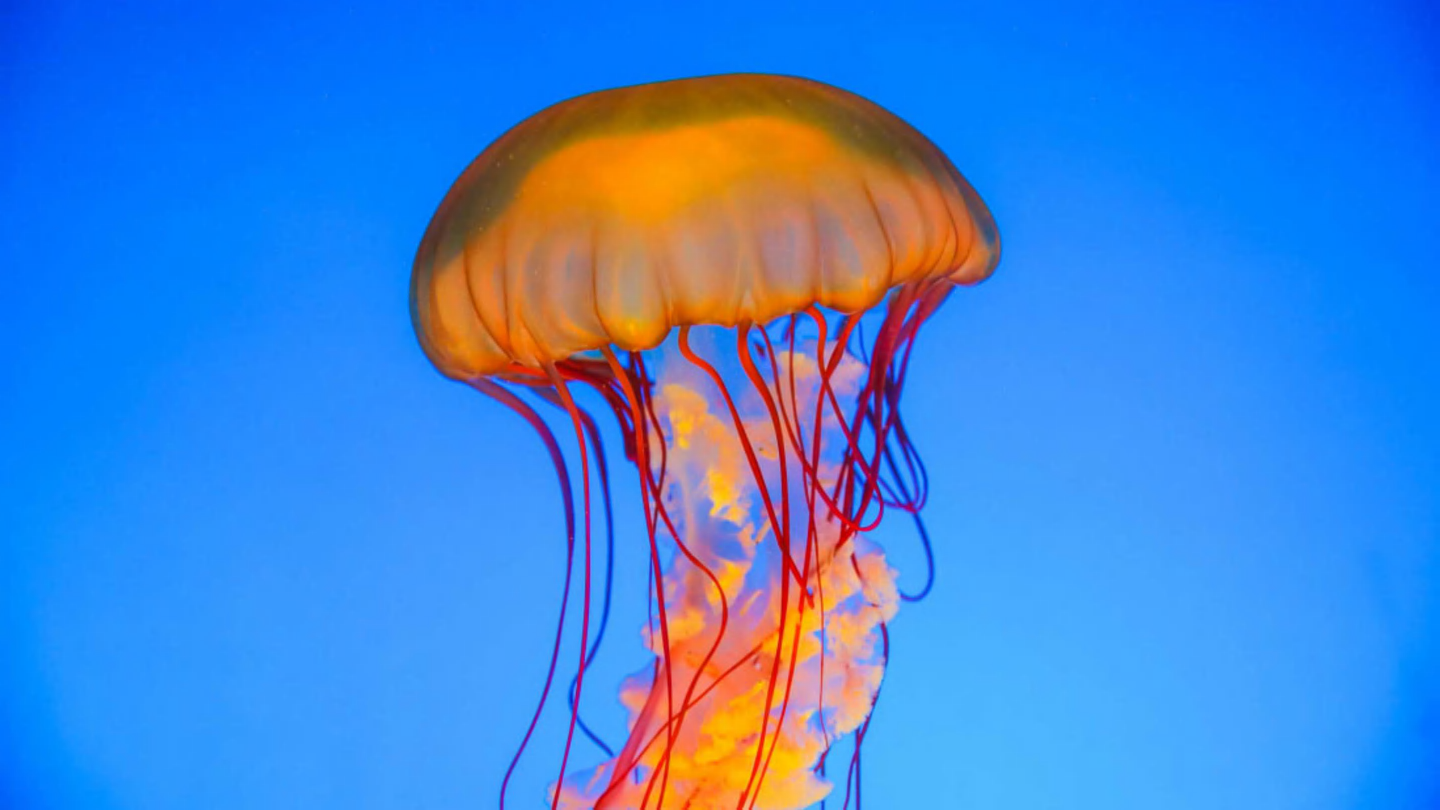
Colorful, dangerous, and mesmerizing: There's a lot more going on with jellyfish than meets the eye. Here are 15 electrifying facts about these undersea beauties.
Even when theyâre attached to a carcass, the cells of a jellyfishâs venomous tentacles will sometimes continue to fire: In 2010, about 150 New Hampshire beach-goers were stung by the disembodied tentacles of a dead lionâs mane jelly.
From the outside, jellyfish look like squishy, insubstantial blobs, and this is reflected in their structural makeup. Jellyfish are 95 percent water with the rest of them made of minerals and proteins. Between their two dermis layers is a gelatinous, water-based substance called mesoglea that contains muscle cells, nerve cells, and structural proteins.
Nuclear power plants in Scotland, Sweden, California, Israel, and Japan have all been taken offline by slimy swarms of jellyfish. Power plants use outside water sources to cool down the fuel rods inside their reactor cores. If this water contains jellies, they can clog up the system and force plants to shut down.
At any stage in its development, Turritopsis dohrnii âalso known as the â immortal jellyfish â or the âBenjamin Button jellyfishââis capable of reversing its life cycle until it reverts to a polyp, from which it starts the whole process over again. Some scientists believe that, by aging backward to escape death, this jellyfish has unlocked the key to immortality.
Jellyfish have inhabited Earthâs oceans for over 650 million years , making them more ancient than sharks and dinosaurs.
The Phialella zappai was named in honor of Frank Zappa , the favorite musician of the scientist who discovered it. Zappa was quoted as saying, âThere is nothing I'd like better than having a jellyfish named after me.â
In 1991, NASA made history by sending 2478 jellyfish polyps to space. It was part of an experiment called âThe Effects of Microgravity-Induced Weightlessness on Aurelia Ephyra Differentiation and Statolith Synthesis.â The creatures were kept in flasks and bags that contained artificial seawater, which astronauts then injected with chemicals that encouraged them to reproduce. By the end of the experiment there were approximately 60,000 jellyfish in Earthâs orbit.
Jellies donât have lungs, intestines, or stomachs, but they do use a much simpler system thatâs able to get the job done. Their bodies are composed of two cell layersâthe external epidermis and the internal gastrodermis. The gastrodermis has one opening it uses to consume food, expel waste, and exchange reproductive materials. They are able to absorb oxygen and nutrients through the cell walls of their inner layer and even through their outer layer.
The largest jelly is the lionâs mane jellyfish, which grows up to 6 meters (nearly 20 feet) in diameter and has stinging tentacles up to 50 meters (164 feet) long. The smallest species is the common kingslayer, tinier than a fingernail and one of the most venomous creatures on earth.
A few years ago, scientists from the Mayo Clinic injected unfertilized cat eggs with a green fluorescent protein found in crystal jellies and a gene from rhesus monkeys known to block the virus that causes feline AIDS. The only significance of the jellyfish protein was that it would indicate if the gene had successfully transferred. Sure enough, when the kittens were born, they glowed bright green when placed under a black light.
Sadly, thatâs not often used anymore. The preference these days is to call a large gathering of jellies a " swarm ."
Jellyfish can reproduce sexually by releasing sperm and eggs into the ocean where they form tiny, free-swimming larvae. These larvae then grow into polyps that attach to smooth surfaces and can split into numerous young jellyfish, thus reproducing asexually.
Researchers at Virginia Tech hoping to build self-powered aquatic robots used jellyfish as a model, building a 170-pound aquatic bot they dubbed Cyro to test their idea. The propulsion system of a jellyfish runs on very little energy, which makes it a great model for autonomous, undersea robots of the future.
Sea turtles arenât the only creatures that like to feast on jellies now and then. Blubber jellies, for example, are considered a delicacy in parts of Asia, and students at a Japanese high school once used powdered jellyfish to make salted caramels.
Instead of a brain, jellies use a â nerve net â to process sensory information. Specialized structures like statocysts help jellyfish know if they're facing up or down; rhopalia allow them to sense light, chemicals, and movement in the water. This is the most basic nervous system a multicellular organism can have, and itâs also found in hydras and anemones.
This article was originally published in 2015; it has been updated for 2021.
Loading recommendations... Please wait while we load personalized content recommendations