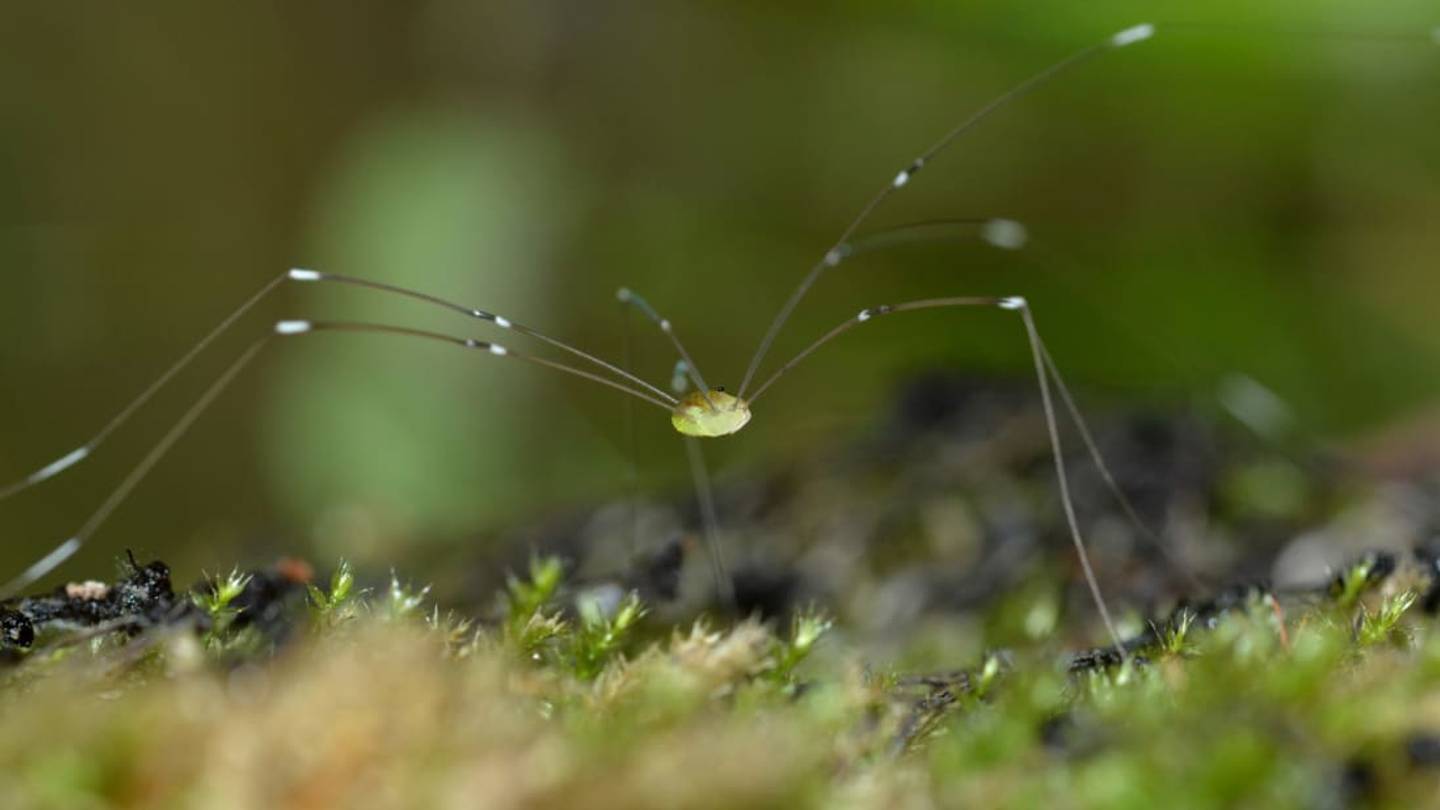
Chances are, youâre familiar with the many things said about daddy longlegs. Maybe youâve heard that that these curious creatures are spiders âor that theyâre so venomous that humans are lucky their fangs are too short , or too weak, to do much damage. Spoiler alert: You shouldn't believe everything you hear. To find out more, Mental Floss spoke with Ron Clouse , who has been studying the DNA and lineages of these often misunderstood arachnids for more than a decade. "I do everything from going into the field and collecting them to analyzing the data and doing the papers and all the lab tests in between,â Clouse told Mental Floss in 2014. Here's what you should know.
Yes, theyâre arachnids, but theyâre actually more closely related to scorpions than they are to spiders. They donât produce silk, have just one pair of eyes, and have a fused body (unlike spiders, which have a narrow âwaistâ between their front and rear).
That thing you heard at summer camp about daddy longlegs being the most poisonous creature in the world, but with fangs too weak to bite you? Not true. They don't even have fangs, and they can't make venom, either. According to Clouse, the rumor might have gotten started during âthe retelling by an American tabloid of a study in Australia on the venom of a daddy longlegs there; the problem is that in Australia, âdaddy longlegsâ refers to a type of spider,â also known as the cellar spider ( Pholcus phalangioides ). And, if that's not confusing enough, there's another creature that sometimes goes by the name daddy longlegs: The crane fly.
âWe know from a very well preserved fossil of a daddy longlegs from Scotland that they are at least 400 million years old,â Clouse said. âThis fossil actually looks a lot like the long-legged species we see today. It is believed daddy longlegs split off from scorpions, which were becoming terrestrial about 435 million years ago. To put this in perspective, this is about 200 million years before dinosaurs appeared, which were only around for about 165 million years.â
In North America, the reason for at least part of their name is pretty obviousâthe species we see most frequently have very long, thin legs. But there are different names for them around the world. âIn other regions, their common names reflect different attributes found in the species common to those areas," Clouse said. "So, the large, short-legged forms in South America are often referred to by their pungent odors. In Europe, terms like âharvestmenâ and âshepherd spidersââand even their scientific name, Opiliones ârefer to them as being associated with good pasture, harvest season, or perhaps even their resemblance to shepherds on stilts or the shape of a scythe.â
These arachnids can be found on every continent but Antarctica. âTheyâre usually found in humid areas, such as under rocks, in leaf litter, and inside caves,â Clouse said. âThey are most diverse in tropical areas, where the moist climate and thick foliage allow them to live in lots of places. Different regions of the world have their own particular daddy longlegs, and some of the most common ones are small and out of sight in the leaf litter on the forest floor. Even here in the U.S. we have some tiny ones in the leaf litter that the average person never sees.â
There might be as many as 10,000 species of daddy longlegs, with 6000 to 7000 currently described. âWeâre describing new ones all the time,â Clouse said. âThey are generally very, very bad at getting around, so they tend to have lots of species, because the minute a river flows between two different populations or a mountain rises and cuts one population off from another population, they split into two new species.â For example, the closest relatives to the arachnids he studied in South Carolina live in West Africa, which were all one species before the continents split and the Atlantic Ocean sprang up between them.
Because of this tendency to split off into new species, daddy longlegs can look very different depending on where they live, and each species will have a very small range: âOne mountain top will have one species, another mountain top will have another species,â Clouse said. In Pennsylvania, they have tiny pod-like bodies and long legs. The type that Clouse studied, called cyphos, are tiny and have short, thick legs. In Laos, a species with a legspan of 13 inches was discovered in 2012, while those in the family Gonyleptidae, which live in South America, have spines and vibrant colors. âThey have so many strange aspects, it's difficult to think of a type that isn't interesting,â Clouse said.
This clumping is pretty typical daddy longleg behavior, Clouse said, and though scientists donât know for sure why they do this, they do have some ideas. âPerhaps they do this when conditions become dry and they need to maintain high humidity,â he said. âPerhaps they are âherdingâ to lower their individual chances of being eaten. Or perhaps they are trying to bolster their chemical defenses.â
You would think that creatures with legs like these arachnids have would move around quite a bit, but thatâs not the case. DNA sequencing populations of long-legged species near the coast of Brazil revealed that âthey do not get around at all. They donât go anywhere,â Clouse said. âTheir day is something like this: Theyâre in a crevice until about 7 oâclock, when they come walking out and they sit on a leaf all night long. And then when the sun starts to come up, theyâll walk back to the crevice. Those long legs are apparently all for male-male competition, or showing off to females, because they donât use them.â
As for why they donât travel much, Clouse said that âitâs some kind of fundamental trait they have about their need for humidity, their own behavior in terms of feeding and mating. Of course, after 40 million years, youâd expect someone to evolve the ability to just get up and get around. But they really donât.â
Birds, frogs, and lizards frequently make meals of daddy longlegs. The arachnids have a few strategies for not becoming lunch, including the aggregation mentioned above. âTheir most obvious feature to avoid predation is to produce chemical excretions from glands on their bodies, which have been observed to repulse predators,â Clouse said. âDaddy longlegs are usually extremely well camouflaged. During the day many of them hide in crevasses, and when disturbed they usually curl up and remain motionless for several minutes.â Yes, they play deadâwhich works extraordinarily well for a couple of reasons. âFirst of all, if youâre living in a leaf litter with dirt and debris and little pieces of deadwood, theyâre exactly the right color brownâthey truly just disappear,â Clouse said. âFor a lot of predators, if something stops moving, they canât see it anymore. It just disappears for them. When these guys stop moving, theyâre gone.â You can see a video that Clouse made of a cyphos playing dead here .
Many species do something called leg threading: âThey slide one leg at a time through the little pincers by their mouths,â Clouse said. âOther species may groom themselves in other ways, but in general this behavior is very important to keep parasites off the body. You can see small red mites on many of them in places that they canât reach.â You can see a daddy longleg leg threading in the video above.
The bigger species, like the kind Clouse studied in Brazil, tend to live for less than two years, but the tiny cyphos can probably live for up to seven years. âYou canât really tell by body size how long theyâre going to live,â Clouse said. âBut unlike a lot of insects, many can survive several seasonal cycles as an adult. The most ephemeral ones are probably the long-legged ones we see in the U.S., which, after a few months as a juvenile, often live only a few more months as an adult.â
If you were one of those kids who plucked off one of these creatures' legs, prepare to feel a little guilty: Those things do not grow back. âWe see injured onesâtheyâll have an article cut off on the end. They probably got bitten by something,â Clouse said. âBut in general, when something with an exoskeleton gets injured, they canât do very much until the next molt happens.â And daddy longlegs, once theyâre fully grown, donât molt anymore. âI presume that if an immature daddy longlegs, what we call a nymph, lost a leg or had an injury, it could very well get repaired,â Clouse said. âWhen it molts again, it would be deformed, but there would be at least another leg starting or developing there. Youâll often see the big, long legged ones with six legs or seven legs. They canât regenerate like a starfish.â Thatâs bad news for species that voluntarily shed legs to get away from predators or in species where males fight and attempt to break off their opponents' hind legs with their large spines.
âIn the field, where these big ones are, the frustration of my colleagues is that they always seem to come upon them already eating something!â Clouse said. âItâs hard to tell if they caught it or if they just ran across it. Hereâs the bottom line: They donât have fangs, they donât have big strong pincers. Some of the little ones do seem to have muscular pincers, which allows them to grab and crush some little tiny, tiny bugs in the leaf litter. But except for a few families of them, most of them just donât seem to be equipped to do much hunting. So we assume they just nibble on pieces of carcass, leftovers, and detritus. Not a very exciting diet.â
Certain speciesâlike the cyphos that Clouse studiedâare so small and hard to spot that no one really knows about their mating rituals or how many eggs they lay. âAll we do know about those little seed-like ones is that, in many cases, the males have special glands that the females donât have,â he said. âIt seems like they make some kind of chemical that they spread around to attract females.â
Here's what we do know about how cyphos does it: âThe male creates a packet of sperm and he extrudes and he gives this spherical package to the female,â Clouse said. What happens next, though, isnât clear. âShe probably opens the package up and takes the sperm inside; itâs kept alive [until] the sperm goes into her reproductive tract somewhere, where it meets the eggs and fertilizes.â Then, the female uses a telescoped ovipositor longer than her body to lay the eggs deep in the dirt.
The mating rituals of bigger species are much easier to observe, and Clouse has gotten an eyeful. âIâve seen some big ones in Brazil mating and itâs pretty elaborate,â he said. "Thereâs a lot of him going up to her and touching her and her kind of making a lot of decisions about whatâs going on here." Most daddy longlegs species "mate with the male depositing sperm inside the female," Clouse said. "What she does with it and how all their parts interact is still not entirely clear." Once, Clouse and his fellow scientists observed a big female in Brazil that had just laid 30 slime-encased eggs on a leaf. "She produces a concentrated substance, which, when it hits the moist air, expands and makes this really nice jelly," he said. "It probably keeps fungus and stuff off."
âIn [some] species, males have much longer legs than females,â Clouse said, âand in others males have glands or protuberances not found in females. What these are used for is not known.â But some species have two types of males, Clouse said, âones which are very distinct from females, and others which are very similar to females. Presumably the latter ones can sneak close to females and obtain matings without engaging in brutal competition with other males.â
Itâs not as weird as it sounds; Clouse said it happens in a number of animals where thereâs a lot of competition between males that is driven by female choice. In fish, for example, these males will âhave the coloration of a female, the size of a female, but theyâre not female,â Clouse said. âThey sneak by all the other males. They get right by them all, right next to the females and next thing you know, sheâs releasing eggs, heâs releasing sperm and the deed is done.â
In daddy longlegs, regular males are called alpha males, while the males that look like females are called beta males. In all systems with alpha and beta males, there are never that many beta males in the population at any one time. âYou can never have more than a certain proportion of these sneaky males,â Clouse said. âIf they get to be too frequent, then theyâre bumping into each other and the alpha males have an advantage. Females still like big strong males, and so these sneaky males tend to remain a certain percentage of the population over stretches of time. And if a female has the gene to produce lots of sneaky males, she has an advantage when there arenât a lot of sneaky males. And if more are around, the trait to make sneaky males becomes less frequent in the population. It fluctuates back and forth around a certain percentage.â
Regardless of whether a male is an alpha or a beta, it will still have the same objective. âThey seem to have all the urges,â Clouse said. âThey want to mate with females, they just donât look male.â
Described in 2016, the Halitherses grimaldii specimen, which was trapped in tree sap 99 million years ago , had an erection. Discover described its penis as being nearly half as long as the creature's body and having âa distinctively heart-shaped head and a twisted tip, meant for delivering sperm to females via a hole near their mouth,â noting that it was âthe first [harvestman] to be discovered in such a, well, unique position.â Because the penis is usually held within the harvestman's body, scientists speculated that the creature had either recently mated or that âthe harvestman may have gotten his erection while locked in a struggle with the sticky resin, raising his hemolymph, or blood, pressure enough that his penis hardened.â
A version of this story ran in 2014; it has been updated for 2022.
Loading recommendations... Please wait while we load personalized content recommendations