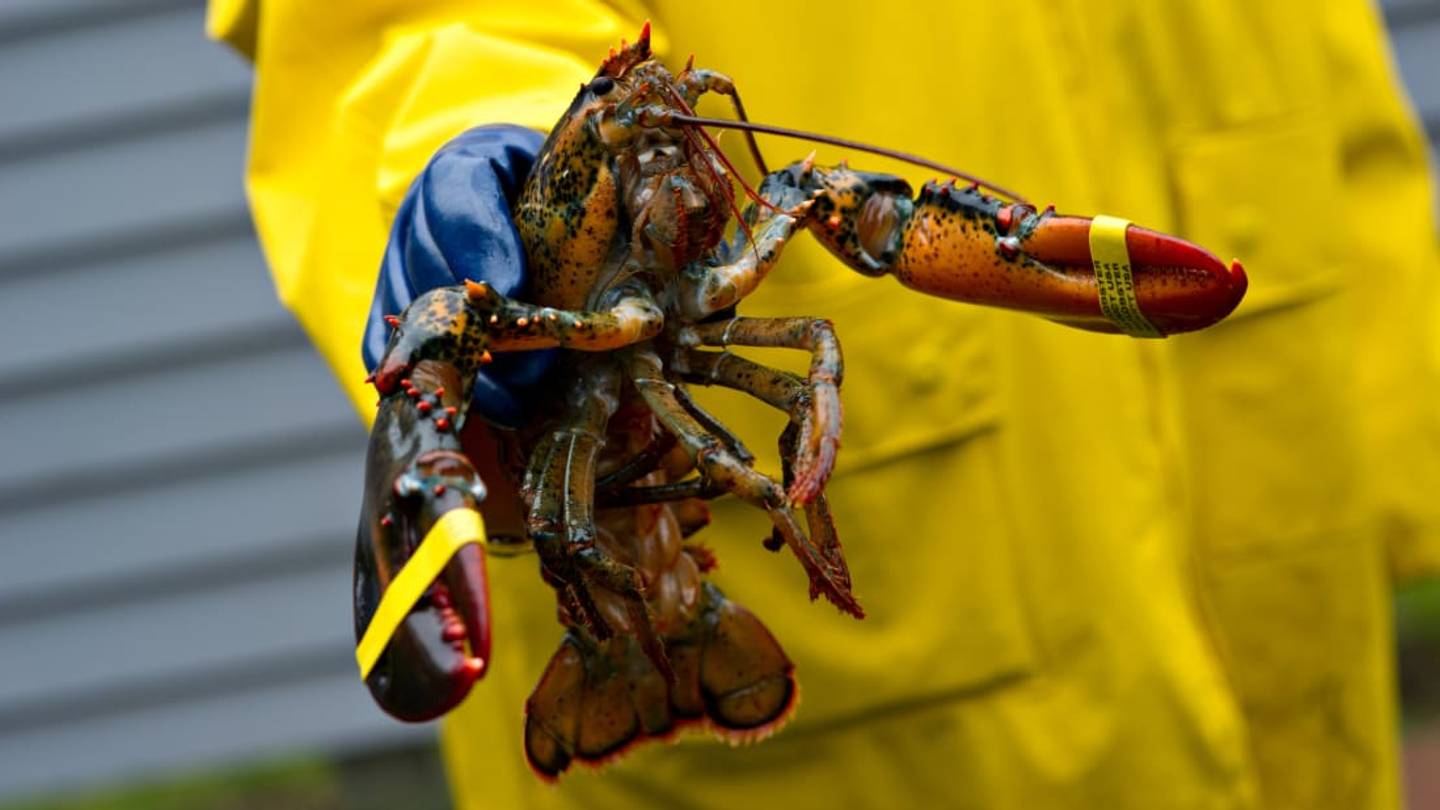
We cracked open America's favorite crustacean, Homarus americanus , to plate the delicious facts hiding inside. Bob Bayer , Professor Emeritus of Animal and Veterinary Sciences at the University of Maine, former head of the universityâs Lobster Institute and research director for Lobster Unlimited, LLC, helps us out.
If you cut a lobster, does it not bleed? Yes, of courseâbut it doesn't look like you'd expect. Lobster blood is colorless until exposed to oxygen, at which point it turns blue.
Typically, lobsters are a mottled brown, but genetic mutations can create red, blue , calico , and even albino lobsters . Heat denatures the proteins in the lobstersâ shells, releasing astaxanthin, which turns their shells bright red when theyâre cooked.
Young lobsters molt several times a year, but after they hit one pound, they start molting annually. After finding a soft place to hide, âthey shed every part of the hard material, including the lining of the intestine,â Bayer says. âWhen the lobster comes out of its old shell, itâs all wrinkly. Its new shell is softer than your skin. If you take that lobster out of water, the claws will fall off; it doesnât have the mechanical strength to keep the claws on.â Then they eat their old shells for the calcium and phosphorus.
Theyâre called shedders.
The warmer the water, the faster lobsters grow.
The largest of lobstersâ three antennae is used for tactile sensing. "If a lobsterâs going to go into a hole, for example, itâll wave those large antennae around, sort of feel the hole, and then determine if it can fit, and then itâll back in and hide," Bayer says. The two smaller pairs are chemosensory, helping the lobster find its food by sensing dissolved substances in the water, "a combination of our sense of taste and smell in one function,â according to Bayer.
The bigger claw is called the crusher claw, and lobsters use it to break up clams, crabs, and sea urchins. The cutter claw is used for tearing. âSome good-sized lobsters can raise a pressure closing strength of 100 pounds per square inch,â Bayer says. âMost of them are less than that, but itâs still a good amount of pressure.â If a lobster loses one of its claws or walking legs, the limb will regenerate. âIf youâve got a wound around the time that lobster is molting, you sort of get mixed biochemical signals, so you might end up with a duplicate of something,â Bayer says. âYou might get, say, two thumbs sticking out of the same claw.â
Lobsters walk forward, but if they need to quickly get away, they propel themselves backward by pumping their tails. Females have broader tails than males so they can hold eggs there.
These crustaceans canât see clear images, but their compound eyes are sensitive to light. Severing the eyestalkâwhich also serves as the lobster's hormonal centerâwill cause it to molt. And eyes don't grow back.
âIt almost looks like a squirrel eating,â Bayer says. The food goes into the stomach, where the gastric millâmade up of three teeth-like structuresâgrinds it up. Next, the food travels through the tomalleyâa.k.a. the green thing you scrape off your meat. Itâs the lobsterâs main digestive tract: a small intestine, pancreas, and liver in oneâand itâs a delicacy!
In fact, they feed on a large variety of live things, including other lobsters, marine worms, clams, mussels, and crabs in addition to bait (which is most often salted herring).
âIt averages about a pound of herring per pound of lobster thatâs caught,â Bayer says. âItâs expensive. It may be more than we need. We actually had a student who looked at this, and she found that you could use less and catch the same amount of lobster. But old habits die hard.â
These fin-like structures help lobsters circulate water inside their shelters; females also use them to carry eggs.
The urine comes from antennal glands located near the antennae. âThey're greenish brown spots,â Bayer says. âThey actually look like two pieces of snotâthatâs the best way to describe them. You'd have to open them up to see them.â Peeing at each other is part of both fighting and courtship.
To woo a dominant maleâwho will have previously spent his time beating up her and all of the other lobsters in his neighborhoodâthe female heads to his shelter a number of times and pees pheromone-laced urine into it, which helps him relax. Because lobsters are cannibals, the pheromone is telling him two things: âItâs time to breedâ and âDonât eat me!â
Eventually, when he is sufficiently wooed, she'll move into his shelter and molt, at which point he uses the first pair of swimmeretsâwhich, in males, are hard and bone-like and called gonopodsâto transfer sperm to her. She'll stay in his shelter for another 10 days or so while her new shell hardens. Then she's back to her own life, and it's time for a new female to woo the male.
After mating, a female lobster will store the semen in a receptacle between her walking legs for six to nine months before she extrudes eggs, which then sit on her tail for another six to nine months. âWhen theyâre immature, theyâre very dark,â Bayer says. âAs theyâre getting ready to hatch, these larvae, you can see the eyes.â
The eggs are kept in place by glue created in her cement glands. âThe bigger they are, the more eggs they have,â Bayer says. âYou might have 30,000 or 40,000 on a really big lobster.â If youâre eating lobster and find bright red stuff, thatâs unextruded eggsâalso known as roe.
This tells other fishermen that she's a breeding female whether she has eggs or not, and should be thrown back. âTheyâre protected as long as that notch is present,â Bayer says. âYou're protecting your breeding population. If you think about it, itâs sensible, because youâre going to have your classes that donât settle well, that donât have good survival, but youâve got this huge root stock thatâs out there, so that the next year it can come back.â
âWhen lobsters first hatch, they floatâthey float for the first couple of weeks,â Bayer says. Some scientists call those floaters superlobsters, because they can swim forward in the water with their claws outstretched by beating the swimmerets under their tails. After this phase, they settle on the bottom. âThose that settle to the bottom, many of them will survive,â Bayer says, âand itâs a good measure of what the upcoming stock is.â
Despite what Phoebe from Friends believed, lobsters aren't monogamous . âSometimes they'll have multiple parentage,â Bayer says.
Scientists only recently discovered an accurate way to determine a lobsterâs age: Dissecting it and counting the rings in the eyestalk and gastric millâsimilar to the way we calculate a tree's age.
The largest lobster ever recorded was caught near Nova Scotia in 1977 and weighed 44 pounds!
Researchers at Woods Hole Oceanographic Institution set up an experiment where two crustaceans fought each other in a ring. Later, when they tried to have those same two lobsters fight again, the one that lost the first time recognized the winner and backed down immediately. âIt wasn't just that the loser lobster had become a sissy or something,â Trevor Corson, author of The Secret Life of Lobsters , told National Geographic . âWhen matched with a new lobster, he fought ferociously. So he was recognizing that previous lobster. They blindfolded him, and it didn't make a difference. So we get back to this pissing-in-each-other's-faces thing. [The scientists] catheterized a lobster with little tubes attached to its face and collected urine during combat. It turned out that without the urine in the water, the lobsters couldn't recognize each other.â The losing lobster would recognize the winner for up to a week.
Can lobsters and other crustaceans feel pain? Scientists have gone back and forth on it, and no one seems to know for sure . A 2013 study suggested that they probably do, while another study, published in 2005, said they don't .
âThere can be no absolute answer,â Bayer says, though he's in the âno painâ camp. âThey sense their environment, but donât have the intellectual hardware to process pain. [If you look at] the nervous system of a lobster next to a grasshopper, and whatâs notable is that the nervous system is so primitive that there isnât really much to it. We argue that there is no brain and no ability to process pain. They do respond to their environment, and they sense that itâs not right for them. If they sense warmth or even chemicals in their environment, theyâll try to avoid them, those things that are noxious.â Some suggest that the most humane way to cook a lobster is to start by putting it in fresh cold water or the freezerâboth of which essentially put it to sleepâbefore dropping it in the pot. (The "scream," by the way, isn't a scream at all, but steam escaping from their shells .)
Though there isnât a clear answer here, some stores have quit keeping live lobsters in stores , and Switzerland made it illegal to boil live lobsters in 2018.
According to Bayer, âAnything that kills insects can kill a lobster,â and lobsters are extremely sensitive to insecticides, even at parts-per-billion concentration: âTheyâre so sensitive that, if youâve got a room with a lobster tank, and you take an insecticide and you give it a five-second spray at the end of the room, it's likely that all those lobsters would be dead by the end of the day,â he says. So we might want to think about what we're dumping into our oceans.
A version of this story ran in 2014; it has been updated for 2021.
Loading recommendations... Please wait while we load personalized content recommendations