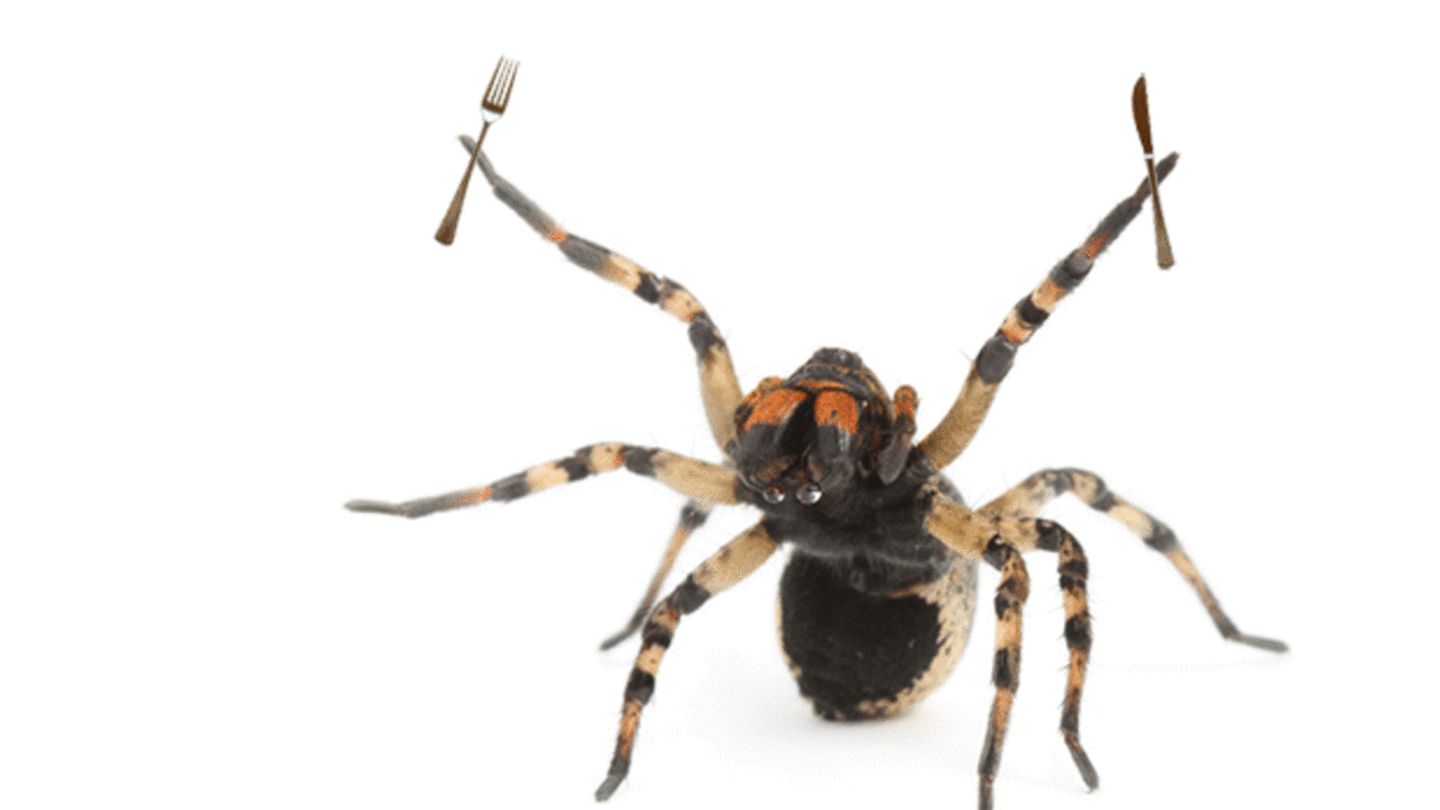
If you thought spiders only eat insects, think again. In recent years, scientists have discovered that small animals and other surprising food items are an important part of many spidersâ diets.
Semiaquatic spiders such as Dolomedes facetus (above) occasionally kill and devour small fish, according to a new study in PLoS One . The studyâs authors list more than 80 known cases, spread across every continent except Antarctica, where spiders have ambushed fish from the edges of ponds, lakes, rivers and swamps. The arachnids use their neurotoxic venom to subdue the fish, then drag them to a dry place to eat them. The chum are smallâtypically between one and 2.5 inches longâbut on average theyâre 2.2 times larger than the spider.
One interesting species, Argyroneta aquatica , constructs a dome-shaped web amongst water plants, and fills it with air from the surface. After the spider slays its aquatic prey, it brings the meal back to the dome to eat it.
Scientists have reported more than 52 cases of spiders eating small or juvenile bats with a wingspan of up to nine inches. In the majority of those cases, the bats accidentally get tangled up in websâusually those of tropical and subtropical orb-weaving spiders, whose webs can be six feet in diameter or larger. But some species of tarantula have been known to stalk and attack bats on rare occasions.
Thereâs no indication that spiders are adapted to eat birds. In fact, a collision with a bird can cause significant damage to a spiderâs web. But when life hands you lemons ⦠wrap them in silk, liquefy their innards, and feast.
A 2012 paper catalogued 69 cases of birds getting trapped in spider webs, including 18 that had been mummified in silk for consumption by the spiders. (Many of these birds were rescued through human intervention.) The largest species recorded was a three-ounce Laughing Dove. Most of the other victims were hummingbirds. Here again, the culprits were almost always orb weaver spiders.
Thatâs rightâspiders can eat snakes. And if you donât believe us, check out this horrifying video , or these images . In 1926, Canadian entomologist James Henry Emerton wrote a graphic description of how the tarantula Grammostola actaeon kills its slithering prey:
Of the worldâs 35,000 or so spider species, only one is known to be herbivorous. The (mostly) vegetarian Bagheera kiplingi dines on leaf tips  of the acacia shrub in Mexico and Central America. It uses its hunting kills to avoid the ants that colonize acacia ⦠and occasionally dines on their larvae to supplement its diet.
Loading recommendations... Please wait while we load personalized content recommendations