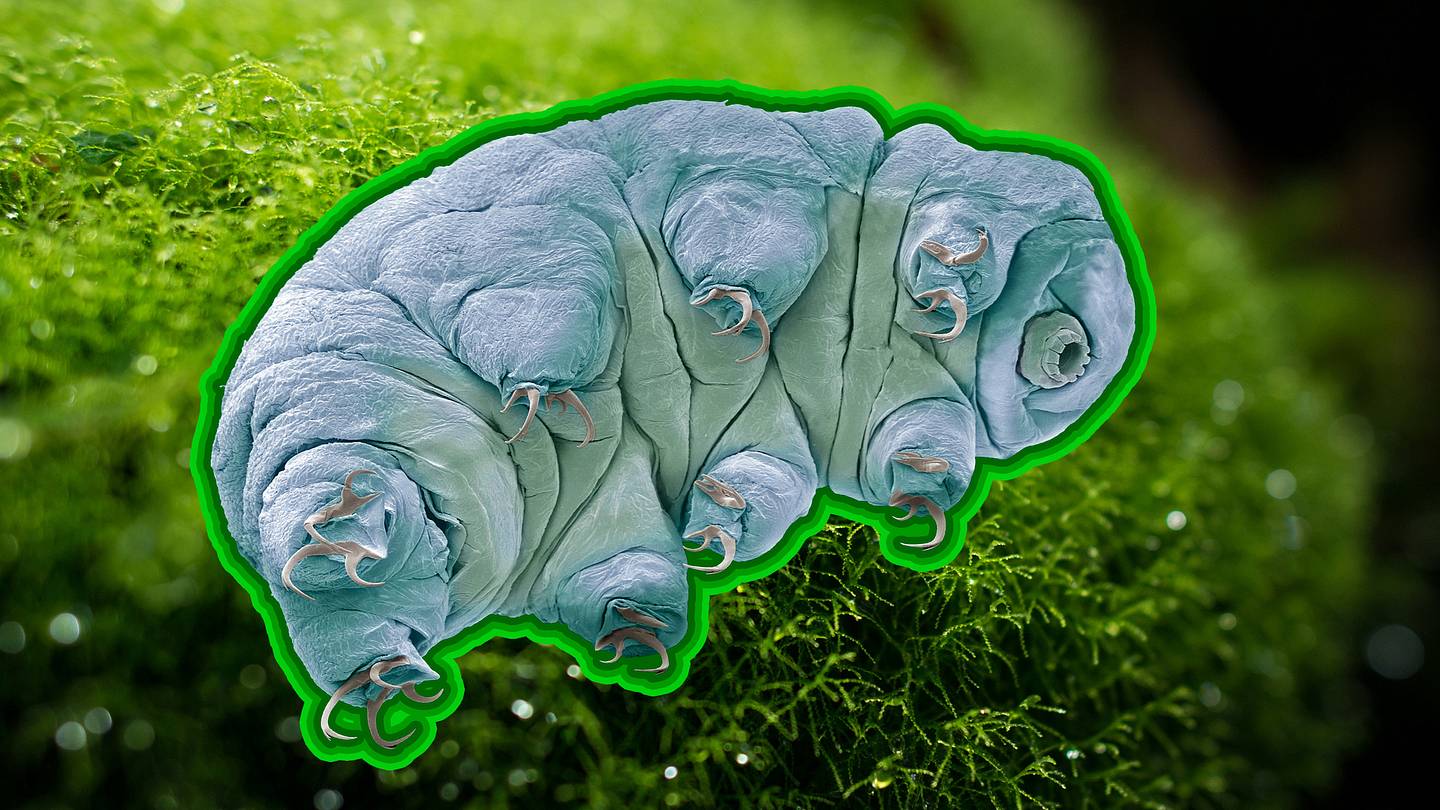
Tardigrades are tough, tubby, and tiny. There are more than 1000 species, and all of them are itty-bittyâabout the size of a grain of sand . Hereâs what you need to know about these nearly indestructible microanimals.
Tardigrades are also known as âwater bearsâ and âmoss pigletsâ for the endearing way they trundle across their chosen habitats. Even the word tardigrade means âslow-moving.âÂ
Actually, old doesnât really begin to cover it. Scientists estimate that tardigrades have been around for 600 million years . To put that in perspective: Dinosaurs first appeared about 230 million years ago, which makes T. rex and friends the new kids on the block.Â
And we do mean anywhere. True to their nicknames, most tardigrades prefer living in the water or on damp places on land in the worldâs temperate zones. Dirt, leaf litter, and patches of moss are favorite hangouts. But those are just the tardigradeâs preferred habitat; these tiny animals could easily live in the fires of Mount Doom if they had to. They may be little, but theyâre darn near unkillable.
What makes tardigrades so tough? One word: cryptobiosis . Translated literally, cryptobiosis means âhidden life,â and thatâs exactly what it is: a form of suspended animation in which organisms can go on living even as they look dead. Cryptobiosis is the secret to Sea Monkeys ; itâs also the reason tardigrades can survive pretty much anything. So when times get tough, tardigrades play dead. They hunch up into little dried husks and more or less shut down, which drops their metabolisms to 0.01 percent of their usual rate. In this deathlike state, the tardigrade becomes nearly untouchable.Â
Tardigrades can withstand temperatures that would easily fry or freeze a human being. Scientists have exposed them to heat over 300°F and cold below 1° Kelvin, or -458°Fâa temperature at which most substances freak out. Liquids turn to solids and gases turn to liquids, but the hardy tardigrade just keeps on truckinâ .
Without the aid of a pressurized suit, humans can survive just a few minutes in the vacuum of space . Tardigrades can make it for 10 Â days. But the hazards of space go beyond mere skull-crushing pressure; thereâs also UV radiation. Humans can withstand about 500 roentgens, or units, of ionizing radiation, but it takes more than 100 times that much to kill a tardigrade.Â
You may be thinking that the only thing that could kill a tardigrade would be a nuclear explosionâbut even that might not be enough. In 2016, Japanese researchers discovered that a tardigrade protein called Dsup seemed to protect their DNA from damage caused by nuclear radiation: when the scientists inserted the protein into human cells and pelted them with radiation, they were less impaired than normal human cells. Two studies published in 2024 suggest why: tardigrades can repair any damaged DNA extremely quickly, perhaps with the aid of Dsup. But there is still a lot we don't know about these marvelous microorganisms.
A version of this story was published in 2015; it has been updated for 2024.