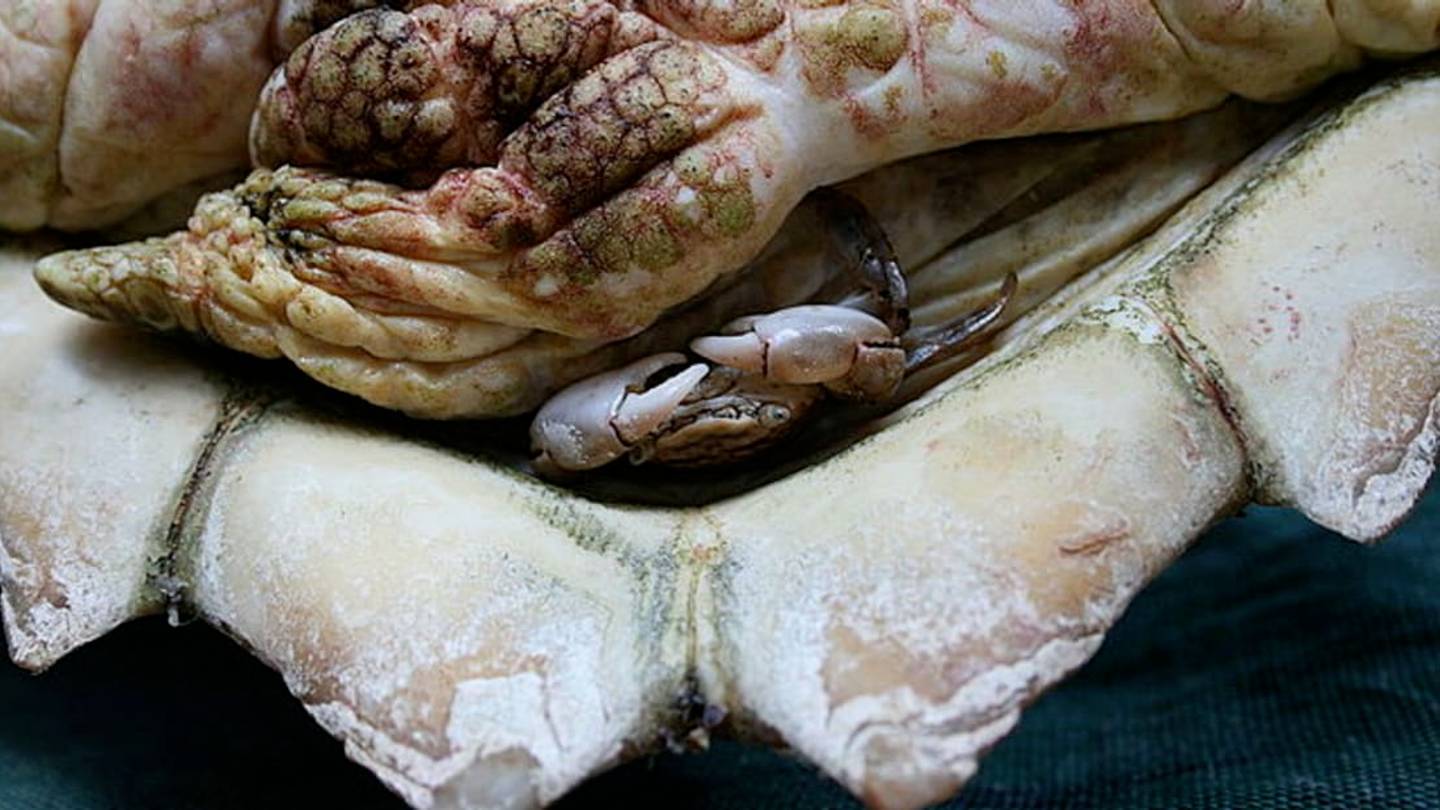
Columbus crabs ( Planes minutus ) are tiny and canât swim very far, but they manage to get aroundâin more ways than one. They make their homes on anything that floatsâlogs, ship hulls, plastic junk, and even sea turtlesâand ride the waves around. On many of these mobile âislands,â the crabs are plentiful and have an âinclusiveâ mating system, say biologists Joseph Pfaller and Michael Gil . Sometimes, the crabs like to play the field, readily switching among multiple mating partners. At other times, though, they have more monogamous love lives, sharing their territory with just one other crab, with whom they form a mating pair. The difference? The size of the place where they shack up, say the researchers. They recently published their findings  on the crabs' love life in Biology Letters .
Pfaller and Gil were curious about what made the crabs switch between these two mating styles. What was it about a particular turtle or piece of debris that pushed them toward swinging, or into settling down? For many crustaceans that live on or in other animals, itâs the size of the host that dictates how many critters call it home and how they mate. The biologists wondered if the same was true for Columbus crabs, who thrive in both living and non-living âhosts.â
To find out, they took a boat out into the North Pacific Subtropical Gyreâsite of the Great Pacific Garbage Patch âand collected dozens of pieces of plastic debris, from soda bottles to boat bumpers. Back in the lab, they measured the size of the debris and recorded the number of crabs, and each crabâs life stage (adult or juvenile) and sex. To get data on sea turtles, they dove into scientific journals instead of the ocean, reading through 270 records of sea turtleâColumbus crab associations, and recording the same information they did with the debris.
Pfaller and Gil found that even though Columbus crabs can travel far and wide on a hunk of plastic or a sea turtle, they still seek out the cozy confines of a burrow-like refuge on their floating homes. On pieces of debris, they usually take up residence in stalks of barnacles. On sea turtles, the crabs tuck themselves into the supracaudal spaceâthe small area between a turtleâs tail and shell. The researchers say that itâs the size of these refuges, and not the overall size of the host, that matters most when it comes to the size and demographics of a crab communityâand thus how they mate.
Bigger refuges, of course, support more crabs. A bigger space with more neighbors makes it harder for any one crab to defend a chunk of real estate or a mate, so they opt for a more open and free mating system. A smaller refuge, on the other hand, can only hold so many crabs and is easier to monopolize, leading the crabs to form monogamous pairs and fend off rivals. This was almost always the case for crabs living on sea turtles, where Pfaller and Gil found lone maleâfemale pairs far more frequently than expected by chance. Because a typical turtleâs supracaudal space is the perfect size for two crabs, the researchers say, âsea turtle symbiosis specifically promotes social monogamy.â Who would have thought that living on a turtleâs tush could provide the key to a happy, stable relationship?
Loading recommendations... Please wait while we load personalized content recommendations