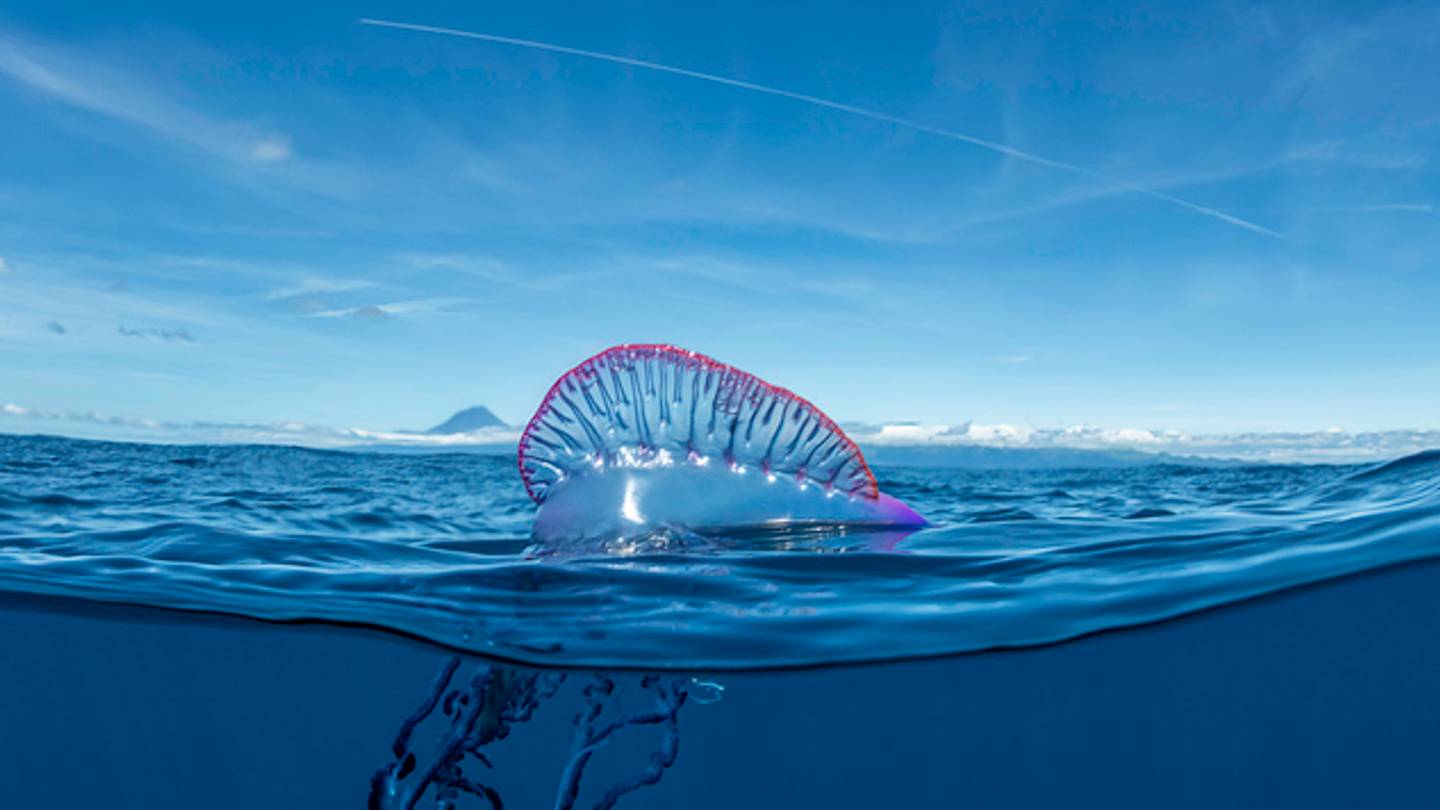
The dangerous Portuguese man oâ war, which has a potentially deadly sting, is often sighted on U.S. beachesâwhich leads to problems for beachgoers. Read on to learn more about these unusual creatures.
The Portuguese man oâ war may look like a bloated jellyfish, but itâs actually a siphonophore âa bizarre group of animals that consist of colonies made up of dozens, hundreds, or even thousands of genetically identical individual creatures. A siphonophore starts out as a fertilized egg. But as it develops, it starts âbuddingâ into distinct structures and organisms. These tiny organisms, called polyps or zooids, canât survive on their own, so they merge together into a tentacled mass. They must cooperate as one in order to do things like travel and catch food.
Though the zooids within a man oâ war are basically clones, they come in different shapes and serve different purposes [ PDF ]. Dactylozooids are long hunting tentacles built to ensnare prey; gastrozooids are smaller tentacles which digest the food; and gonozooids are dangling entities whose job is to facilitate reproduction. Every man oâ war also has a pneumatophore, or âfloatââan overgrown, bag-like polyp which acts as a giant gas bladder and sits at the top of the colony. Capable of expanding or contracting at will, it provides the man oâ war with some buoyancy control. An expanded float also enables the colony to harness winds to move around.
When we say Portuguese man oâ war, weâre talking about Physalia physalis , the siphonophore also known as the Atlantic Portuguese man oâ war, which can be found in warmer parts of Pacific, Caribbean, Indian, and Atlantic waters.
Another kind of siphonophore that regularly stings beachgoers is the bluebottle, Physalia utriculus . Itâs sometimes called the Indo-Pacific Portuguese man oâ war and is restricted to the Pacific and Indian oceans . Itâs smaller than the Atlantic species and, unlike its bigger counterpart, it hunts with a single, elongated tentacle.
In the Age of Sail, many European navies used tall warships loaded with cannons and propelled by the wind. British sailors took to calling this kind of vessel a âman of war.â
Physalia physalias colonies spend a lot of time floating at the waterâs surface, and when the gas bladder is expanded, it looks and acts a bit like a sailboat, hence the man oâ war moniker. As for the Portuguese part, 19th-century scientists proposed that sailors encountered it near the Portuguese island of Madeira, while modern etymologists tend to think that it looked like the Portuguese version of the ship. Itâs also been suggested that Renaissance-era sailors thought the pneumatophores resembled the helmets worn by Portugalâs soldiers during the 16th century.
Thatâs the maximum length for the dactylozooidsâwhich are normally around 30 feet long and use venom-spewing cells to deliver painful, neurotoxic stings. When a tentacle is detached from the rest of the colony, it might wash ashore somewhere or drift around for days on end until it decomposes. Even a severed tentacle can sting you .
The odds of being killed by a Portuguese man oâ war are slim. But just because deaths are rare doesnât mean you should touch one. In 2018, 204 people in Hollywood, Florida, were treated for stings, which can lead to red welts on the skin, muscle cramps, elevated heart rates, and vomiting .
In 1987, one victim suffered a cardiovascular collapse and died after getting too close to a man oâ war in eastern Florida. A woman swimming off Sardinia was stung by one and died of what was believed to be anaphylactic shock in 2010.
Given that tiny fish make up about 70 to 90 percent of the man oâ warâs diet (it also eats shrimp and other crustaceans), Nomeus gronovii , a.k.a. the man oâ war fish , is playing a dangerous game: It lives among the siphonophoreâs tentacles even though itâs not immune to its stings, swimming nimbly between the stingers. Young fish eat plankton that wanders under their hosts and, as they get older, will sometimes steal the man oâ warâs preyâor nibble on its tentacles.
The man oâ war has a long list of enemies. Loggerhead sea turtles and the ocean sunfish eat them. There are also blue dragon sea slugs, which not only devour the man oâ war but actively harvest and appropriate its toxins. After storing man oâ war stinging cells in their own skins, the blue dragons can use it as a predator deterrent.
Although itâs translucent, the float is usually tinted with blue, pink, and/or purple hues [ PDF ]. Beaches along the American Gulf Coast raise purple flags in order to let visitors know when groups of man oâ war (or other potentially deadly sea creatures) are at large.
The man oâ warâs gonozooids have sacs that house ovaries or testes âso each colony can therefore be considered male or female. Though marine biologists arenât completely sure how the man oâ war procreates, one theory is that the gonozooids release eggs and sperm into the open ocean, which become fertilized when they cross paths with floating eggs or sperm from other man oâ war colonies. This method of reproduction, called broadcast spawning, is also used by many species of coral, fan worms, sea anemones, and jellyfish.
The man oâ war isn't always seen in isolation. Legions consisting of over 1000 colonies have been observed floating around together. Because they drift along on somewhat predictable wind and ocean currents, itâs possible to anticipate where and when a lot of the creatures will show up. For example, the Gulf Coastâs man oâ war season arrives in the winter months.
A version of this story ran in 2018; it has been updated for 2023.
Loading recommendations... Please wait while we load personalized content recommendations