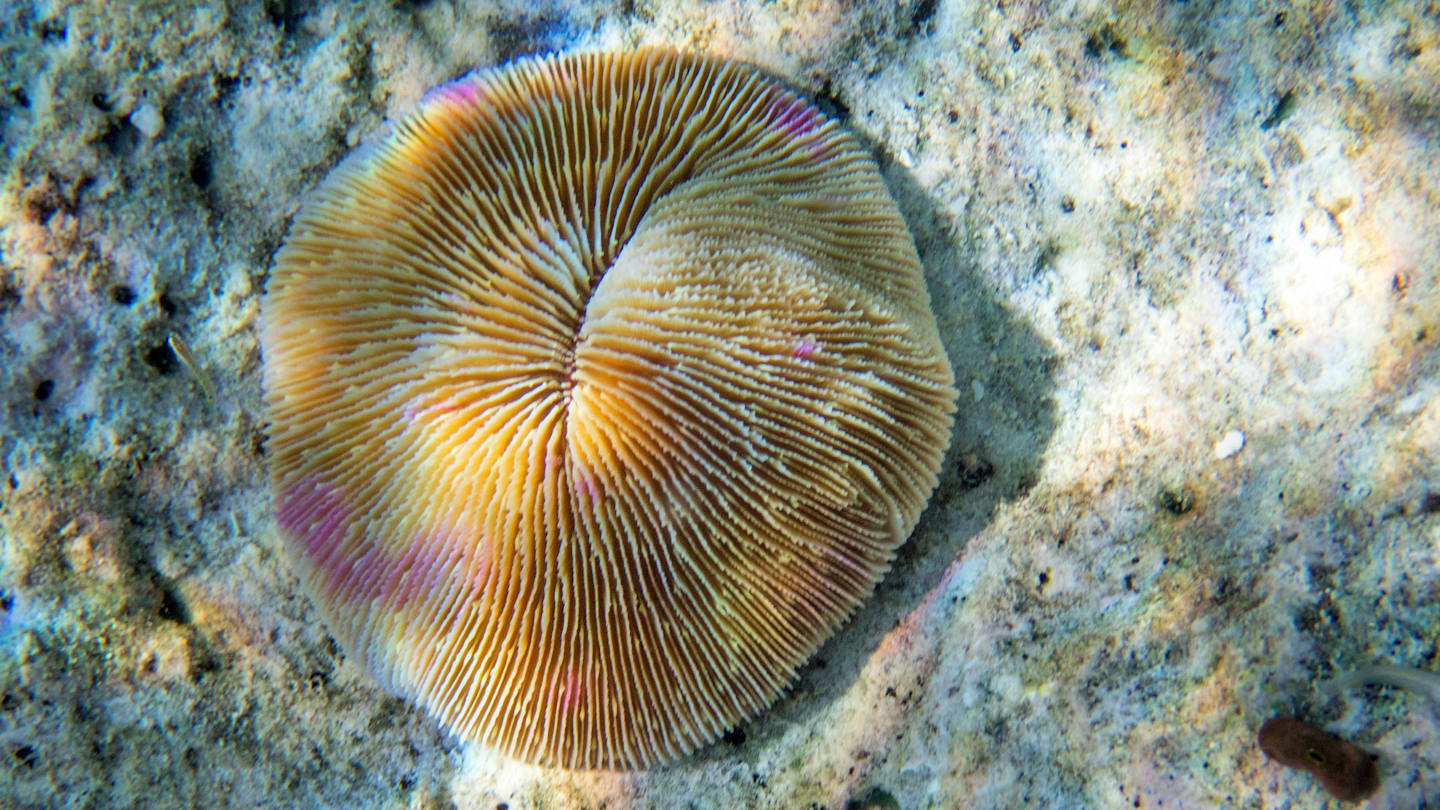
You might be used to seeing corals planted in one spot. Thatâs because most of them permanently attach themselves to an area on a reef and stay there indefinitely. But not all coral species want to be tied down forever; according to the The New York Times , adult mushroom corals âwalkâ to new destinations, and experts are now closer to understanding how they do it.
Scientists at Australiaâs Queensland University of Technology and University of Technology Sydney conducted a study of tiny mushroom corals, which was published in the journal PLOS One . They examined the movement of these solitary corals using time-lapse cameras inside a blacked-out aquarium. Brett Lewis, a marine ecologist, microscopist, and co-author of the study, shined two lights on either side of the tank: a sliver of white light, similar to the brightness of shallow waters, and one of blue light, like the deeper areas of water.Â
The mushroom corals tended to move toward the blue light. Science explains that since blue light wavelengths penetrate deeper into water compared to other colors, the corals may have evolved to associate it with the ocean depths where they seek refuge.
Mushroom corals arenât fast creatures: They only moved 45 millimeters every 24 hours. Nonetheless, their mobilityâhowever slowâis a useful adaptation. They may need to relocate to deeper water because of overcrowding among colonial corals, rough waves, or reproduction.Â
Whatâs more, mushroom corals move similarly to jellyfish. As Lewis told The New York Times , âJellyfish can move through water by twisting and contracting muscles in and around the edges of that bell shape as it pulses.â Mushroom corals are similarly shaped, so they move by inflating the outermost layer of tissues on their bodies and quickly release the air to propel themselves.
These scientists arenât the first to reveal that corals can move, or to record coral movement. The first tape of a moving coral was made in 1995, when video resolution wasnât as developed. Consequently, scientists knew that some corals could move, but they couldnât see exactly how they did it until now.Â
You can watch the high-definition time-lapse video of a mushroom coral shimmying across a tank under the âSupporting Informationâ section of the study .
Read More About Marine Animals: