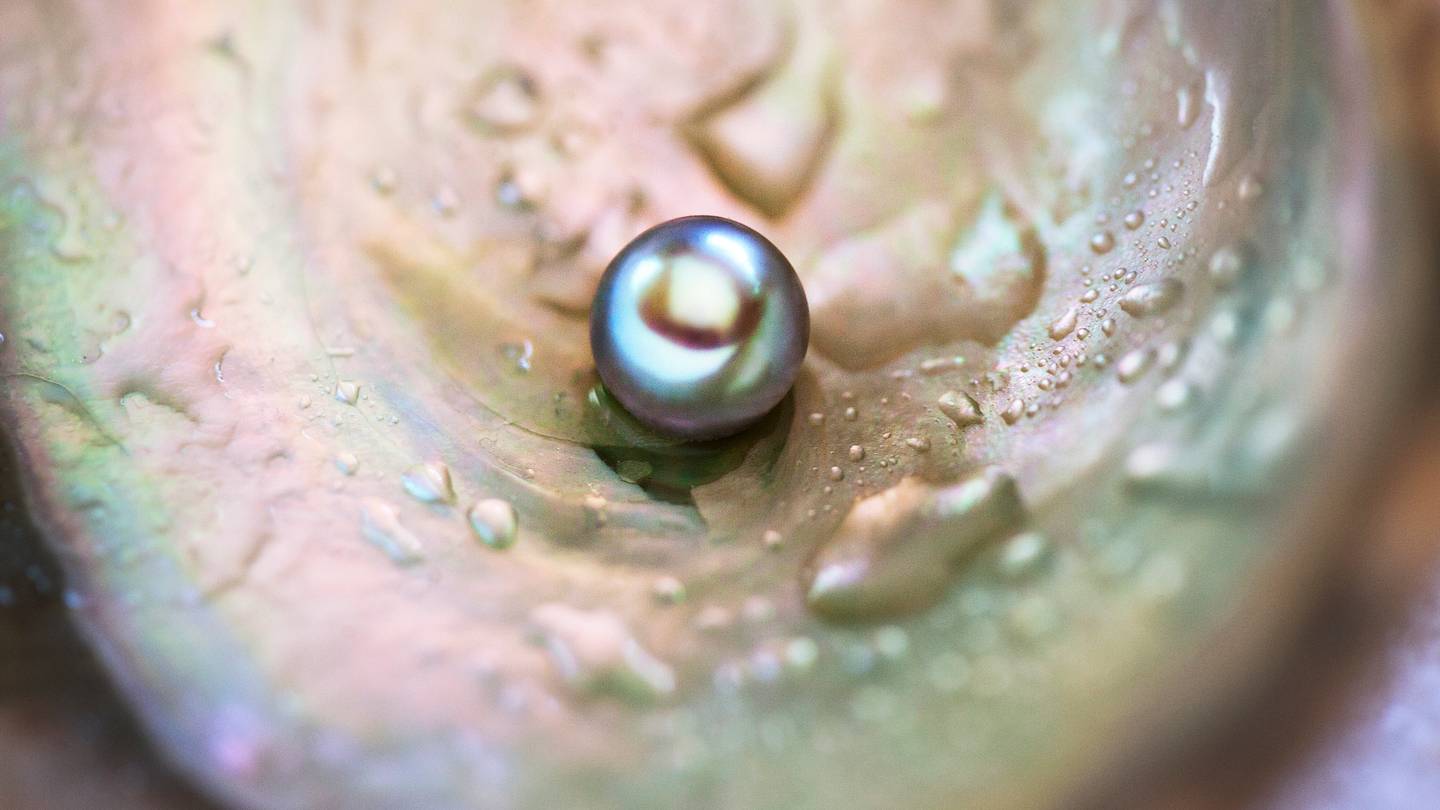
The most popular origin story for pearls goes something like this: A grain of sand gets stuck in an oyster and eventually becomes a pearl. While this isnât wrong, itâs definitely an oversimplification; and itâs also not true for every one of these gems .
For one thing, the ability to produce pearls isnât specific to oysters. In fact, according to Smithsonian , all mollusks âfrom mussels and clams to marine snails and scallops âtechnically have the capacity to do so. And the process doesnât always start with a grain of sand: Itâs often an errant bit of food or some other irritant that ends up stuck in the creatureâs tissue. As a means of protection, itâll begin encasing that irritant in layers of the same materials its shell comprises. It can take as long as five years for a good-sized pearl to emerge.
Not every mollusk can produce the iridescent, lustrous gems you picture when you think of pearls. But oysters can, and thatâs because their pearls are built from nacre âaptly known as mother of pearl. Nacre is created by alternating layers of aragonite (a form of calcium carbonate) and a protein called conchiolin. Though some people refer to other, non-nacreous pearls simply as âcalcareous concretions,â they can be just as stunning as their nacreous counterparts. A sea snail called the queen conch , for example, produces them in varying hues of pastel pink.
These days, the pearl industry doesnât leave much of the process to chance. Instead of cracking open oyster after oyster in the hopes that an irritant landed inside years earlier, pearl farmers actually slip an irritantâoften a tiny shell beadâinside the oysters, leave them alone for some years, and then harvest the pearls.
Loading recommendations... Please wait while we load personalized content recommendations