Bigfoot and the Loch Ness Monster are cool and all, but in Dr. Edie Widderâs opinion, thereâs no animal more appropriate for science fiction than the real life giant squid. âYou couldnât ask for a better alien,â she says. âAn animal with multiple arms and two long tentacles, the most enormous eyes, three hearts that pump blue blood, suckers with serrated edges, and a beak that slices flesh. And it happens to be real!â
A featured creature in mythology (the Kracken from Norse legends and Greek mythology), literature ( 20,000 Leagues Under the Sea , among others), and old sailorâs tales, the giant squidâwhich can grow up to 40 feet longâhas proved elusive for scientists to find: The only way researchers could study the beasts was by examining carcasses that washed up on beaches and tentacles snared by fishermen. Although one was photographed in its natural habitat in 2004, attempts to film the beast have failed. Until now.
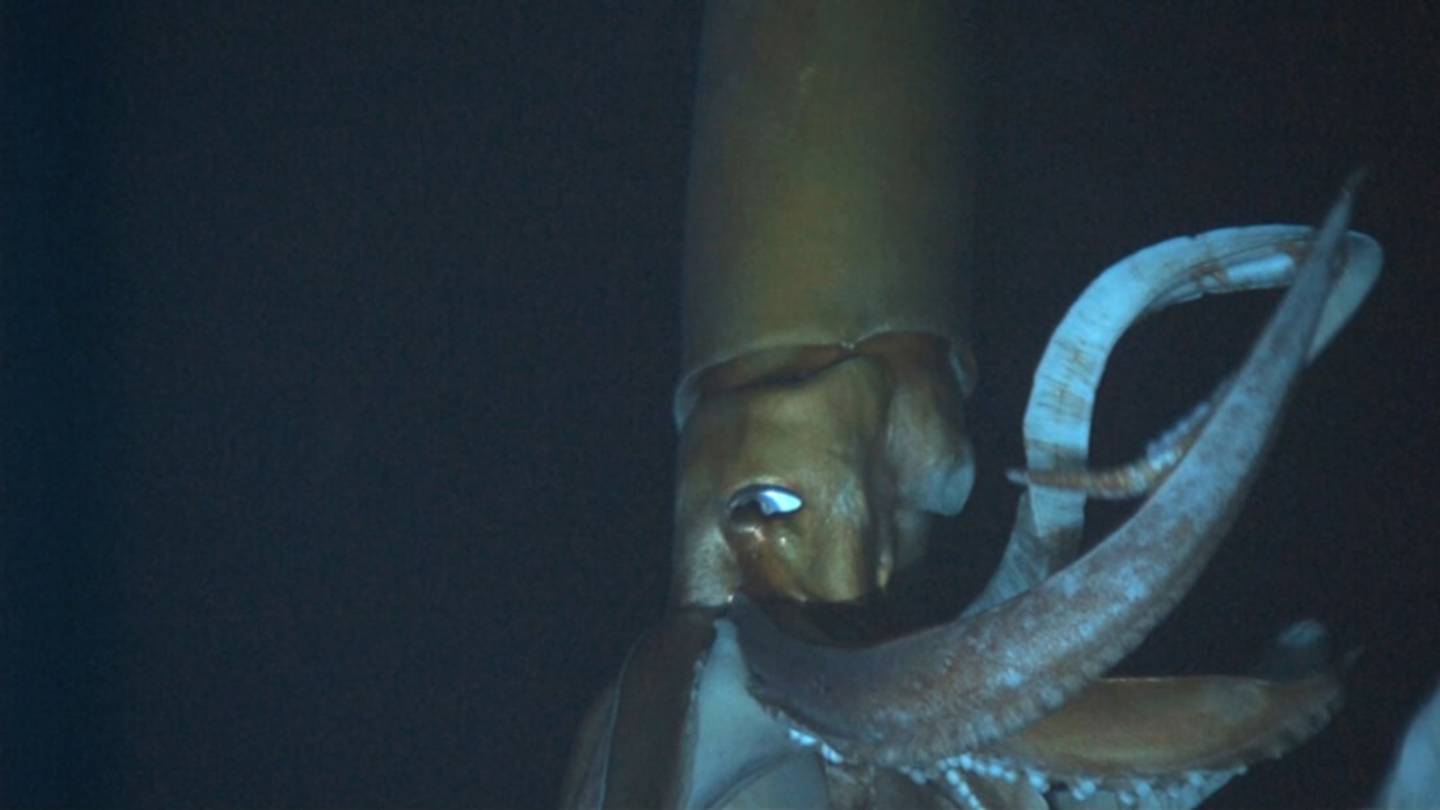
Last summer, Widderâwho is co-founder, CEO, and Senior Scientist at the Ocean Research & Conservation Associationâwas part of a team of scientists that filmed the giant squid in its natural habitat for the first time ever. The historic footage airs on Curiosity this Sunday, January 27, on the Discovery Channel. âThe giant squid has been an enigma,â Widder tells mental_floss. âTo finally have this kind of imagery of it is so exciting.â
Widder joined the teamâwhich also included marine biologist Steve OâShea and zoologist Dr. Tsunemi Kobodera of the National Science Museum of Japanâin 2010, after Mike deGruy heard a TED talk she gave about an optical lure she had invented. The lure, on its first deployment in the Gulf of Mexico, attracted a deep sea squid so new to science it canât be placed in any existing family. âHe just got so excited,â Widder says. ââCanât we use these techniques to go after the giant squid?ââ (Sadly, deGruy died in a helicopter crash in 2012.)
The system is comprised of an optical lure called the Electronic Jelly (or EJelly) that mimics the pinwheel light display of a jellyfish under attack. Attached to the lure is a gadget called the Medusa, a highly sensitive camera and far red lights (which are invisible to most sea creaturesâthey can only see greens and blues) within a waterproof housing. Thanks to her success on the systemâs first deployment and during an eight-month run in Monterey Bay, Widder thought that the EJelly and the Medusa might just be the right tools for catching a glimpse of the giant squid in its natural habitat. âGiant squid are visual predatorsâyou donât have eyes the size of a human head unless itâs important to your survival,â she says. âIâve spent a lot of time in submersibles thinking about what animals must face for survival in dimly lit environments. Thereâs an enormous volume in which to find food. An awful lot of these animals are bioluminescent, and itâs clear from the work Iâve done that bioluminescence doesnât happen spontaneouslyâitâs usually stimulated by some kind of interaction, frequently predatory interactions. So it would make sense that a visual predator would be on the lookout all the time for a flash of light to find something thatâs worth feeding onânot the jellyfish, but whatâs eating the jellyfish.â
Finding the squid was all about location: The crew headed to the deep seas off Chichi island, Japan. "That was the doing of Dr. Kobodera," Widder says. "He had done a tremendous amount of work in that area. We knew that's where sperm whales come to feed, and fishermen had snagged tentacles from the squid there. So there was a lot of interest in going to that spot." And it also took a lot of patience; the scientists made hundreds of dives in a submersible, sometimes to deeper than 3000 feet.
When a storm was rolling in, Widder placed the system on the ocean bottom and left it there for 30 hours while the ship returned to port. When they reviewed the footage (Widder was in the submersible, so grad student Wen-Sung Schung was checking the video), bam: There was a giant squid. âIt really, really worked,â Widder says. âWe had five separate sightings with the Medusa.â
Later, Kobodera and a team went down in the submersible with bait and a different optical lure and captured more than 20 minutes of high-definition video of a giant squid as it fed on the bait. âNothing can top that high res video,â Widder says. âTo have that eye looking back at you like thatâ¦itâs just incredible footage.â
This mission, which was funded by the Discovery Channel and the Japanese Broadcasting Commission (NHK), succeeded where so many others had failed thanks to one important thing. âWe paid attention to the squidâs visual system,â Widder says. âAll previous expeditions have used bright lights and noisy platforms. ROVs have their place, but I donât think theyâre good tools for exploring animal life in the ocean. Thereâs a tremendous amount of noise, and you donât have the range of vision that you do from a submersible. That really shouldnât be ignored when youâre trying to explore such a big space. And using optical lures instead of just using bait had huge impact.â
The scientists plan to go back and review the footage they filmed, but Widder says theyâve already learned a lotâand much of it surprised them. âThe appearance of the squid was so different that what we had imagined given dead specimens,â she says. âAnd the eyeâthere was something looking back at you. It wasnât a blank, dead eye. And it was very exciting that when it attacked, it didnât go directly to the optical lure but to what was next to the optical lure.â
But the most important takeaway, she says, is that thereâs still more of the ocean to explore, and what we find there could lead to a myriad of advancements, including a cure for cancer. âWhat else is down there that we havenât discovered?â she wonders. âWhy spend billions of dollars on space exploration when we havenât explored our own planet?â Her hope is that this latest discovery will lead to more funding that will allow scientists to go on more expeditionsâand not just in search of the giant squid. âIt would be wonderful to man an expedition like that to find the colossal squid,â she says. âThat might be even more exciting. Itâs not longer, but itâs bigger by weight, more massive, and bioluminescent. My fascination is with animals that make light.â
"Monster Squid: The Giant is Real" premieres January 27 at 8pm ET/PT on the Discovery Channel as the season finale of Curiosity .
Loading recommendations... Please wait while we load personalized content recommendations