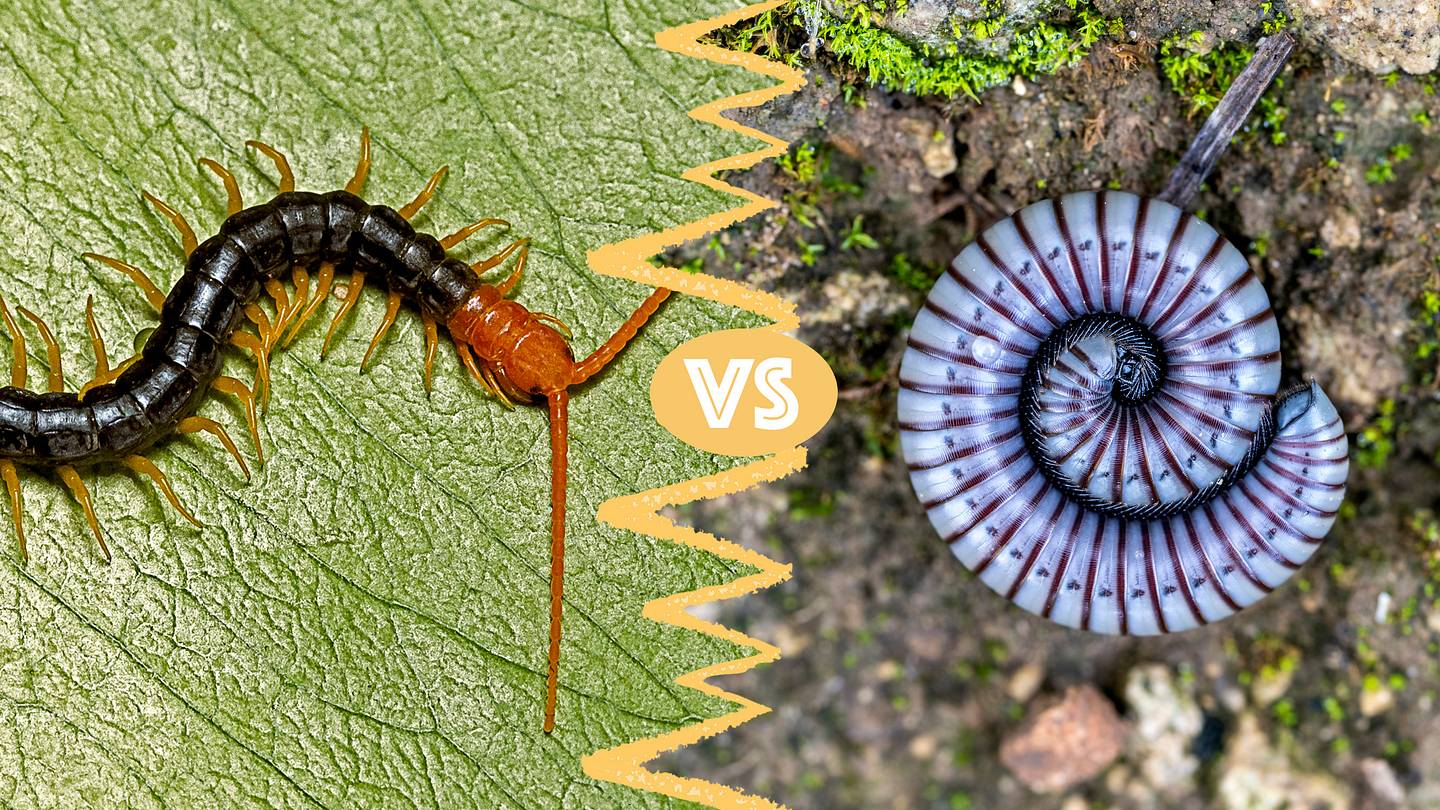
From their names, it might seem like the main difference between centipedes and millipedes is their leg count. Not so: Thereâs much more to these creepy-crawlies than meets the eye (or the ground).Â
Centipedes and millipedes have some similaritiesâboth have too damn many legs for anyoneâs comfortâbut more importantly, they have distinct differences that can be helpful to know.Â
Collectively, centipedes and millipedes belong to the subphylum Myriapoda in the phylum Arthropoda. In other words, they arenât insects but terrestrial arthropods, and theyâre more closely related to shrimp than beetles or butterflies .Â
Both live throughout the world (except for the polar regions), but are more common in the tropics where theyâre likely to find the moist environment they require. As for housing, the space under an old log, a pile of leaf litter, or soil suits them just fine. Both are more active at night.
Aside from being greedy when legs were handed out, they also share attributes like antennae, segmented bodies, and their breathing mechanism: Centipedes and millipedes respire through tiny holes in the sides of their bodies called spiracles. They also have poor vision; some centipedes have no eyes at all.
Though their names include -pede , Latin for âfeet,â centipedes and millipedes each have different arrangements and numbers of limbs.
Like others in the class Chilopoda, centipedes are segmented animals with one pair of legs per segment. Despite their name, their number of legs ranges from about 20 to 300 and they are placed so that they stick out from the sides of the animalâs body. Some speciesâ legs are shorter and pointy; some long and willowy like over-excited hairs.
Millipedes, on the other leg, are in the class Diplopoda. They have two sets of legs per segment, except for segments near the head, which have only one set. They donât actually have 1000 legs like their name suggests; itâs more like anywhere from 34 to 400 legs, which are positioned on the underside of the body and allow them to march in a neat, jaunty line.
The exception to that range is the female Illacme plenipes millipede, dubbed â the leggiest animal known on Earthâ in the journal Zookeys . The 1.2 inch-long central California girl can sport up to 750 legs.
Centipedes and millipedes show huge ranges of size among species. The smallest centipede species in the worldâwith the Guinness World Record to prove itâis Hoffmanâs dwarf centipede ( Nannarrup hoffmani ) that measures less than half an inch long. It was discovered in New York Cityâs Central Park in 2002. The largest, the Amazonian giant centipede ( Scolopendra gigantea ), can grow up to a foot long.
Duff millipedes (genus Polyxenus ) are among the tiniest of their class, measuring only a millimeter (.03 inches) long [ PDF ]. The largest species is the 13-inch African giant millipede ( Archispirostreptus gigas ).
Centipedes are carnivores and eat insects and other small arthropods like spiders. They kill their prey with a pair of modified legs under their head that act like fangs to inject venom. Larger species can kill larger prey: The 8-inch Chinese red-headed centipede ( Scolopendra subspinipes mutilans ) releases venom that can kill a mouse 15 times its size in under a minute .Â
The comparatively gentle millipedes are detritivores, feasting on dead plant matter and insects on the forest floor. According to the Field Museum , forests would be choked with rotting leaves and woody plants were it not for millipedes eating and then excreting the nutrients back into the world.
Centipedes move quickly and may be able to outrun their opponent. If theyâre caught by a predator, centipedes will puncture or scratch their attacker. They wonât do much damage to a human, but their scratches may cause itching and swelling that can last up to 48 hours. Larger species like the aforementioned Chinese red-headed centipede can inflict an extremely painful scratch that could require hospitalization .
A millipedeâs mode of defense is to curl up around itself, coiling its body like a cinnamon bun. This posture keeps its legs and undersides safely surrounded by its body armor. Some species look quite pretty this way , and also resemble old-fashioned phone cords .
Lest you think theyâre wimps, millipedes also emit chemicals from their sides, including hydrogen cyanide, that will irritate and deter predators.
Millipedes are so discreet that scientists didnât know how some of them mated until 2020. Long story short, male millipedes have to do some contortions to get their sperm transferred to a femaleâs genital opening. Once that is accomplished, her eggs are fertilized and sealed inside until sheâs ready to lay them in moist soil. The young will start out with only a few pairs of legs and will add more with each molt of their exoskeletons. Like their lobster cousins, theyâll eat their discarded exoskeletons for their nutrients.
Rather than mate directly, a centipede female avails herself a male's spermatophore , a capsule containing sperm and nutritious materials. She lays her eggs in a damp area, curling around them to keep them safe.
Leaf litter and small insects
Insects, lizards, mice
Scratching with venomous mouthparts
Read More Stories About Animal Comparisons: