If youâre the outdoorsy type, you may have occasionally stumbled upon a colony of ants assembling itself into a tower-like structure to avoid being swept away by incoming rainfall. This type of non-random, coordinated movement in which multiple individuals coalesce into a kind of âsuperorganismâ is incredibly rare among animals. In addition to fire ants, the behavior has been observed only in certain species of spider mites, slime molds, and now, nematodes.Â
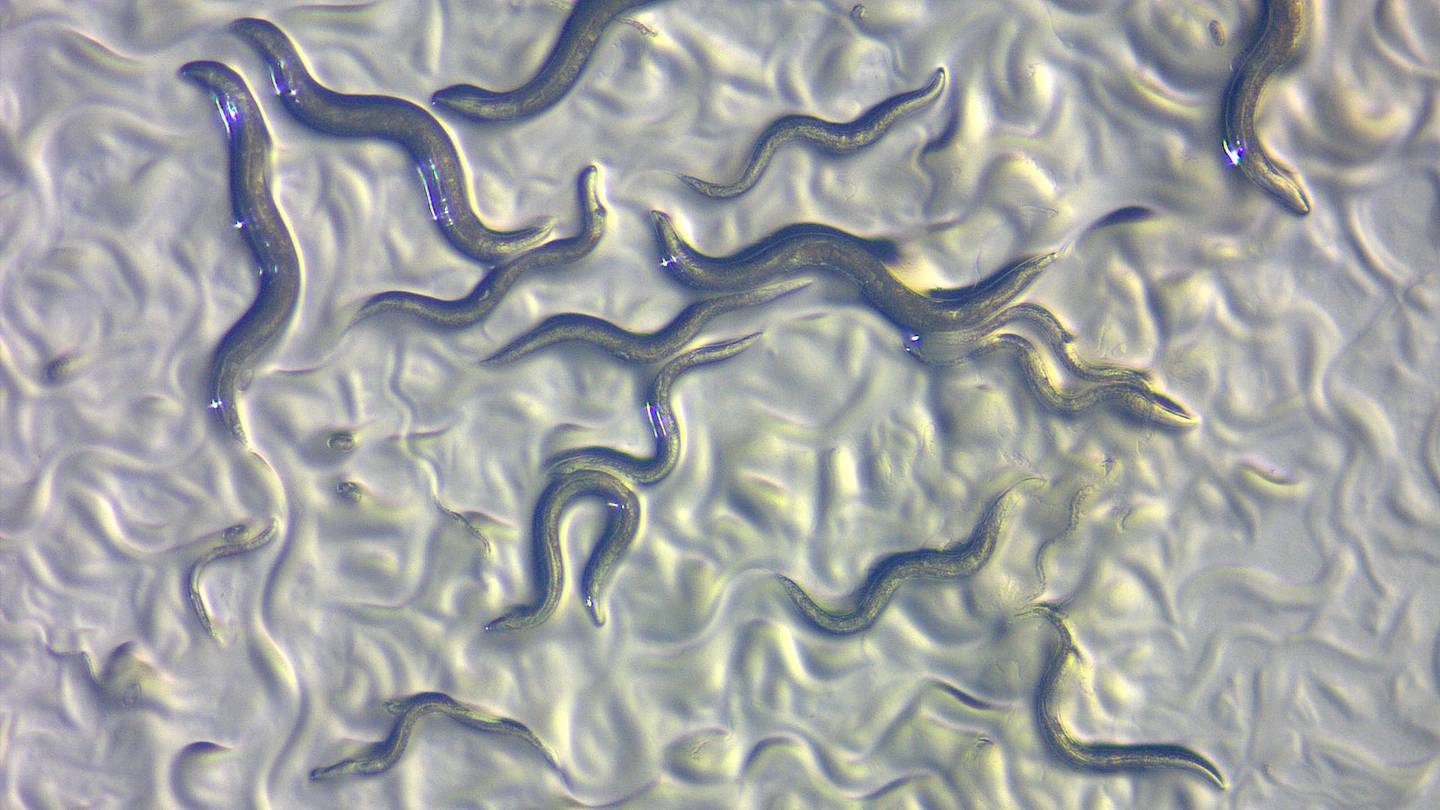
Nematodes are mostly tiny, non-segmented, often parasitic worms in the phylum Nematoda. They range in size from less than one-tenth of a millimeter (0.04 inches) to about 29 feet in the case of one species, Placentonema gigantissima , which parasitizes the digestive tracts of sperm whales. The worms can be found in just about any biome, from forests and oceans to swamps, deserts, the plains of Antarctica, and even the human gut. Theyâre also the most common creature on the face of the Earth, making up an estimated 80 percent of all animal life.Â
Because theyâre usually extremely small, they have a hard time moving from point A to point B over gaps in terrain. To solve the problem, some species of nematodes have been known to assemble into bridge-like towers, but itâs been seen only in controlled laboratory environments. This year, however, researchers from the University of Konstanz and the Max Planck Institute of Animal Behavior, both located in Germany, were excited to discover that nematode toweringâknown scientifically as âdispersal behaviorââoccurs in nature as well.Â
In a new paper published in the journal Current Biology , the researchers describe how they recorded video evidence of nematode towering in rotting apples and pears collected from nearby orchards. âI was ecstatic,â senior author Dr. Serena Ding said in a statement. âFor so long natural worm towers existed only in our imaginations. But with the right equipment and lots of curiosity, we found them hiding in plain sight.â
Through close observation and experimentation, the researchers were able to better understand the mechanics and purpose of nematode towering. They found that, while towering in the lab was observed in a variety of nematode species, towering in nature was observed only on one species and only in its larval, or âdauer,â stage.Â
The researchers also found that, when towering, the nematodes behaved as though they were a single individual. Whether they responded to touch or attached themselves to surfaces and objects, they did so in unisonâa hallmark of dispersal behavior.
âA nematode tower is not just a pile of worms,â first author Dr. Daniela Perez said in the statement. âItâs a coordinated structure, a superorganism in motion.âÂ
Some towers were able to stand for more than 12 hours and generate âexploratory armsâ to survey the surrounding space. As with ants, mites, and slime molds, nematode towers could be formed for a variety of purposes, including to evade danger, reach new food sources, or âhitchhikeâ en masse to different environments by latching on to other organisms passing by.Â
Unlike in ants, whose dispersal behavior depends on the individual ants' roles within the colony, nematode towers that the researchers created in their lab did not appear to be organized according to individual specialization. Each worm, whether located at the top of the tower or at the bottom, exhibited similar behaviors, though this may be because the researchers were studying clonal (a.k.a genetically indistinguishable) populations.
Evidence that nematodes form living towers of worms in the wild hints at an important turning point in evolution of life on Earthâthe point at which organisms learned to overcome challenges by working together. âCollective dispersal,â the authors write, âraises interesting questions about kin selection, cooperation, and social conflictsâ in other animals, including humans.Â
Discover More Fascinating Facts About Invertebrates: