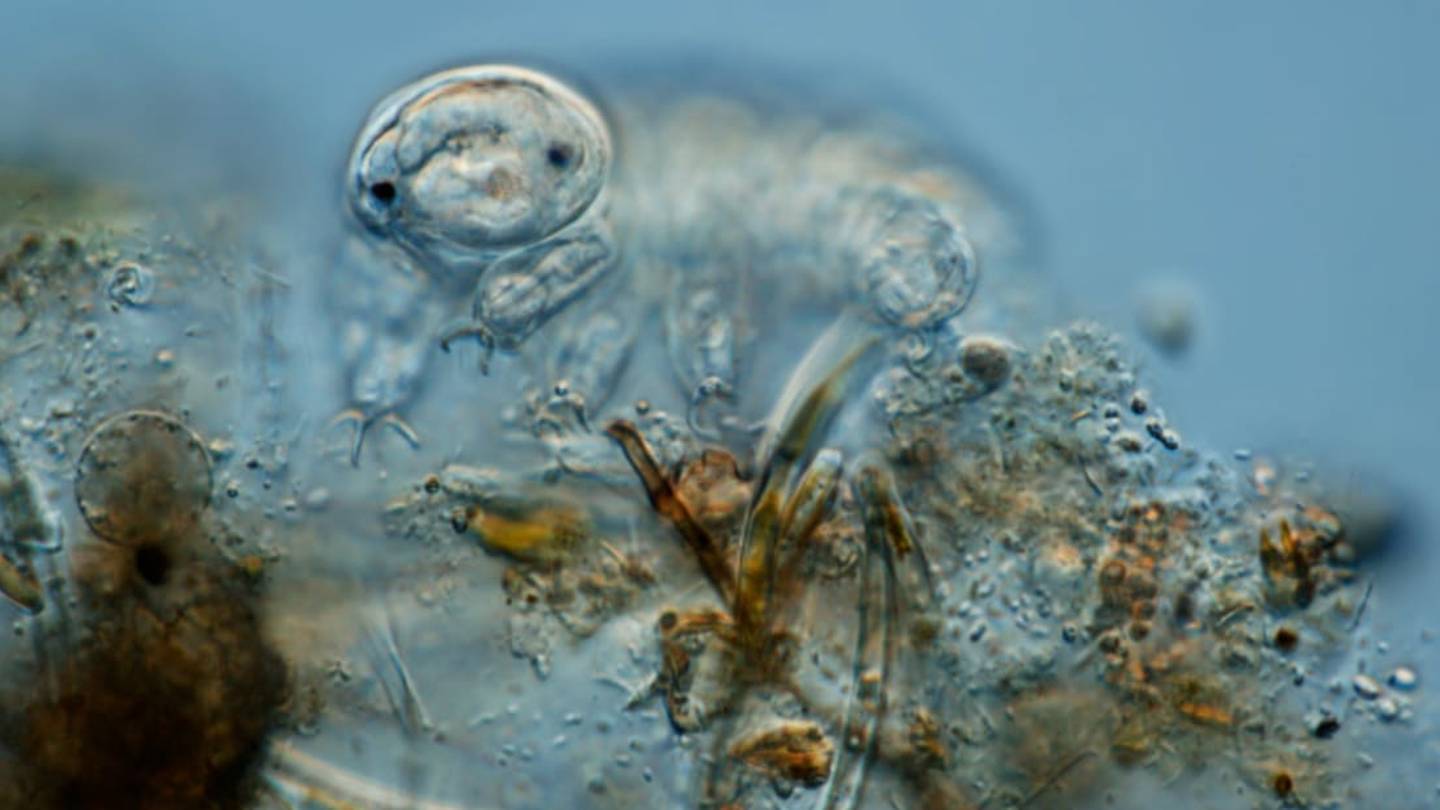
Science is based in facts, but it isn't a static, objective truth; it's a constantly changing landscape that evolves with each new discovery or shift in perception. One such discovery occurred last year, when researchers determined that as much as 17 percent of tardigrade DNA had been taken and adapted from plants, fungi, and bacteria. Now, once again, the story evolves. A new paper in the Proceedings of the National Academy of Sciences ( PNAS ) refutes last yearâs finding, setting the tardigrade weirdness level from âwhat even is this?â back to just plain weird.
Tardigrades, also known as moss piglets or water bears, are tiny, chubby animals that are near indestructible. They can withstand being burned, frozen, irradiated, even exposed to the vacuum of space, and still live to fight another day. For this reason, moss piglets and their DNA are of very special interest to biologists.
Last year, researchers at UNC sequenced the genome of the tardigrade species Hypsibius dujardini and found that as much as 17 percent of the tardigradeâs genes had been borrowed from other species. DNA borrowing (also known as horizontal gene transfer) is not unheard of, and if any organism would up the gene transfer ante, it would be tardigrades. Still, even UNC researcher Thomas Boothby was rattled by the quantity of transferred genes. âThe number of them is pretty staggering,â he told The Atlantic .
But even as the bizarre findings made headlines (including here at mental_floss ), researchers at other institutions were calling them into question . Yes, the UNC scientists had double-checked their work, but wasnât it possible that all those foreign genes had been accidentally introduced to the sampleâthat they didn't belong to the tardigrade at all?
Yep, argue the authors of the current PNAS study. Shortly after the UNC paperâs publication, this team of UK researchers ran their own independent scan of H. dujardiniâ s genome and got very different results. âWe agree and find that horizontal gene transfer does occur,â co-author Sujai Kumar wrote in an email to mental_floss , âbut it is on the scale of ~1 percentâ2 percent (which is not unusual for animal genomes), rather than 17 percent, invalidating the flashy headline of the original PNAS paper.â
Kumar and his colleagues say the UNC sample was likely contaminated with bacteria, but theyâre hardly gloating. âWe are not rivals,â he wrote, âand at no point do we want to de-emphasize the other teamâs efforts. We are aware that unintentional bias can creep into anyoneâs work, including ours.â
Loading recommendations... Please wait while we load personalized content recommendations