Peer out the passenger window of an airplane arriving or departing Dublin Airport in County Dublin, Ireland and you may get a birdâs eye view of two islands with significant stories behind them. One is Irelandâs Eye, thick with fog and gothic history âan artist named William Kirwan was convicted of killing his wife during a holiday there in 1852. The other is Lambay Island, a rocky, green terrain spread across 650 acres that was long ago used as a layover for Vikings and pirates in pillaging operations.
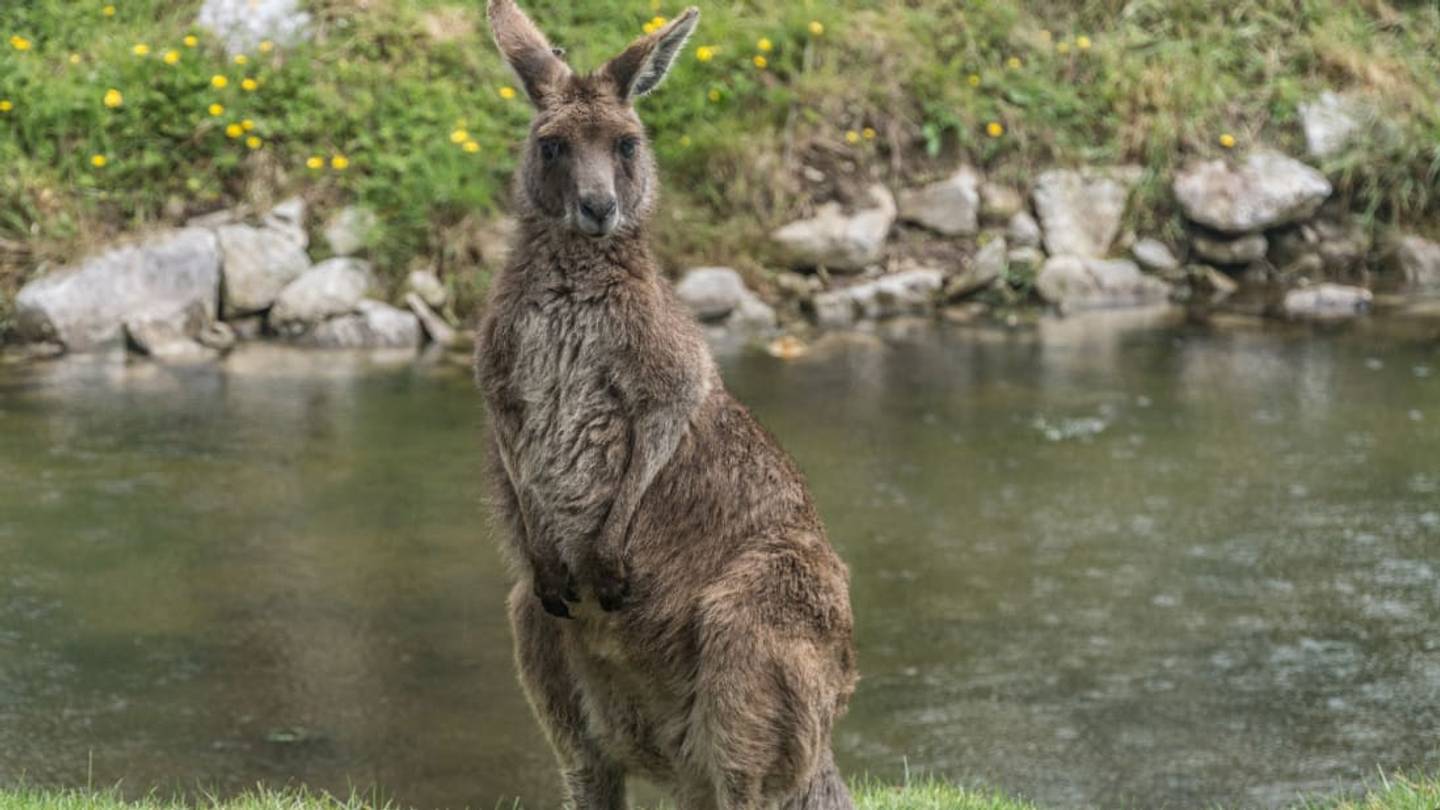
What really sets Lambay apart, however, needs to be seen up closeâand then only if you're lucky. At any given time, between 100 and 140 red-necked wallabies roam the grounds, bouncing away from tourists and residents and grazing on grass along with cattle and deer. Natives of Australia, the displaced wallabies have attracted plenty of attention and curiosity over the decades. Who brought them? And what happens if they begin to outgrow a small slice of land more than 9000 miles from home?
An aerial shot of Lambay Island. Wikimedia Commons
In April 1904, banker Cecil Baring was browsing Irelandâs Field newspaper when he came across a classified advertisement that caught his attention . âIsland for Saleâ referred to Lambay, which had been owned for most of the previous century by the Talbot family and was named after the Norse word for âlamb.â
Baring paid a sum in the range of £5250 to £9000 (around $700,000 to $1,200,000 today), an investment that secured Lambay as a Baring property handed down from one generation to another. Cecil commissioned an architect named Edward Lutyens to renovate the worn castle that sat on the land; it eventually became a refuge for Cecilâs adult son, Rupert, who became a fixture in newspapers in 1935 when his fiancé, Angela, sued him for âbreach of promiseâ after he didn't marry her. (Their published love letters became the entertainment of the day, with Rupert's pet name disclosed as "Boodles.")
In the 1950s, the Barings reportedly planned for a zoo to occupy Lambay. Among the animals brought over were wallabies, tortoises, and lizards. Itâs not known how many were delivered or how many survived, but "Boodles" apparently took a liking to the kangarooâs smaller relatives. In the 1980s, when the Dublin Zoo experienced a surge in wallaby numbers, the Barings agreed to take seven of them for Lambay.
Rupert died in 1994, but the wallabies remained. Rupertâs son, James, a pilot who owned Londonâs Regent Sound Studio that hosted the Beatles and the Rolling Stones, inherited the island. Once, kayakers decided to step on the grounds and ran into James, asking if the legend about the wallabies was true. It was.
James Baring died in 2012 , leaving the island to the Lambay Estate Company and his son, Alex, who is a part-time occupant and plans on opening the area to a high-end tourist trade. (Alex did not respond to requests to comment for this article.)
Clearly, the unusual sight of roving, red-necked wallabies is intended to be part of the attraction. But what do the animals make of Irish landscapes when the species was reared in Australia?
âTheyâre actually quite adaptable,â Kevin Drees, a director of animal care at Blank Park Zoo and an expert in captive wallabies, tells mental_floss. Thanks to an ability to grow a dense coat of fur, âthey can cope with cooler temperatures than kangaroos, which is one of the reasons theyâre so popular in zoos.â
Lambay is not so strange an environment for them as it might appear. (It's also not the only island outside of Australia they occupy: Inchconnachan in Loch Lomond, Scotland has had wallabies for over 60 years after a wealthy vacation resident introduced them in the 1940s.) While the presence of puffins and cattle makes for what Drees calls âan unnatural grouping of animals,â they have plenty of grass to munch and plenty of places to hop and hide when their shy instincts kick in around humans. Docile, theyâre unlikely to mimic the boxing kangaroos of Australian lore, and the only time they might get anxious is if a visitor brings a dog along.
âTheyâre very clever,â Michael Bermingham, a business associate of Baringâs who has made several treks to the island, tells mental_floss. âTheyâll climb up on rocks where you canât follow.â
Although the Barings allow boat and walking tours, itâs by invitation only: The island remains largely untouched by human intervention. Only the Barings, a few farmhands, and a veterinarian spend any real length of time in residence there. âThe animals there really tend to the land,â Bermingham says. âGrazing is important to maintain it.â And while wallabies like to swim, itâs virtually impossible they could make it the three miles to shore to invade the coast.
The real problem, as Drees sees it, is twofold. Wallabies can reproduce quickly, leading to potential overpopulation problems. (Their babies, known as joeys, can feed from the mother while a fertilized egg waits for an opportune time to continue development and take over the pouch.) And because the inhabitants are descended from a small number of non-native relatives, inbreeding is a possibility.
âInbreeding can lead to health issues, like heart defects,â he says. "You'd have to bring in [new] wallabies to keep that from happening."
For now, the wallabies of Lambay appear to be thriving. And one way the Barings appear to be keeping their numbers under control is by entering into a partnership with Bermingham, who has an exclusive agreement to claim a portion of the wallaby population for his own purposes.
âI like making wallaby slider burgers," he says.
Bermingham is co-owner of M&K Meats, a prospering meat supplier in Rathcoole that enjoys a brisk trade in organic, farm-to-fork premium meats that he sells to high-end clients all over Ireland and the UK. Three years ago, he agreed to peddle wallaby meat sourced exclusively from Lambay Island.
âItâs very lean, very rich in protein,â he says. âI donât know if itâs the grass diet, or the herbs on the island, but it has a fascinating flavor.â
Wallaby steak, he admits, is ânot going to be everyoneâs cup of tea.â Still, interest in the meat appears to be gathering momentum. âWallaby meat in Irelandâpeople go, âWhat?â Some are intrigued, some take it or leave it.â
M&K appears to be taking enough of it to keep the population curbed. Culling is done on site, with hunters dispatching of the wallabies using rifles. Because theyâre so averse to humans, Bermingham says it can make a round-up difficult. âThe last time, it took a guy three days to get four of them.â
Bermingham also captures rabbit and deer on site, with cattle and lamb taken as livestock. Because of the islandâs seclusion, he says the meat is untouched by any of the illnesses that can plague agricultural farming on the mainland.
Itâs not yet known whether Baringâs plans for tourism will include an on-site wallaby dining experience. But the time may have come when the animals are less an invasive species and more an integral part of the islandâs unique ecosystem.
âIf itâs about nature, no, the wallaby doesnât fit,â Drees says. âBut if itâs about the history of the island, then perhaps they see the value in it. It would make a good study in human-altered habitats.â
Loading recommendations... Please wait while we load personalized content recommendations