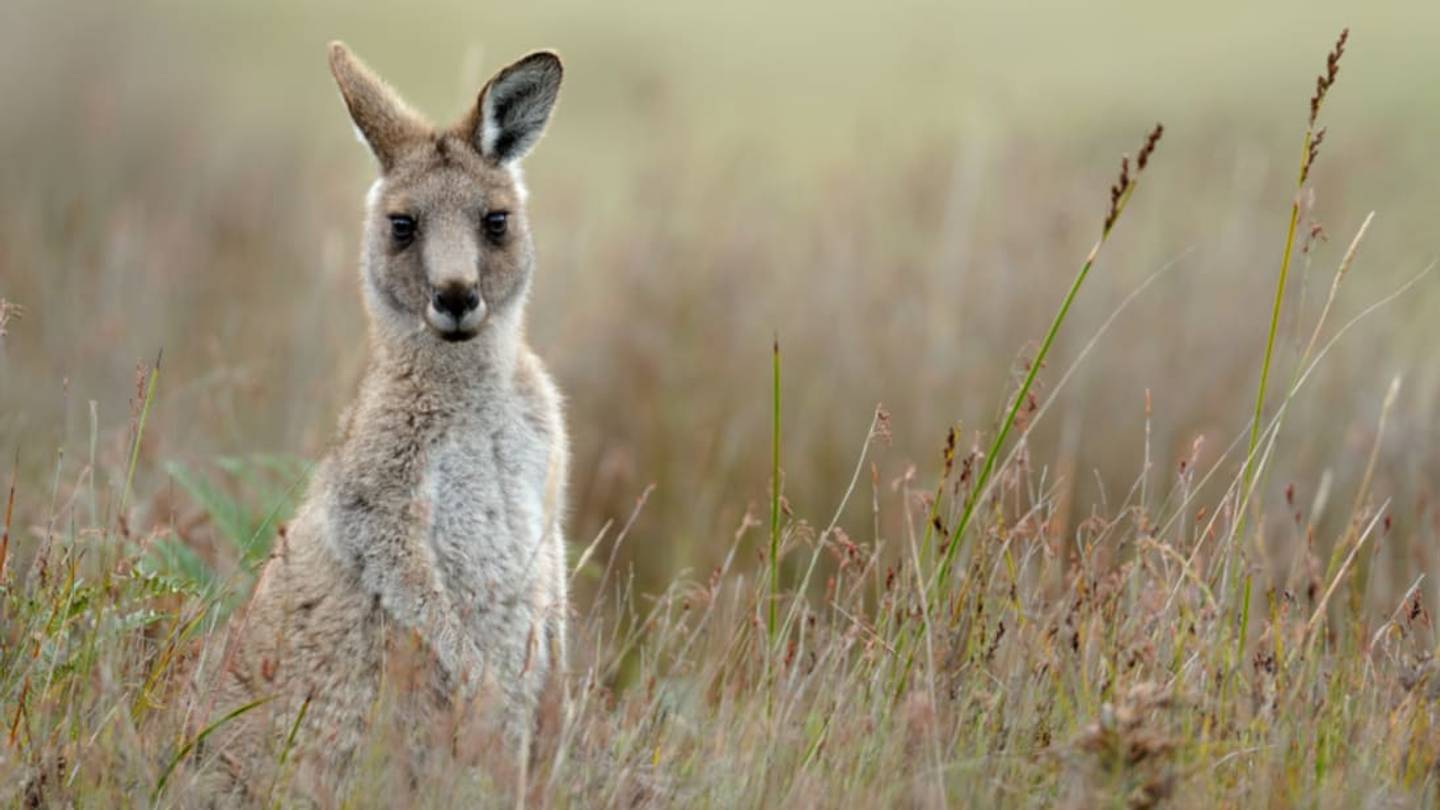
Nine out of 10 humans may favor their right hands, butâaccording to a paper that was recently published in Current Biology âmost kangaroos have the opposite preference.
Researchers from Russia, Australia, and Tanzania monitored 38 eastern gray kangaroos ( Macropus giganteus , the worldâs second-largest species), snapping thousands of photos in the process. Every single animal disproportionately relied on its left hand while âgrooming the nose, picking a leaf, or bending for a tree branch.â Meanwhile, red kangaroos ( Macropus rufus ) displayed a similar bias, as the team observed âsignificantly more left- than right-handed individuals.â
Other marsupials have a different technique. The study also kept tabs on two wild red-necked wallaby ( Macropus rufogriseus ) populations. These critters âalways used their right paw for strength work, like pulling a branch down, but always brought the leaves to their mouth using their left paw,â ecologist Janeane Ingram says.
In nature, preferring one appendage over another is not at all unusual. Many vertebrates have a dominant sideâelephants, for example, are either right- or left- tusked . But this is the first proven case of true handedness in non-primate creatures. As Ingram explains , that particular trait was believed to have âevolved primarily in humansâ and our closest relatives. Kangaroos and wallabies, though, represent a very different mammalian group.
Given this, we may need to amend long-standing assumptions about how, when, and why righties and lefties first appeared. Like kangaroos, people are built for getting around on two legsâwhich leads Yegor Malaschichev, a Saint Petersburg State University zoologist, to suspect that bipedal lifestyles are the chief driving force behind the evolution of handedness.
Interestingly, the hopping marsupials show hand-based favoritism to an extent matched only by Homo sapiens (even our fellow apes lack such blatant partiality). â[We] are not alone in the universe,â declares Malaschichev, âwe are twoâhumans and kangaroos.âÂ
Loading recommendations... Please wait while we load personalized content recommendations