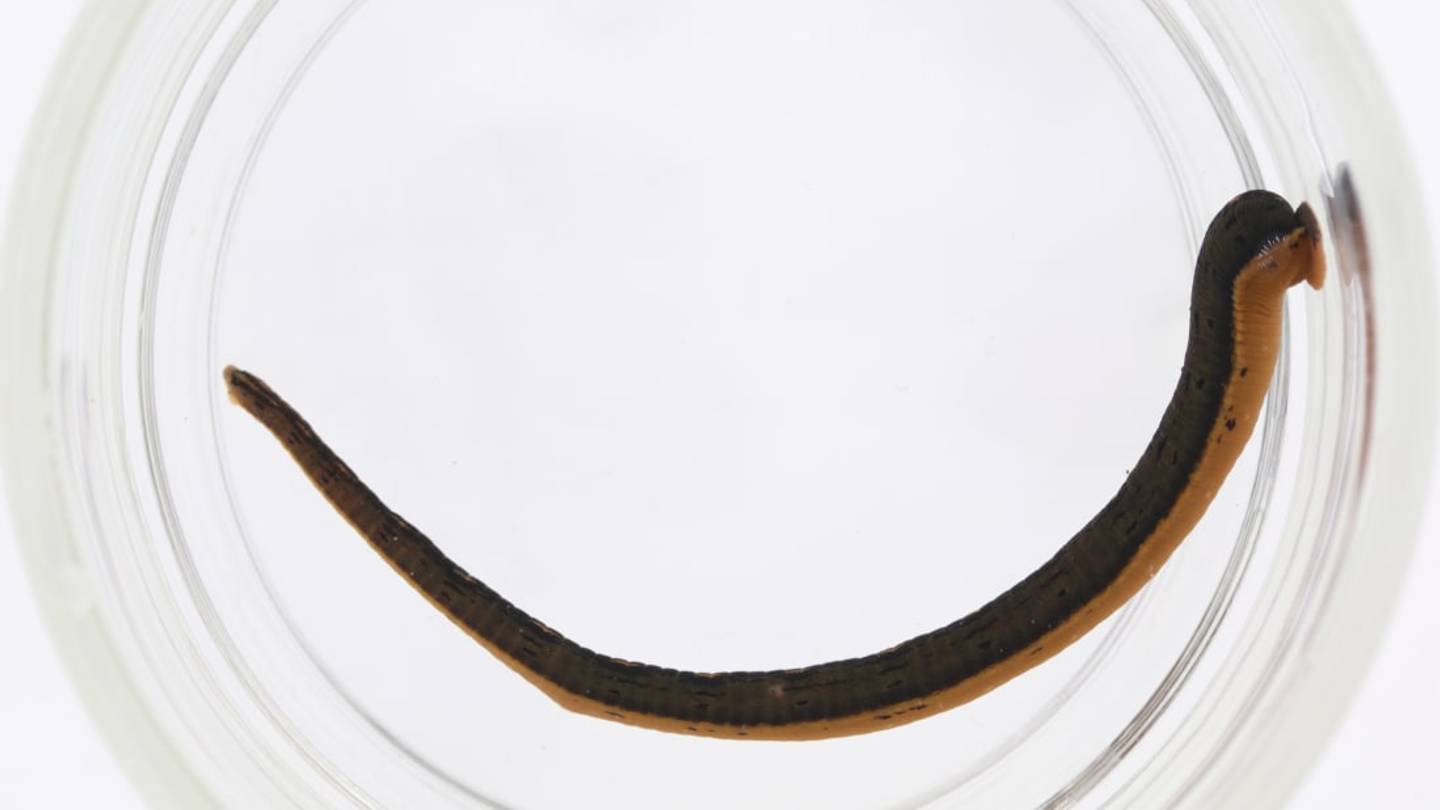
Leeches get a bad rap, but theyâre actually pretty cool once you get to know themâand we're finding out more about them, even today. Recently, a team led by Anna Phillips , curator of parasitic worms at the Smithsonian National Museum of Natural History, discovered a new species of medicinal leech (pictured above) in a Maryland swamp. We asked parasite expert and curator at the American Museum of Natural History Mark E. Siddall to share some surprising facts about the worms we love to hate.Â
Hematophagous, or blood-feeding , species are only one type of leech. âThe vast majority of species are [hematophagous],â Siddall tells Mental Floss, âbut it depends on the environment. In North America, there are probably more freshwater leeches that donât feed on blood than there are blood-feeders.â And even among the hematophagous species, there are not too many who are after you. âVery few of them are interested in feeding on human blood,â Siddall says. âCertainly theyâll do it, if theyâre given the opportunity, but theyâre not what theyâre spending most of their time feeding on.âÂ
âEvery continent on the planet has leeches, with the exception of Antarctica,â Siddall says. âAnd even then there are marine leeches in Antarctic waters.â Humans have co-existed with leeches for so long, according to Siddall, that just about every language has a word for leech.
Bloodletting for bloodlettingâs sake has fallen out of favor with Western physicians, but that doesnât mean medicinal leeches are enjoying a cushy retirement. Today, surgeons keep them on hand in the operating room and use them as mini-vacuums to clean up blood. âThat is a perfectly sensible use of leeches,â Siddall says. Other uses , though, are less sensible: âThe more naturopathic application of leeches in order to get rid of bad blood or to cure, I donât know, whatever happens to ail you, is complete hooey,â he says. âHow on Earth would leeches take away bad blood and leave good blood? Itâs silly.âÂ
Land-based leeches made an appearance in Tanâs 2005 book Saving Fish from Drowning , a fact that instantly put the author in leech researchersâ good graces. âThere are not a lot of novels out there with terrestrial leeches in them,â Siddall says. So when he and his colleagues identified a new species of tiny terrestrial leeches, they gave the leech Tanâs name. The author loved it. âI am thrilled to be immortalized as Chtonobdella tanae ,â Tan said in a press statement. âI am now planning my trip to Queensland, Australia, where I hope to take leisurely walks through the jungle, accompanied by a dozen or so of my namesake feeding on my ankles.â
The giant Amazon leech ( Haementeria ghilianii ) can grow up to 18 inches and live up to 20 years. And yes, this oneâs a blood-feeder. Like all hematophagous species, H. ghilianii sticks its proboscis (which can be up to 6 inches long) into a host, drinks its fill, and falls off. Scientists thought the species was extinct until a zoologist found two specimens in the 1970s, one of whom he named Grandma Moses . We are not making this up.
Many walleye anglers swear by leeches. âA leech on any presentation moves more than other types of live bait," pro fisher Jerry Hein told Fishing League Worldwide. "I grew up fishing them, and I think they're the most effective live bait around no matter where you go." Thereâs an entire leech industry to provide fishers with their bait. One year, weather conditions kept the leeches from showing up in their typical habitats, which prevented their collection and sale. Speaking to CBS news, one tackle shop owner called the absence of leeches âthe worst nightmare in the bait industry.â
Siddall and his colleagues collect and study wild leeches. That means hours of trekking through leech territory, looking for specimens. âWhether weâre wandering in water or traipsing through a bamboo forest,â Siddall says, âwe are relying on the fact that leeches are attracted to us.â Do the leeches feed on them? âOh my god, yes. We try to get them before they feed on us ⦠but sometimes, obviously, you canât help it.â
Like many worms, leeches are all hermaphroditic. The specifics of mating vary by species, but most twine themselves together and trade sperm packets. (The two leeches in the video above are both named Norbert.)
âThereâs a whole family of leeches that, when they lay their eggs, will cover them with their own bodies,â Siddall says. âTheyâll lay the eggs, cover them with their bodies, and fan the eggs to prevent fungus or bacteria from getting on them, and then when the eggs hatch, they will attach to the parent. Theyâre not feeding on the parent, just hanging on, and then when the parent leech goes to its next blood meal itâs carrying its offspring to its next blood meal. Thatâs pretty profound parental care, especially for invertebrates.â
Despite living side-by-side with leeches for thousands of years, weâve still got a lot to learn about them. Scientists are aware of about 700 different species, but they know there are many more out there. âIâll tell you what I wish for,â Siddall says. âIf you ever get fed on by a leech, rather than tearing off and burning it and throwing it in the trash , maybe observe it and see if you can see any color patterns. Understand that thereâs a real possibility that it could be a new species. So watch them, let them finish. Theyâre not gonna take much blood. And who knows? It could be scientifically useful.â
Loading recommendations... Please wait while we load personalized content recommendations