Like all parasites that can live inside people, tapeworms probably fill you with disgust. But theyâre also fascinating. Specially adapted and uniquely armored, they inhabit a menagerie of animals, including us. Here are some facts about our ancient companions.
People love to call pretty much any long, skinny animal a âworm.â Thereâs a legless lizard, for example, that weâve named the slow worm . Inchworms are really moth caterpillarsâtheyâve even got legs. And tapeworms get their name because theyâre long, thin, and flat like tape.Â
But if you take a closer look at a tapeworm (eww), youâll find that theyâre unique parasitic specialists, only distantly related to the familiar earthworms in your garden. For example â¦
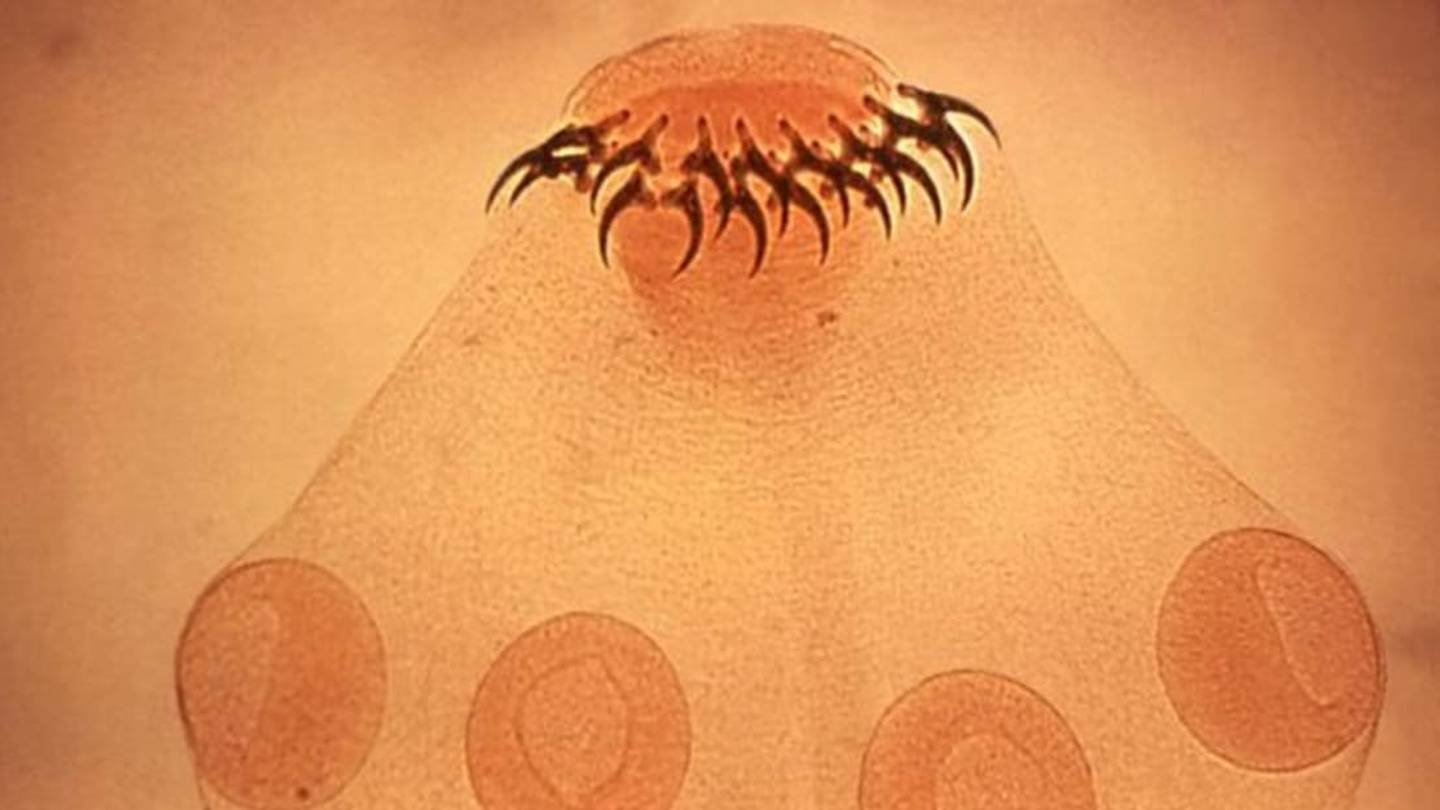
Head of a Taenia solium, or pork tapeworm. Image credit: Rjgalindo via Wikipedia // CC BY-SA 3.0
Adult tapeworms live in animal intestinesâand thatâs not an easy place to call home. For one thing, itâs regularly rocked with muscular contractions that push along digestive material and waste. Tapeworms need to hang on for dear life.
To do this, theyâve evolved specialized âheadsâ that carry an arsenal of attachment devices. Â Some have spines or retractable hooks. Some have circular suckers or grooves that work like suction cups. Many have a combination of these. No matter what weapons the tapeworm has at its disposal, the purpose is the same: to keep it anchored in the intestinal wall so that its body can dangle free and soak up nutrients. Yum!
Tapeworms donât have a gut of their own. Instead, they use their specialized outer surface to absorb nutrients and excrete waste. And they do it pretty efficiently.
Your small intestine has finger-like bumps called villi that basically add more intestinal surface, creating extra space for absorbing food. Tapeworms are also covered in little villus-like bumps that help them soak up more of whatever their host is eating.Â
Beyond the âheadâ and a sort of âneck,â a tapeworm is just a series of segments , each with its own male and female sexual parts. As the tapeworm adds newer segments near the head, older segments move down the body. Eventually, they mature and make eggs. The parasiteâs host then poops out either eggs or egg-filled segments ⦠and thatâs when things get interesting.Â
Tapeworm in a human appendix. Wikimedia Commons // Public Domain
Those new baby tapeworms are about to take an amazing cross-species journey. Most tapeworms hang out in two or three types of animal hosts across their lifespan. The first host gets infected by eating eggs from the environment, and the subsequent hosts get infected by⦠eating the previous hosts. Tapeworms only grow to their full adult formâand reproductive abilityâin their final animal home.Â
Humans arenât the only animals that get tapewormsânot by a long shot. These parasites are found across much of the animal kingdom. Dogs and cats can get them. Birds , too. Fish get tapeworms, as do hyenas, antelopes, moose, wolves, insects such as beetles and ants  ⦠and the list just goes on.Â
AdultTaenia saginata tapeworm. Wikimedia Commons  // Public Domain
Larger animals have larger intestinesâand bigger tapeworms. Whales get tapeworms , and these onboard companions can grow to 100 feet or more . Thatâs over twice the length of the longest giant squid ever discovered.
Not only are tapeworms everywhere, but theyâve also been around for a loooong time. In 2013, scientists from Brazil announced the discovery of tapeworm eggs in fossilized poop from a 270-million-year-old shark. For context, thatâs tens of millions of years before the first dinosaurs walked the Earth.Â
As Carl Zimmer writes in his book Parasite Rex , thereâs a rare tapeworm group that inhabits marsupials in both Bolivia and ⦠Australia. How did these parasites get to two such faraway spots without hopping on a jet plane?
The answer is continental drift. Long ago, the continents of South America and Australia were smushed together, and an ancestral marsupialâwith an ancestral tapewormâroamed their forests. When the continents split up, so did marsupial populations. And the tapeworms came along for the ride.
A kingfisher holding a stickleback fish. Image credit: Getty Images
Tapeworms rely on their first host getting eaten. And some of them donât just sit around and wait for their lucky day (and their hostâs unluckiest one).
For example, one tapeworm species needs three hosts across its lifespan: first a crustacean, then a stickleback fish, and, finally, a bird. While itâs inside the fish, the tapeworm encourages its host to seek out the warmer waters that help tapeworms grow. An infected stickleback becomes larger and more lethargic, which makes it an easier target for predatory birds.
Another tapeworm species exerts similar mental pressure on ants, making them less likely to flee when a hungry bird drops by for a snack. It also turns the ants yellow for reasons that arenât clearâbut probably arenât purely aesthetic.Â
People usually get these parasites by eating raw or undercooked meat, such as beef, pork, or fish . Sometimes people with tapeworm infections will feel weak or nauseated, and they may experience anemia or a vitamin B-12 deficiency . But most of the time, an infected human wonât feel any different . Often, the only sign is those yucky but harmless tapeworm segments in poop.Â
As a side note: anyone can get these and other tapeworm infections, but they are sadly much more common in developing nationsâand in underserved communities with poorer sanitary infrastructure.
Hereâs where it gets (really) gross. Improper sanitation may lead someone to consume tapeworm eggs that came out of another person. The larval tapeworms then hatch and start roaming the body, looking for a safe place to hide out. They can latch onto muscle tissue, brain tissue (where they cause seizures), and other body parts, causing an infection called Cysticercosis . Itâs relatively rare in the United States, though the CDC has labeled it one of five neglected parasitic infections âailments that need more attention.
Adult Hymenolepis nana tapeworms. Georgia Division of Public Health via Wikimedia  // Public DomainÂ
In 2013, a 41-year-old Colombian man showed up at the doctorâs, and tests showed that he had many cancerous tumors. But a closer look revealed something peculiar: the cancer cells were too small to be human. That man also had a tapeworm infectionâand those cells were from his tapeworm. Yes, a tapeworm gave him cancer .
Thereâs no need to worry that something similar will happen to you. This event was astonishing, and astonishingly rare.
Thereâs a persistent myth that placing bowl of warm milk in front of an infected personâs mouth will cause their tapeworm to crawl out. While this may attract some nearby stray kittens, it wonât work on a tapeworm .Â
Hereâs the thing: adult tapeworms hang out in your intestines. To reach the mouth, theyâd have to crawl through a veritable gauntlet of digestive tubing, squeeze through a sphincter up into the stomach and scale the mighty esophagus. Oh, and theyâd have to smell the milk through all of those guts. Tapeworms are very happy staying put, thank you.
If you suspect you have a tapeworm infection, visit a doctor for the proper prescription and let medical science remove your unwanted passenger.
This article has been corrected from the original version.
Loading recommendations... Please wait while we load personalized content recommendations