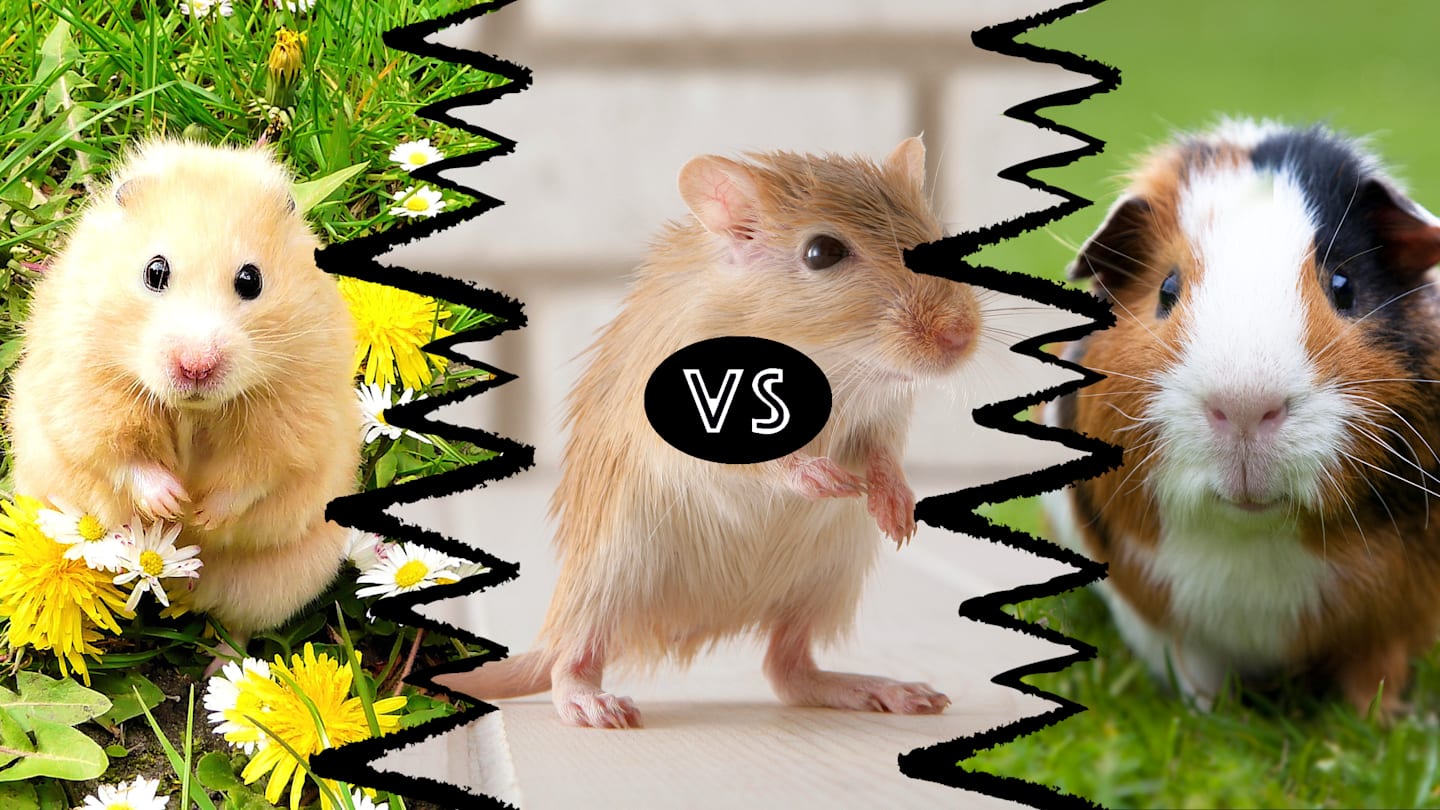
Hamsters, gerbils, and guinea pigs are all types of cute rodents commonly kept as house pets . Hereâs a breakdown of how they differ and which physical features can help you tell them apart.
Depends on the species but often around 4 inches
Not very social with humans or hamsters; like to live alone
Long and covered in fur, like a mouse's
Very social; like to live with other gerbils and be handled by humans
Very social; like to live with other guinea pigs and be handled by humans
Hamsters, gerbils, and guinea pigs belong to the same scientific orderâRodentia, i.e. rodentsâbut theyâre in different families.Â
Hamsters are their own subfamily ( Cricetinae ) of Cricetidae (a.k.a. cricetids), which also includes lemmings, voles, muskrats, and New World rats and mice. Gerbils are part of a subfamily ( Gerbillinae ) within Muridae (murids), which also includes whistling rats and Old World rats and mice.
In other words, the terms hamster and gerbil each encompass various species. The same isnât true for guinea pig , which is a colloquial term for one particular species of cavy: Cavia porcellus . Cavies make up the family Caviidae . So guinea pigs are more closely related to other cavy speciesâlike capybaras and marasâthan to hamsters and gerbils.
Most gerbils are somewhere between 4 and 7 inches long , not including their tails. Hamsters vary a bit more by species. Golden hamsters, or Syrian hamsters , are usually around 6 to 8 inches long, while most Chinese hamsters are in the 3-to-5-inch range; and dwarf hamster species usually cap out around 4 inches long. The European hamster is significantly bigger than its kin: between 8 and 14 inches.
The easiest way to tell a hamster from a gerbil is to look at its tail. Gerbil tails are at least a few inches long, while most hamster tails are stumpy. Gerbils also just generally look more like mice than hamsters do, with pointy faces and thin bodiesâcompared to hamstersâ chubbier and rounder appearance. And hamsters have expansive cheek pouches that they fill with food, which gerbils donât have. Another difference is that gerbils are known to stand on their hind legs more than hamsters.
Guinea pigs donât have cheek pouches or tails, and their faces are fairly distinct from both hamsters and gerbilsâmore rectangular than triangular, with a long nose that slopes downward. And at 8 to 10 inches long, guinea pigs are generally larger than many pet gerbils and hamsters.
Behavior-wise, hamsters are the odd one out. Theyâre predominantly nocturnal and not very social, with a tendency to be territorial about their space. A dwarf hamster can be OK with sharing a large cage with another dwarf hamster, but itâs recommended that you make sure each creature has its own food, water, toys, hideouts, etc. As Oxbow Animal Health puts it, âHamsters are more likely to get along if they donât have to share resources.â And while you can train hamsters to let you hold them, theyâre not the best option for people who want an especially cuddly and social pet.Â
Gerbils and guinea pigs, on the other hand, are very social both with people and with their own kind. Itâs often recommended that you buy gerbils and guinea pigs in pairs so they donât get lonely. (In Switzerland, itâs actually illegal to own only one guinea pig.) Their sleep schedules varyâsome sources label them crepuscular , i.e. most active around sunrise and sunsetâbut they are generally awake during the day .
You can expect a gerbil to live for three to four years, while a hamsterâs life expectancy is a little shorter than that: 1.5 to three years. According to Chewyâs petMD, âAny hamster that is a year and a half old is considered elderly.â¯â Guinea pigs have the longest lifespan of the threeâoften cited as five to seven years, though they sometimes live double that .
Gerbils and hamsters are both omnivores: They like a variety of fruits, vegetables, and grains, plus insects and mealworms. Guinea pigs are herbivores, so they enjoy fruits, vegetables, and lots of grass hay .
Read More Stories About Animal Differences:
Have you got a Big Question you'd like us to answer? If so, let us know by emailing us at [email protected] .