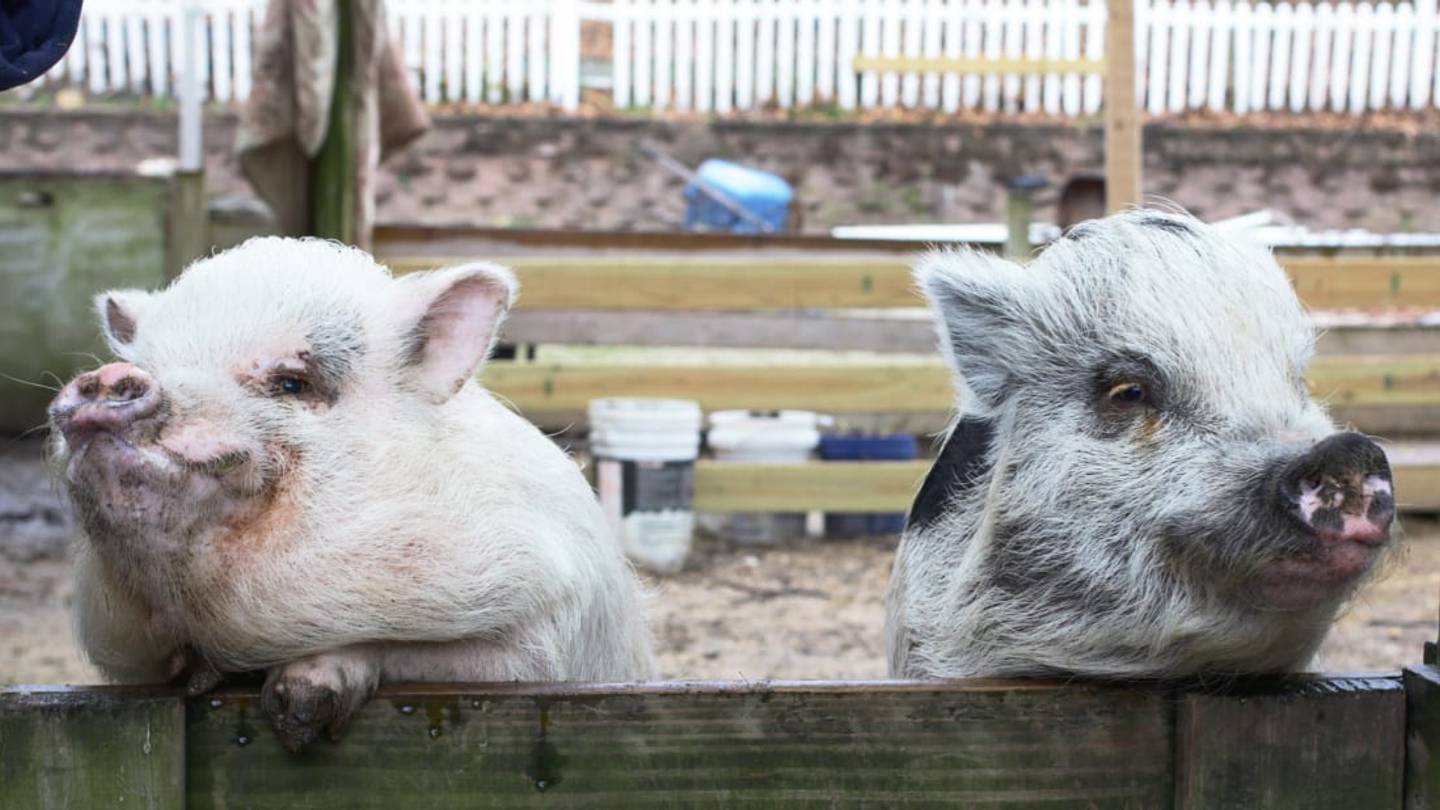
At mealtimes, Janice Skura ambles between the pig pens in the yard of her Long Island home, greeting each of the pigs she's rescued by name as she drops wet food from a bucket into their troughs. She says please when she asks them to move, and thanks them when they do.
âIâm polite to them,â she says. âI just think itâs nice to be acknowledged.â
Skura, 57, lives on an acre of land in a Long Island suburb an hourâs drive from New York City. The property-turned-sanctuary is home to 32 potbellied pigs, all surrendered by owners who couldnât or didnât want to care for them.
Potbellied pigs, a breed that originated in Vietnam and stays smaller than those raised for meat, were a fad pet in the 1980s; at the height of their popularity, potbellied pigs were sold for tens of thousands of dollars . Breeders continue to list them online today, with unscrupulous sellers advertising them as âteacupâ pigs that will stay small. When the pigs grow to weigh between 70 and 100 pounds (or heavier), as most of them do, surprised owners often realize they got much more pig than they bargained forâand thatâs when they turn to Janice. Skura estimates she has saved 500 to 600 pigs over the 17 years sheâs been running her sanctuary.
âPigs are not dogs, theyâre not cats. Youâll have behavior problems,â Skura says. âPigs want to be the top pig. They do better off with a herd. Pigs in a herd learn manners, and when theyâre an only pig they tend to get fresh.â
Each day, feeding and poop-scooping comprise the bulk of Skuraâs maintenance. The pigs stay quiet until she appears for her once-daily feeding routine around noon. After the pigs have had their lunch, Skura makes another pass with a small rake and scooper, dumping the dense nuggets of excrement down what she calls the poop chute, a pipe sticking out of the ground in her backyard that leads to a defunct cesspool. She distributes fresh hay in each pigâs house as needed, clips hooves, and cuts tusks that have grown to problematic lengths. You can hear her tell each pig âI love youâ as she tends to their needs.
âThe number of pigs I have is too many,â Skura says. âItâs very hard for me. I want to love on all of them every day and I just physically canât.â
Most pigs that end up in Skuraâs attentive custody live out their days with her, although she adopts out any that she can find a good home for. Locating a worthy home is no easy taskâSkura considers her pigs part of the family, after all.
âYou have to make sure youâre going to give the pig a better life than I could give it,â Skura says. So she visits the homes of all potential adoptees prior to adoption and follows up after making a placement to check that the pig is happy and give the new owners any help they may need.
âIt breaks my heart,â she says of rehoming her pigs. âItâs like a piece of me is gone. Like right now I could get choked up when I think of some of them that I did give up and I never should have. As much as itâs enriched my life, my life is a living hell when I think of all the ones that Iâll never see again, that loved me and trusted me. We had such a bond, and I just put them in someoneâs car and let them drive off.â
Skura was always an animal lover, she says, though her mother only let her have a pet bunny when she was young. As an adult, she spent years working as a caregiver for babies and the elderly. She had wanted to take in foster children, she says, but she got married and had two sons of her own before she had the chance.
âFalling in love with pigs fulfilled that [nurturing] need for me,â she says. It has become her full-time job.
Skura took in her first pig in 2000; at the time, she was rescuing pet rabbits. She felt overwhelmed by her furry charges and visited a local farm to get some help. During the visit, the farmâs owner pulled what looked like a fetus, with umbilical cord still dangling, from inside her coat and asked Skura if she wanted it. It was a three-day-old piglet.
âThe minute I saw it, not even knowing what it was, I wanted it,â Skura says. âAnd I loved it from that minute.â
Skuraâs husband, Peter, a union electrician, was into it at first. âI thought the little pigs were, you knowâit was cute,â he says. âI wanted the first one just as much as [Janice] did. I thought it would be a great little pet, something different. Never thinking it was going to evolve into this.â
Gone are Peterâs dreams of a lush lawn and pristine back patio. After a few early successful adoptions, Peter thought the operation might be scaling back. But he quickly found that these only made room for more rescues.
âI donât ever see it ending,â Peter says. âI just gave up [asking to scale back]. Whatever.â
He doesnât share his wifeâs passion, but Peter has built fences and pitched in when heavy lifting is needed, like when a pig dies and needs to be buried. (Their graves are 6-foot-deep holes at the top of a wooded hill behind the house.) Above all, Peter knows the pigs make his wife happy.
âI seen her drive all night to take a sick pig somewhere, or go out at 1 or 2 in the morning with my son to go catch a pig thatâs running around the streets,â he says.
Their son Stephen, 25, has spent almost his whole life helping care for the pigs. âIt actually does teach you a lot of values about taking care of stuff,â he says. âEvery parent buys their kid a dog and says, âYouâre going to clean up after your dog and take it for a walk every day.â Well, I grew up with, âYouâre feeding 40 pigs and cleaning up after them every day.ââ
Skuraâs operation is illegal. Town officials know about it, Skura says, but leave her be because they donât get any complaints. âIâm so grateful that they kind of cooperate with me,â Skura says.
In nearly two decades, officials have only intervened once. They had received a call about a 600-pound pig, Babe, that Skura took from a nearby animal shelter when he was a piglet. She didnât know there was a difference between ordinary farm hogs and potbellies. But Babe didnât top out at 100 or even 200 pounds, and Skura received a letter from the town notifying her that she had been reported for having an agricultural animal at her address. She found Babe another home, and things have been quiet since.
In fact, Skuraâs expertise has helped authorities out of binds in the past. She once got a call from police who had raided a property on Long Islandâs East End where various animals were being bred and neglected. Dozens of carcasses were found there, and a surviving pig had evaded capture by police officers and workers from the American Society for the Prevention of Cruelty to Animals. They wanted help.
When Skura arrived on the scene she immediately got down to business. âI got down on my knees and was saying, â hawhawhawhawhaw ,â and the little pig stopped [running away],â Skura says, imitating the airy sound pigs make when they utter a friendly greeting. She inched closer, kept hawhaw ing, and reached out to scratch his chin, then scratched his belly.
âThey were standing with their jaws open,â she says of the officers, âlike, âWhat the hell just happened?ââ
Unique animals attract unique people, and a home doubling as a pig sanctuary produces some unusual scenarios. There was the time a bagpipe player and his harpist wife wanted to adopt a pig, so they brought their instruments to make sure the pig they picked wouldnât be freaked out by the noise. The bagpipes blaring in the driveway woke Stephen, who went downstairs and found the woman sitting on the kitchen floor strumming her harp. Stephen went back upstairs. The couple took two pigs home.
Some of Skuraâs charges find their way into show business. Two separate animal talent agents in Manhattan call when they want a pig for a photo shoot or a TV appearance. Skura has various sizes and colors the casting agents can pick from, and several of her pigs have appeared in magazines like Cosmopolitan and Menâs Health . Skura has provided pigs for Live! With Kelly and Michael , Inside Amy Schumer , and The Martha Stewart Show , to name a few.
At Stewartâs studio, a piglet slipped out of the greenroom while Skura was otherwise engaged.
âI said, âWhereâs that little pig?ââ Skura says. âAnd then I got up and I didnât see it in the hallway. I thought, âOh my God.â I tiptoed down the hall and there he was in Martha Stewartâs dressing room, messing up her shoes. I just quick straightened up her shoes and picked him up and went on.â
The shoots, infrequent though they are, generate some much-needed funds for supplies. Feed costs about $10 per day, and medical expenses can add up to a couple thousand dollars a year (Skura's veterinarian happens to be named Dr. Wilburs). Then thereâs hay, wood for fencing repairs, transportation costsâSkura pays for it all out of pocket. She doesnât ask for donations.
Her giving nature is her defining feature, says Skuraâs friend Kathy Montreuil. âSheâs an extraordinary woman. She gives selflessly and she gives from the heart, with no expectations from anyone, even from the pigs. If theyâre happy, sheâs happy,â Montreuil says.
Skura buys gifts for people who enter her orbit. She arranges an assortment of snacks on the kitchen counter each morning for Stephen to pick from on his way to work. She tries to work through problems with stressed pig owners who want out; when they insist she take their charges, she has trouble saying no.
âI donât want to see any living thing suffer,â Skura says. âEven an animal thatâs been hit on the road, I jump out and move it over so it doesnât get run over one more time. Because how would you like it to get run over again and again?â
For all she gives them, Skura says the pigs give back. âTheyâre my constant,â she says. Sheâs learned their language and their individual traits, and has let them teach her patience.
âIâve talked to them and theyâve actually come around,â Skura says. âI know that sounds weird, but Iâve actually explained things to them and then theyâll get up and kind of cooperate with me. Itâs crazy, but itâs true. Theyâre so intelligent.â
Skura wishes more people would see it. âThey are the most misunderstood animals in the world,â she says. âIf I could just change one personâs mind a day Iâd accomplish something. They think [pigs are] filthy. They think they smell. People have told me, âYeah but they eat their own poop.â They think theyâre disgusting.â
Skura rattles off unflattering pig stereotypes: Youâre stupid as a pig; youâre disgusting like a pig. âThey give them no credit for intelligence,â she says. âThereâs a total disregard for the whole swine family and itâs so wrong. Theyâre wonderful little creatures.â
If you are interested in adopting a pig or need Janiceâs help caring for one you already own, you can contact her at [email protected] .
All images courtesy of Micah Danney
Loading recommendations... Please wait while we load personalized content recommendations