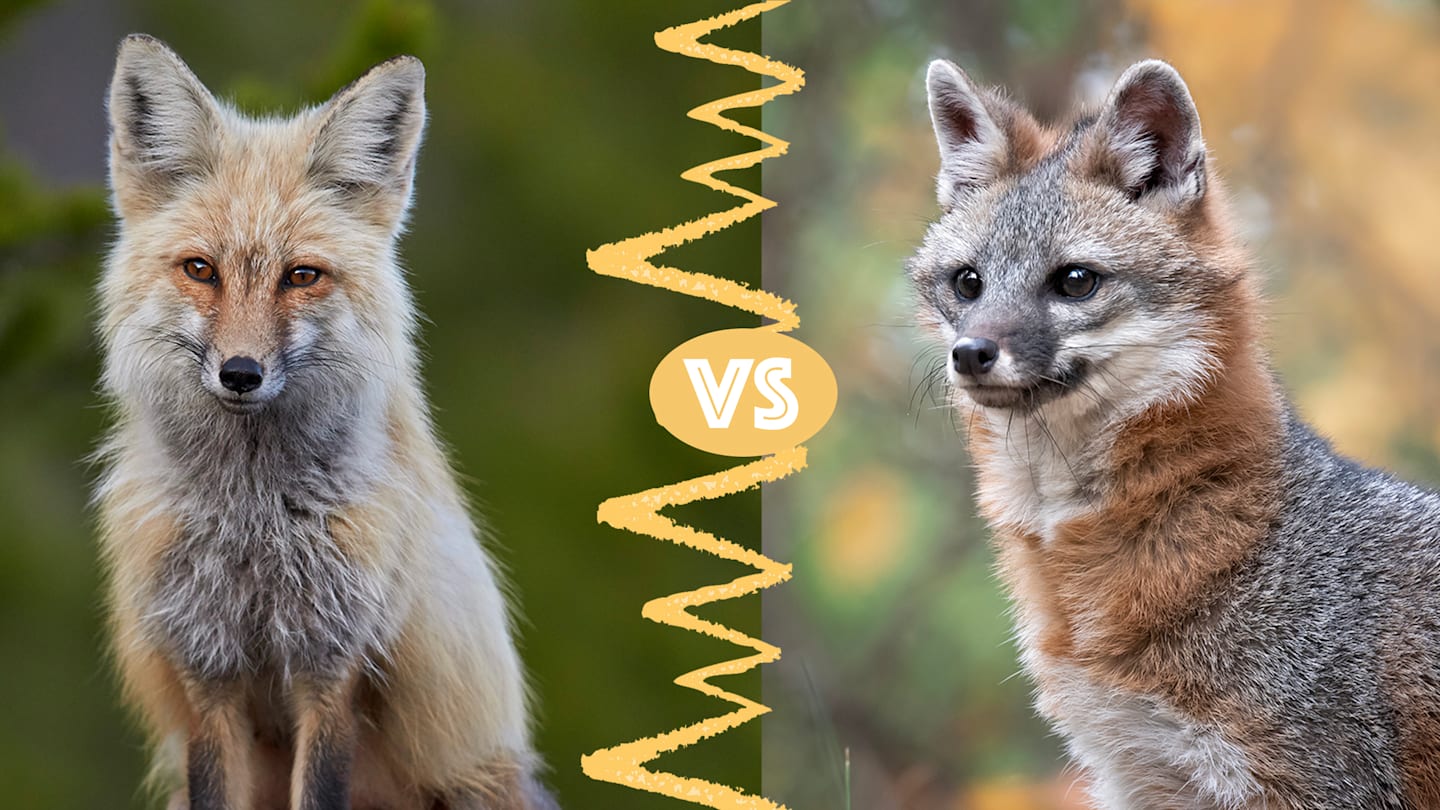
You may think that if youâve seen one fox , youâve seen them all. But while theyâre all part of the Canidae (dog) family; communicate using intricate yips, barks, and squeals; and follow nocturnal and crepuscular activity patterns, thereâs more than one type of fox slinking around the woods of North Americaâand when you really start to compare them, youâll quickly realize there are many differences between them.
Hereâs a closer look at two commonly found North American speciesâthe gray fox and the red foxâand some tips on how to tell them apart.
Can be red, black, silver, and red/silver; will usually have black legs and black ear tips, and often has a white tail tip
Long, pointy snouts with pointier, dog-like ears
Urban, suburban, and agricultural neighborhoods, as well as forests and marshes
Urocyon cinereoargenteus
Salt and pepper gray, with a black dorsal stripe and black-tipped tails
Shorter, stouter snout with slightly rounded, more cat-like ears
Forests and marshes, usually farther away from human settlements
There are several ways to visually tell the difference between a red fox ( Vulpes vulpes ) and a gray fox ( Urocyon cinereoargenteus) . Hint: Relying on their name alone doesnât help much! Despite their moniker, red foxes can have a variety of color morphs , including yellowish red, black, silver, albino, or even a cross between red and silver, which is called a â cross fox .â Red foxes do, however, typically have black legs, a white tail tip, and black ear tips.
Most gray foxes , on the other hand, have dark, grizzled gray salt-and-pepper coats, with a black stripe that runs down their backs, and black-tipped tails. Theyâll occasionally have some rusty or reddish coloration around their necks and on their legs.Â
From tip to tail, both species of foxes measure between 31 to 44 inches long and weigh between 7 to 15 pounds, with males being slightly larger than the females. The gray fox often appears significantly smaller because it has shorter legs and a stockier body.Â
There are differences in their faces, too. Red foxes look much more like dogs âthey have longer snouts and pointy, canine-looking ears. Gray foxes, on the other hand, have a more cat -like appearance, with smaller snouts and more rounded ears.Â
Both red and gray foxes live in North America, and their ranges overlap to cover most of the U.S. The red foxâs range extends north into most of Canadaâin recent years, warming temperatures have allowed them to encroach upon the arctic foxâs territoryâwhile the gray fox can be found farther south, into Mexico Central America.
When it comes to habitats, red foxes thrive in a wide variety of places: You can spot them in urban, suburban, and agricultural neighborhoods, as well as in forests and marshes. Theyâll dig dens (or sometimes claim cozy spots another species had previously dug up) to give birth and raise their young. It isnât unusual for someone to discover a red fox family has set up camp beneath their backyard shed or deck.
Gray foxes, on the other hand, generally choose to live farther away from humans; youâll typically find them deeper in the woods where thereâs more tree cover, and closer to lakes, rivers, and marshes. Theyâll select a den site thatâs in some sort of rocky crevice, or even in a hole in a tree. Unlike other fox species, gray foxes have impressive climbing skills, thanks to their sharp, curved claws. They can also rotate their forelegs, which helps them grip tree trunks. Â
Both foxes are opportunistic foraging omnivores. Theyâll feast on birds, insects, small mammalsâgray foxes have a particular penchant for rabbitsâand berries. If food is abundant, theyâll cache it away, burying it for later use under piles of leaves, snowbanks, or stacks of brush.Â
Read More Stories About Foxes Here: