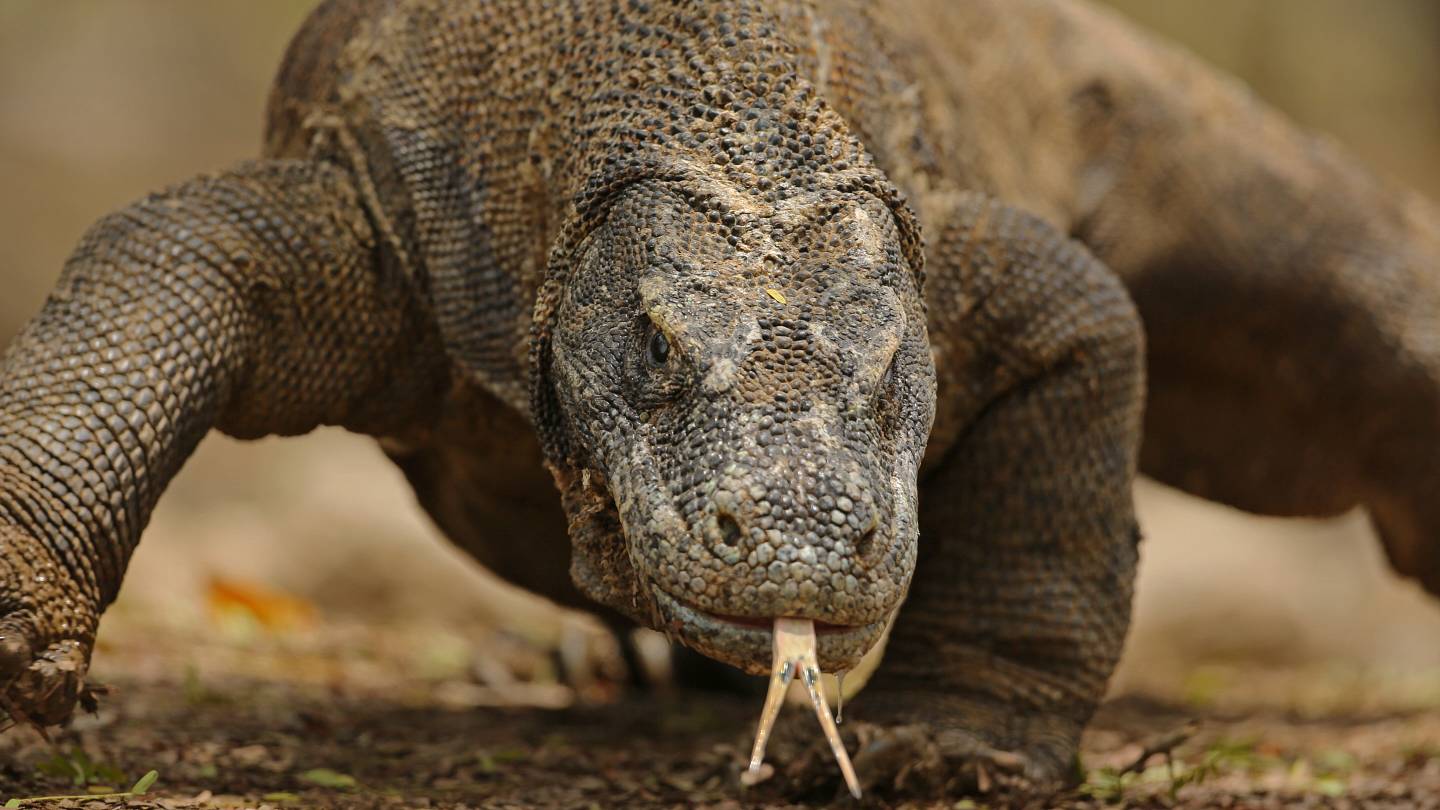
In addition to being Earthâs largest living lizard, behavior like human-eating and grave-robbing are the Komodo dragonâs biggest claims to fame. But did you know that these guys are also surprisingly intelligent, even playful, creatures gifted at both long-distance swims and virgin births? Read on to learn more.
Western scientists didnât find out about the giant reptiles until 1912, but long before they finally showed up on academiaâs radar, Komodo Island residents had given them the name ora , which means âland crocodile.â
Traveling between Indonesian islands is often a necessity for hungry Komodo dragons; the animals are sometimes spotted paddling along miles off shore.
Snakes and many lizards have forked tongues to pick up microscopic, airborne taste particles. After being exposed to air, the tongue gets retracted and its prongs are inserted into the animalâs Jacobsonâs organ (located on the roof of its mouth). This enables the reptile to identify whatever flavors it has just picked up, which allows Komodo dragons to start tasting a scrumptious carrion dinner from more than two miles away.
Halfway through his only term, Bush 41 was given a male Komodo dragon, courtesy of Indonesiaâs government, named Naga. While the idea of letting a giant lizard prowl around the Oval Office sounds pretty awesome, the president instead chose to hand him over to the Cincinnati Zoo. After fathering 32 offspring, Naga died in 2007 at the age of 24.
Scientists once believed Komodo dragons had saliva laden with deadly bacteria, and that bites containing the spit were potent enough to bring down a water buffalo. But that wasnât actually the case: In 2009, biochemist Brian Fry tested this conventional wisdom by hunting for dangerous microorganisms inside several Komodo dragon mouths. But Fry learned that the saliva had proportionally fewer bacteria than that of most meat-eating mammals. However, he did find venom glands. Situated in the lower jaw, these release a nasty cocktail that causes paralysis, extreme blood loss, tissue damage, and excruciating pain. Those poor buffalo never stood a chance.
Having freakishly flexible jaws really helps these creatures gorge. Komodo dragons can swallow smallish animals (like mid-sized piglets) whole.
Mortal encounters between Komodo dragons and humans were documented in 1974, 2000, 2007, and 2009. The 2009 attack involved a man who fell from an apple tree and was mauled by two dragons while lying dazed on the ground. As a general rule, Komodo dragons prefer raiding graves to killing people, so people on the island frequently pile rocks over their loved onesâ tombs as a deterrent.
Wannabe Komodo dragon moms neednât wait around for a male to help them. On multiple occasions, captive females have laid eggs that produced healthy babies despite not mating first. In fact, one mother had never even shared an enclosure with a member of the opposite sex before. When no males are around, female Komodo dragonsâlike certain other lizardsâare capable of parthenogenesis, a process in which certain egg cells can fertilize each other.
Adults are anything but picky eaters and wonât think twice about devouring their own offspring. Until they grow large enough to fend for themselves, young Komodo dragons keep away from hungry grown-ups by taking to the trees, where they become nimble, branch-climbing predators. When close encounters happen, juveniles make themselves as unappetizing as possible by rolling in dung , which not even the most ravenous dragons can stomach.
A version of this story originally ran in 2021; it has been updated for 2024.
Loading recommendations... Please wait while we load personalized content recommendations