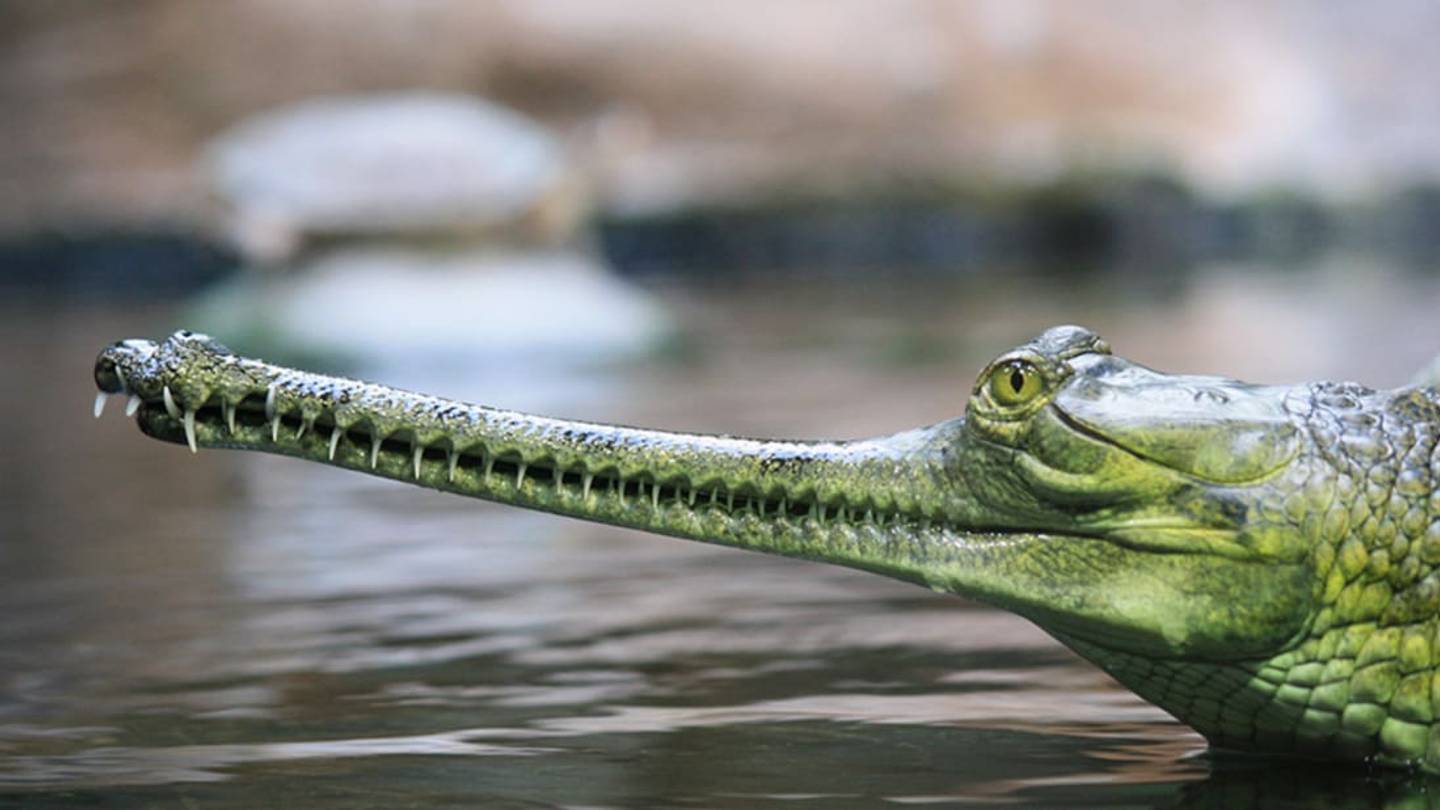
Once a widespread predator, the strange, skinny-jawed gharial is now critically endangered and has been restricted to a handful of Nepalese and northern Indian rivers. Hereâs everything you should know about the worldâs most unusual crocodilian.
When a male of this species gets to be around 10 years old , a bulbous knob will start to emerge just behind his nose. (More about that in a minute.) Scientists refer to the knob as either the ghara or gharal. Both termsâalong with the animalâs common nameâare descended from the Hindi word ghara , which is a round earthenware pot. A common sight in India and Nepal, ghara pots bear a passing resemblance to the gharialâs snout.Â
The gharial is the only living crocodilian that is visibly sexually dimorphic beyond body size: Females donât have the aforementioned gharas. At around 11 to 14.5 feet long, they're also much smaller than the males, which typically range from 16 to 19.5 feet in length. Some monstrous, 21-foot male specimens have been documented. Such huge individuals can weigh a whopping 1500 pounds, making them some of the heaviest reptiles on Earth. And yet in weight, they're completely upstaged by the famous saltwater crocodile, which can weigh more than a ton .
Whereas most crocodilians have rather broad snouts, a gharialâs is so long and thin that it looks like a toothy broomstick. Comical as these jaws may seem, the slender shape is perfectly designed for snapping up the animalâs favorite food: fish. The gharial snout can rapidly slice through the water with minimal resistance , and its jaws are equipped with 106 to 110 needle-like teeth, which interlock when the crocodilian snaps its mouth shutâimpaling any fish that happen to be between its jaws.
As it grows, a gharialâs snout changes shape , and its diet evolves accordingly. Since hatchlings have broader jaws than adults do, the youngsters mainly eat insects, crustaceans, and frogs. Over time, their snouts get thinner and longer and become ill-suited for snapping up the large land animals that other crocodilians tend to pursue. Full-grown gharials almost exclusively dine on fish, although big individuals sometimes gulp down the occasional bird, reptile, or small mammal.
With their specialized jaws, gharials just arenât built to take down big land animalsâincluding us. Attacks on people are exceptionally rare âonly a handful have ever been reported, and most cases implicate either a mother gharial who was protecting her nest or an irate specimen that had gotten tangled up in somebodyâs fishing net. Not one of these interactions resulted in the loss of human life.
Still, while the beasts donât kill people, they do scavenge our cadavers. Homo sapiens remains have been found inside gharial stomachs, along with bracelets and jewelry. Corpses are regularly sent down the Ganges river as part of a Hindu funerary custom, and to the gharials that stalk these waters, lifeless bodies make for easy targets. There's another benefit to eating humans, too: Like all reptiles, gharials canât chew and must gulp down their meals in large chunks. In order to better process its meals, a gharial will swallow hard objects like rocks, which, within the stomach, jostle around and mash up undigested chow. Some theorize that the crocodilians might be deliberately swallowing human jewelry because it helps them to digest real food.
The ghara, which mainly consists of cartilage, is attached to a flap that partially covers the nostrils. Taken as a whole, this apparatus acts like a resonating chamber . When the male exhales, the flap starts vibrating, which can produce a long-range buzzing noise. Itâs believed that this sound is used to communicate with females in mating season. Furthermore, males blow bubbles through their gharas during the courtship ritual.
Normally, crocodilians keep their legs sprawled out to the sides on dry land. However, most species can also do whatâs known as a â high walk .â To do so, the animals straighten their legs and raise their bellies high above the ground; this allows a crocodile or alligator to stride across rocky terrain without scratching up its underside. In general, the high walk is reserved for short forays, although some crocsâparticularly juvenilesâwill use it during long-distance treks as well.
But to gharials, high walking isnât an option. Compared to other crocodilians, this species has abnormally weak limb musclesâso when they're on land, gharials must resort to pushing themselves along on their stomachs. They're much better suited to swimming, and, in fact, itâs been argued that the gharial is the worldâs most aquatic crocodilian . By and large, gharials only ever haul themselves ashore to bask or to lay their eggs.
Once they reach sexual maturity at age 10, female gharials are inducted into a harem . Usually, these groups consist of four to six members who are jealously guarded by a resident bull male. Come mating seasonâwhich lasts from December to January âthe resident bull breeds with all the females and fights to keep rival males at bay. Later, as the water levels recede during the dry months (March to May), the nesting season begins.
Gravid females looking to dig their nests will seek out deep sand banks, and the beaches of small, mid-river islands are considered idealâpredators will be less likely to disturb the eggs there. Using mainly her hind limbs, the female will create a pitcher-shaped burrow into which she'll deposit anywhere from 30 to 50 eggs. On average, each weighs about a third of a pound, making them the biggest eggs produced by any crocodilian .Â
Throughout the incubation period, the gharial will spend every night sitting beside her nest and every day keeping a close eye on it. Finally, after about 70 days, the eggs hatch into chirping, foot-long babies. Hearing their cries, the mother helps dig the newborns out of their burrow. Theyâll spend a few months under her protection before striking out on their own.
Junkyardsparkle , Flickr // CC0
Present-day crocodilians are divided into three groups . First, thereâs the aligatoridae family, whichâas the name suggestsâincludes alligators, along with caimans. Meanwhile, all âtrueâ crocodiles (for example, saltwater and Nile crocs) are contained within another group called the crocodylidae. Last but not least is the third and final subgroup, the gavialidae.
Traditionally, the gharial has been regarded as the only extant member of this last bunch. Yet, some experts believe that another gavialid is wandering around out there. The creature in question is Tomistoma schlegelii , also known as the false gharial (pictured above). A native of southeast Asia, this endangered reptile can grow longer than 16 feet and weigh more than 450 pounds. Like its namesake, the false gharial has a long, slender snout filled with needle-shaped teeth. Yet, despite these features, itâs long been classified within crocodylidae.
Until fairly recently, most biologists believed that this animalâs resemblance to the true gharial was 100 percent superficial. However, some new information has forced scientists to reconsider the relationship between these two predators. Molecular data suggests that Tomistoma should, in fact, be regarded as a member of the gavialidae family. Still, many scientists arenât sold. At the anatomical level (and in the fossil record), false and true gharials are quite differentâespecially in terms of tail and jaw musculature. Given all the contradictory evidence we have to sort through, it looks like this debate wonât be settled anytime soon.
Juveniles tend to frequent side streams and tranquil backwaters. Mature gharials, on the other hand, are usually found in deep, fast-flowing rivers. Most of their time is spent in the calmer sections of these bodies, away from the high-velocity currents. Adults are especially fond of river bends and confluences, where theyâre known to gather en masse.
Overfishing, poaching, and habitat loss are all contributing to the decline of this species. Invasive prey items also bear some of the blame. In an attempt to boost the local fishing industry, African tilapia have been deliberately released into Indian rivers since the 1950s. It turns out that the foreign fish are terrible for gharials, which can die of gout after eating them. Itâs believed that the tilapia contained chemicals from polluted rivers and when the gharials ate them, the toxins became concentrated, leading to gout. Or itâs possible that some unidentified toxin could be to blame.
Factors like these have put the gharialâs long-term survival in jeopardy. For millennia, they patrolled the rivers of Pakistan, Myanmar, Bangladesh, and Bhutan. But over the past century, theyâve gone extinct in all four countries. Today, the species occupies just 2 percent of its former range. According to the World Wildlife Federation, a meager 1100 wild gharials currently reside in India, while fewer than 100 holdouts live in Nepal. Itâs estimated that the global population of adult specimens has fallen below 400.
On the positive side, there have been record hatchings in recent years, and this year, 2500 hatchlings were counted on the Chambal River. Hopefully, captive breeding efforts and education initiatives will be able to replenish their numbers. Who would want to live in a world without gharials, anyway?
Loading recommendations... Please wait while we load personalized content recommendations