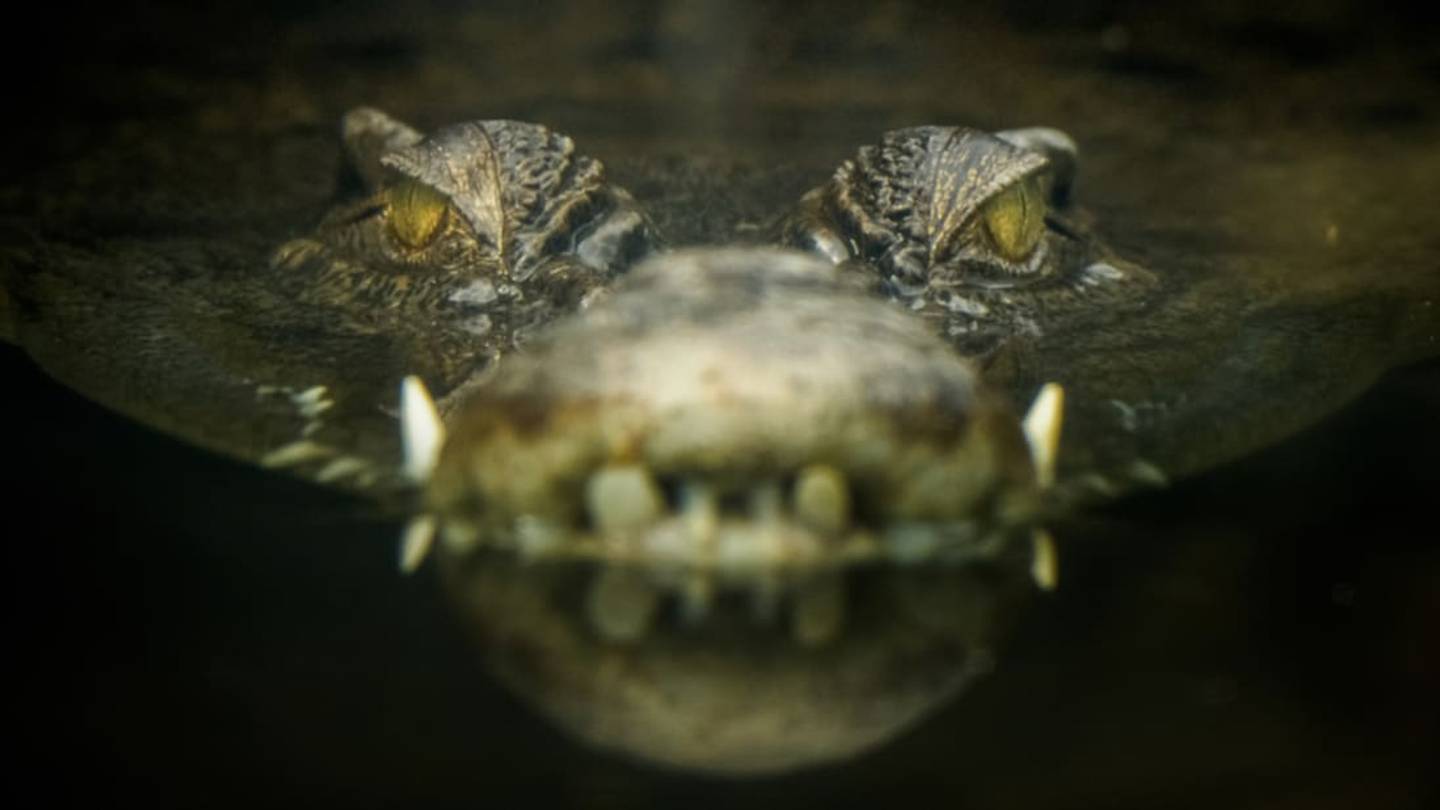
There are a lot of myths out there about crocodilians, the order to which both alligators and crocodiles belong. Evon Hekkala, the principal investigator at Fordham Universityâs Hekkala Lab and a research associate at the American Museum of Natural History, spoke with mental_floss after the opening of AMNHâs latest exhibition, â Crocs: Ancient Predators in a Modern World ,â to get to the truth.
Winning Brew, the Guinness World Record holder for Fastest Racehorse, clocked in at nearly 44 mph during her record-breaking run. Crocs donât get anywhere near that fast on land. âThey top out at about 12 mph on land, and they can only do it for a really short period of timeâfor maybe 20 or 25 meters,â Hekkala says. âA really fast human race walker, goes about 11 or 12 miles on land. In other words, without even breaking into a run, most people could actually outrun a crocodile.â
In the water, though, itâs a different story: Crocs still arenât as fast as racehorses, but they can reach speeds a little over 20 mph. âI wouldnât want to try to outrun one in the water,â Hekkala says.
Though people often refer to crocodilians as lizards, lizards are an entirely separate order not related to crocodilians at all. According to Hekkala, â[Crocodilians] are the other lineage of living archosaurs,â a.k.a. â ruling reptiles ,â which have two lineages: âThereâs the lineage that includes dinosaurs and birds and then thereâs the lineage that includes crocodiles, and theyâre each otherâs closest relatives,â she says. âTheyâre quite distant from lizards, even though they look sort of superficially similar.â And speaking of that â¦
Though crocodiles and alligators look very similar, their last common ancestor lived 65 million years ago. âThatâs about as far back in time as when the primates diverged from things like bats,â Hekkala says. âThey look really similar because itâs a really great body plan that works really well, and thereâs no need to change that. So even though they look superficially like theyâre the same thing, theyâve evolved on different pathways for a really long period of time.â
âA lot of people think [crocodilians have] tiny lizard brains,â Hekkala says. âBut actually there are people at the American Museum of Natural History who are studying the evolution of the brain in birds, dinosaurs, and crocodilians, and the brain is much more complex than we previously thought.â
Like birds, crocodilians have complex social systems (more on that in a minute), and they can even be trained. âThere are people recently who have been training captive populations of crocodiles to come to a clicker so that they can get their veterinary treatment, and itâs working,â Hekkala says. Crocs can be trained the same way you train a dog or a cat: The croc comes to the clicker and gets a treat, reinforcing the desired behavior.
OK, now on to that complex social behavior. âThere was a myth, for a long time, that crocodilians were these terribly baby-eating predators,â Hekkala says. âA long time ago, people would observe the crocodiles and alligators digging up nests and having hatchlings in their mouths, and they would think that they were eating them.â In reality, the baby crocodilians were actually calling out to their parents for help out of the nest as they were hatching, and when moms were walking around with babies in their mouths, it was because they were taking their young to the water. âThereâs parental care and communication,â Hekkala says. Male crocodilians will occasionally cannibalize young, but âtypically, when you see a crocodile or an alligator with babies in its mouth, itâs helping, not hurting.â
The animals can delicately carry their young thanks to pressure sensitive pits in their skin. âAlligators only have them on part of their jaw, but crocodiles actually have the pits all over their skin, everywhereâall over their face, all over their bodies, and theyâre unbelievably sensitive to pressure, and these were only recently discovered,â Hekkala says. âItâs an amazing new finding, and thatâs probably one of the things that allows them to be so gentle with the hatchlings.â
If you looked at a crocodilian, or had a purse made of their skin, and thought their armored skin was super hard, you wouldnât be alone. âMost peopleâs experience of any kind of crocodilian skin is a tanned leather purse or something like that,â Hekkala says. âThose things are made to be hard so they can be sturdy, but their skin is actually quite soft, and very sensitive.â
Rather than having scales like lizards, crocodilians have skin with bony plates underneath in certain areas. âThis is going to sound weird,â Hekkala says, âbut if you were holding a crocodileâs hand, it would feel strangely similar to a human hand. A little cooler unless theyâd been hanging out in the sun, but yeah.â
Millions of years ago, crocodilians were a very diverse group, living in the sea and on land and ranging in size from small, cat-like creatures to creatures huge enough to dine on T. rex . These days, most people think that there are just two living crocodiliansâalligators and crocodilesâbut there are actually many more than that. âThere are two species of alligator: the one weâre familiar with in North America, and the Chinese alligator, which is critically endangered,â Hekkala says. âWhen I first started my research into crocodiles, there were thought to be 11 species of true crocodiles in the genus Crocodylus , but weâre discovering more and more species.â
By analyzing the DNA of museum specimens, Hekkala discovered that the Nile crocodile was not one species of croc but actually two . And that was not an outlier: âNow we know that the dwarf crocodile thatâs in the exhibit is three species, and we think that the African slender snouted crocodile is now two species,â she says. âSo since 2009, just from molecular research, weâve addedâjust in Africaâfour new species of crocodile.â
The American Museum of Natural Historyâs â Crocs: Ancient Predators in a Modern World â runs until January 2, 2017.
Loading recommendations... Please wait while we load personalized content recommendations