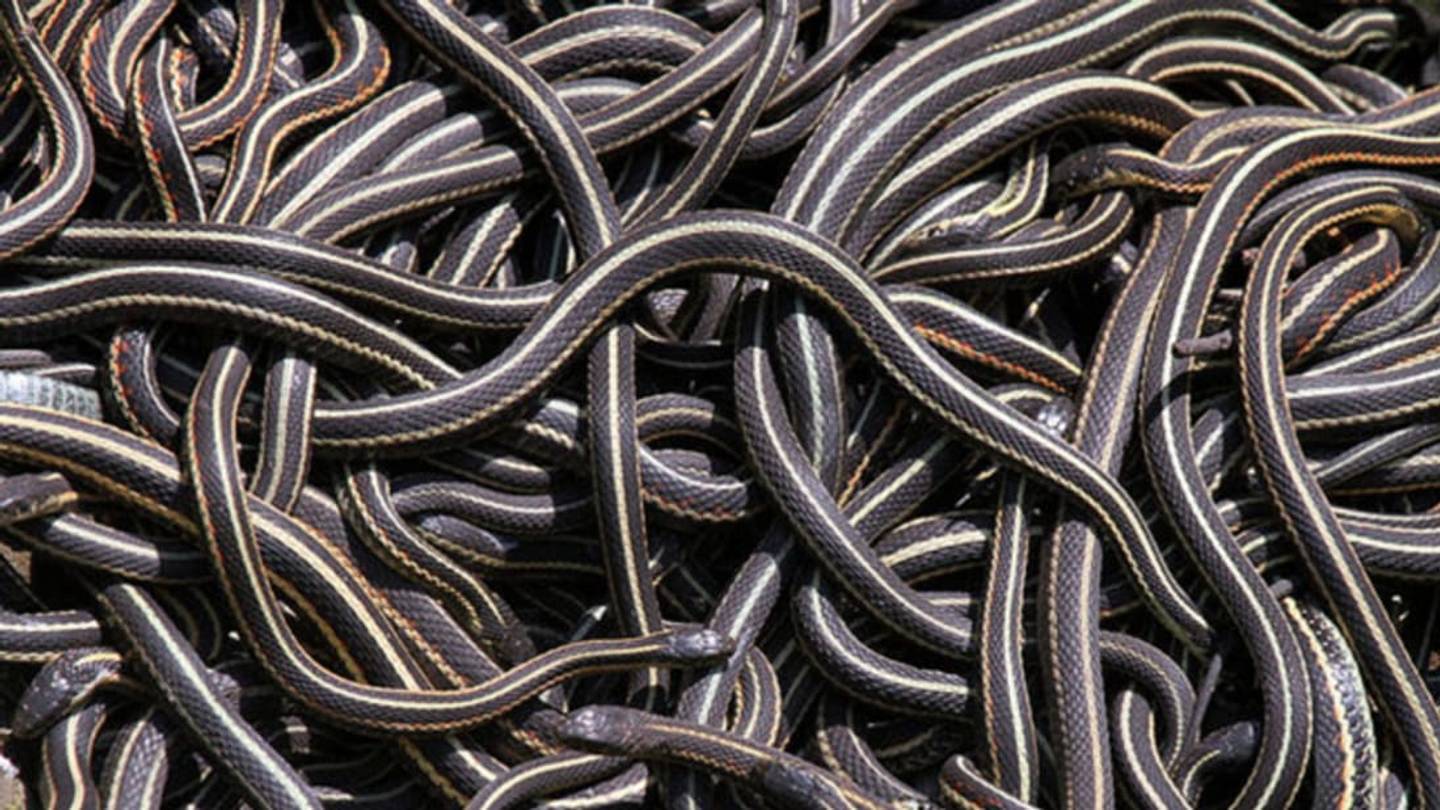
Canada usually seems like such a non-scary placeâthe pristine lakes, the gentle manners, the political tolerance , the free-flowing sorry s. Itâs not exactly a place youâd think would be teeming with snakes just below the surface. And thatâs true as long as you donât hang out in Narcisse, Manitoba.
Every spring and autumn, the largest congregation of snakes anywhere in the world is found in this area, drawing visitors from across the globe. For between one and three weeks at a particular spot along Highway 17, tens of thousands of red-sided garter snakes make their way above ground from inside the fissures in the limestone, looking for mates. They congregate in rocky pits, weaving together to form vast, living, moving tapestries of snakes that can be as wide as 20 feet across . The mass of snakes is clearly audible , between the hissing and the sound of scales rubbing together.
The regionâs geology is to blame for the snake jamboree. Because the winter temperatures in the Interlake area of Manitoba can drop to almost -50 °F, the limestone in the ground tends to freeze, crack, and fill with underground water, which erodes the stone and causes it to collapse, forming caverns and sinkholes. Cold-blooded snakes then move into these caverns and make them their dens, where they can hide out below the frost line when the winter kicks in. There is, however, a limited number of viable dens, so the snakes in the area tend to flock to a single location .
J Hazard via Wikimedia // CC BY-SA 3.0
When theyâre finished with their business in the spring, the garters split from their dens along the highway to nearby wetlands for the summer to bask in the sunshine, and then return to Narcisse in the fall, to slither back underground and do it all over again.
Because of the sheer number of snakes involved hereâweâre talking as many as 50,000 âthe mating process can get a little tricky. Garter snakes use pheromones for this purpose, but sometimes male garters will produce both male and female pheromones  in an effort to confuse other males into trying to mate with themâan attempt to borrow some of the other snakeâs body heat, which is major attraction when youâve been hibernating in the frozen ground for months. Another way for a male garter to locate a female (and warm up) is by joining whatâs called a mating ball: a tangle of males surrounding a lady snake, as many as a hundred of them, all vying to get lucky. As Bob Mason, chair of the biology program at Oregon State University, said in a National Geographic video , itâs like âa sea of living spaghettiâ in a sink hole that âmight be the size of the average personâs living room.â
You wouldnât know it from looking at this spectacle, but there was a time when the red-sided garter population in the area was in danger. In 1999, a one-two punch of inclement weather and the snakesâ habit of trying to cross the highway meant that tens of thousands of them were meeting untimely deaths before they could reproduce . The 1999 installation of 15-centimeter tunnels that run under the highwayâalong with 1-foot-high snow fences that corralled the snakes into the tunnelsâimproved the situation dramatically, as did seasonal signs that warn motorists to drive slowly when they pass the dens, lest they crush any runaway garters. Although snakes still manage to crawl under the fences sometimes, the number that die on the road every year is now under a thousand.
There are four different snake dens at this spot, and the site is well-equipped for visitors , replete with a walking trail to connect the dens, viewing platforms, and public restrooms. Garter snakes are harmless to humans and have a reputation for being docile, so much that children can safely handle them (a good thing, as there are always a few wriggling around on the ground outside the dens). As such, the Narcisse Snake Dens have become a major draw for day-tripping familiesâespecially because the amorous snakes like to make their vernal debut around Motherâs Day . How appropriate.
Loading recommendations... Please wait while we load personalized content recommendations