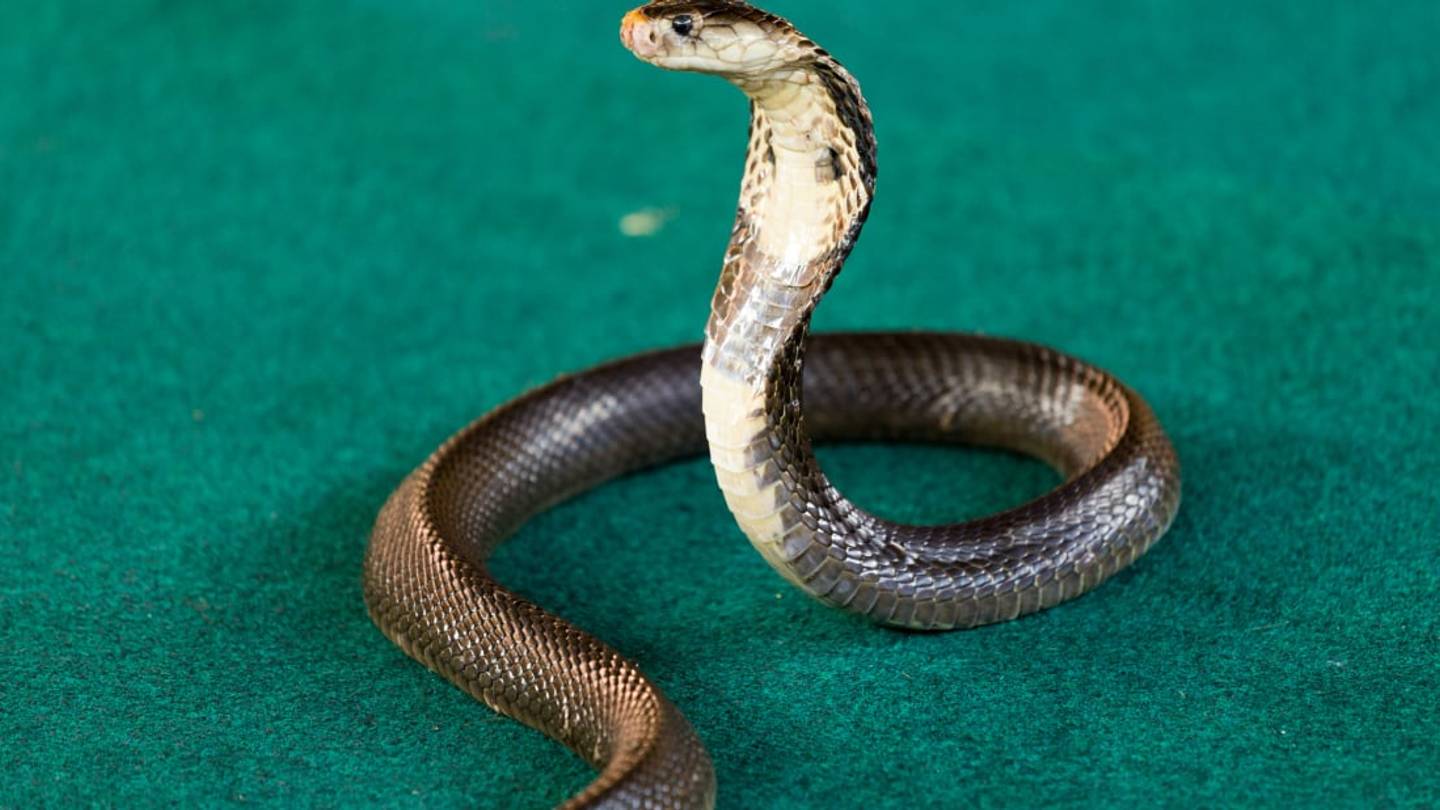
Make most cobras angry, and theyâll bite you and inject the bite with a dose of venom. Frighten or tick off a spitting cobra, though, and it will contract the muscles around its venom glands and âspitâ it out through holes in the tips of its fangs. Right into your face.
Spitting cobras are no slouches when it comes to marksmanship. Neurobiologist Bruce Young found this out when he put on a plastic face mask a few years ago and taunted cobras into taking more than a hundred shots at him. When he analyzed the snakesâ movements, he found that they always spit right after he made a jerky movement with his head. The snakes would turn their heads in the same direction that heâd started to move his and then start spitting. Tracking the target like this, Young wrote in his study , âgives cobras a distinct geometric advantage; even relatively large linear movements on the part of the target can be accommodated by rather modest angular movements of the cobra's head.â A burst of speed when turning their heads also lets the snakes âleadâ the target a little and compensate for the time it takes for their muscles to send the venom flying.Â
Itâs a cool tactic, but not as easy as just biting whatever it is that needs biting. You see, spitting cobraâs venom doesnât do anything if it just hits you on the skin or even gets in your mouth. To be of any use, the venom has to get in your eye, where it causes searing pain and can scar the corneas and leave you blind.
This has had many biologists wondering if the cobras know to shoot for the eyes and are aiming at them. Given the snakesâ accuracy when spitting and the limited targets that their venom is effective on, scientists, zookeepers and others who study and work with spitting cobras assumed they were. In 2005, researchers from the University of Bonn in Germany backed these assumptions up with an experiment . They put undergrad student Katja Tzschätzsch face-to-face with 10 different cobras and got them to spit at her hands, her face and life-sized photos of faces. Hands and still faces and photos didnât get a rise out of the snakes, but a moving face (real and fake) didâless so when the eyes were digitally removed from the photos than when they were left intact. When the researchers looked at the traces of venom on the photos and Tzschätzschâs facemask, they found that the different cobras hit the eyes anywhere from 80 percent to 100 percent of the time.
Now a newer study suggests that maybe the cobras arenât so picky when choosing their targets. Guido Westhoff, a neurobiologist who worked with Young and Tzschätzsch on the previous research, revisited the question last year with another round of experiments . He and his team presented cobras with life-size, human face-shaped boards with and without different kinds of glass eyes, as well as larger and smaller fake faces and triangular boards that didnât resemble faces.Â
In 324 spitting tests, the snakes didnât spit at the boards with eyes any more than the ones without. Also, when the eyes on the targets were moved closer together or farther apart, the snakes didnât adjust their aim to account for the distance between them. Given a choice between a face with eyes and an eyeless one, the snakes spit at the larger target most of the time, whether it had eyes or not.
Westhoff now thinks that cobras donât specifically aim for the eyes, but for the center of whatever body part their tormenter puts closest to them. Often, this just happens to be the faceâand it seems the snakes prefer more face-like round targets than pointy ones; they spit at those almost four times as muchâand at least one eye gets hit by chance.
Whatâs more, he thinks that aiming for the eyes is both unnecessary and even a bad strategy for the snakes. Cobras can spray their venom over a wider area by moving their head as they spit and spitting several times in a row, increasing their chances of hitting the eye and without requiring them to aim right at them. Shooting for eyes instead of just a face also puts a cobra at a disadvantage if it canât clearly see or recognize eyes, like when their own eyes become cloudy while they shed their skins, or in the dark.
Loading recommendations... Please wait while we load personalized content recommendations