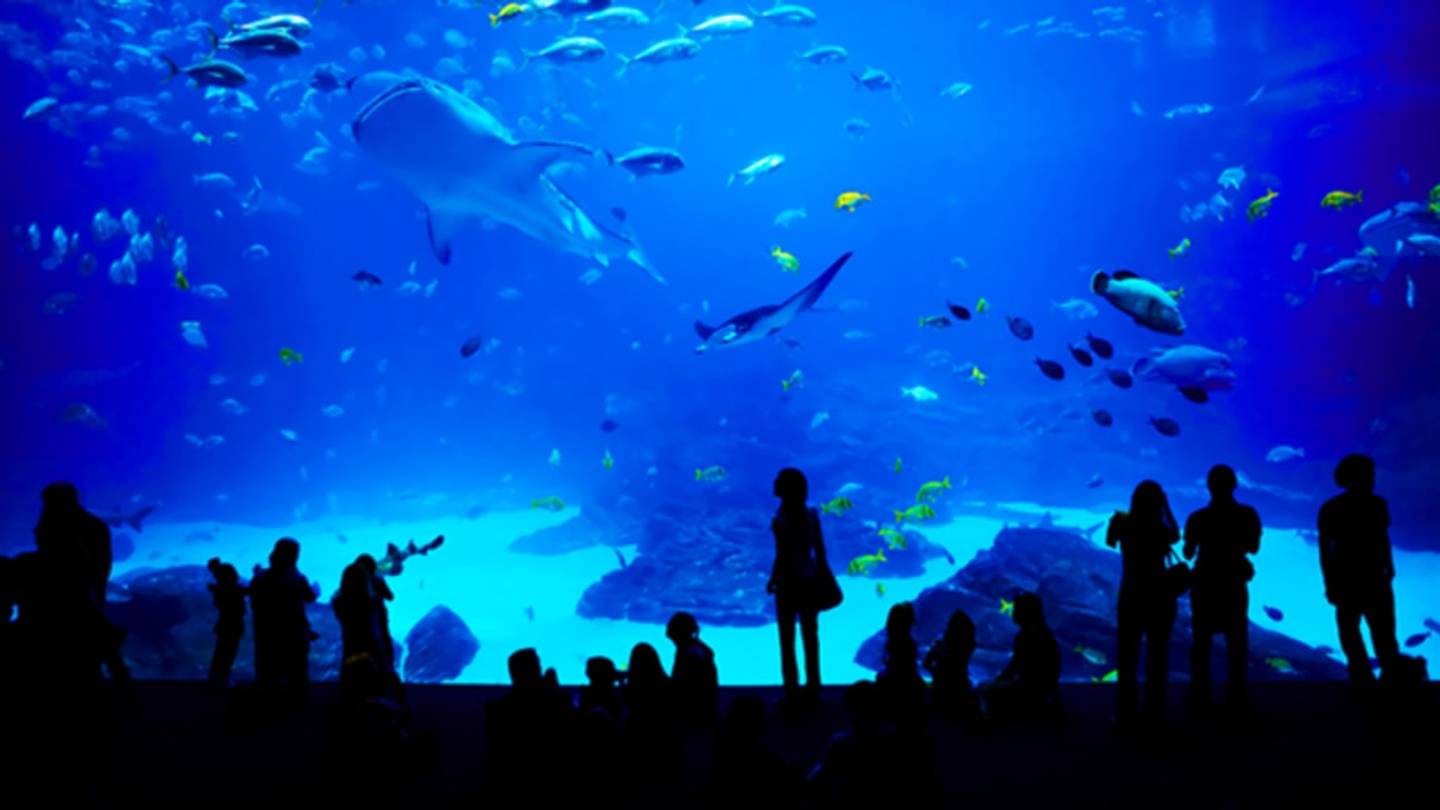
Earth is nicknamed âthe blue planetâ for a reasonâlakes, rivers, and oceans cover around 71 percent of its surface. Aquariums help us connect with these watery environments, but looking after the creatures that live in these places isnât always easy. On any given day, the people who take care of water-dwelling animals and plants for a livingâtheyâre known as aquaristsâmight be asked to swim with sharks, train sea lions, or poke a gassy sea horse.
Like zoos, aquariums get loads of applications whenever an animal care position opens. Therefore, vacancies tend to be filled in short order. âItâs a very, very competitive field,â says Paige Stuart, an aquarist at the Greater Cleveland Aquarium. âBasically everybody wants to do this, so you have to try to get ahead of the game as much as you can.â As a rule, aquariums will expect all applicants to have a degree in biology or a related field. Stuart adds that, on top of this, âYou definitely have to be scuba-certified.â
But satisfying those two requirements still might not be enough to get you hired. âItâs harder to get a job without first having a lot of experience,â Sally*, who works at a zoo in the southeastern U.S., notes. âYou need the degree, but itâs the experience thatâs going to make you better at your job and what will ultimately get you the job in the first place.â
To boost your credentials, Sally recommends volunteering or interning at a local aquarium, zoo, or animal shelter. Applying to pet stores, she adds, might also be a good idea: âTheyâll help you get to know the practical side of things, the actual application of your book knowledge.â
Never underestimate those cephalopods. In 2008, an octopus at one German aquarium deliberately short-circuited the lamp above his tank by squirting a jet of water at the fixture. Not to be outdone, an octopus at the Santa Monica Pier aquarium caused a minor flood the next year. After the creature loosened a water-control valve that fed into its own filtration system, 200 gallons of seawater poured out onto the surrounding floor. And last April, yet another octopus pulled off a spectacular escape worthy of Steve McQueen. Staffers at the New Zealand National Aquarium were dumbfounded to discover that their octopus named Inky had crawled out of his tank and squeezed into a six-inch-wide drain. Where did this exit lead? Directly into the Pacific Ocean .
âBelieve me, you need to know a lot about plumbing for this job,â Vickie Sawyer, an aquarist at Norwalkâs Maritime Aquarium, observes . Those who work with captive fish and marine animals deal with all manner of filters, valves, and pumps, and the bigger the aquarium, the more elaborate the plumbing. Consider, for instance, the world-famous Georgia Aquarium, which utilizes an expansive network of filtration systems that distributes 10 million gallons of water throughout the facility. To keep things running smoothly, a Life Support System (LSS) team oversees some 225 individual pumps. These highly trained employees are also responsible for monitoring the water temperature and pH level in each tank, among other things.
As most people know, itâs the male seahorse that gives birth. A special pouch on his stomach makes this amazing feat possible. When these fish mate , the females deposit their eggs into the pouch. Ten to 25 days later, as many as 2000 babies will come shooting out of this receptacle. Sally tells us that the unusual breeding process makes male sea horses susceptible to an odd medical problem: Excessive gas sometimes accumulates inside of their pouches. To deal with this, an aquarist will need to gently grasp an afflicted male, keeping him just below the waterâs surface. Then, Sally explains, careful pressure should be applied to his midsection with a blunt, stick-shaped object (e.g., a plastic pipette). If all goes well, the gas will be released in the form of harmless bubbles.
Every fish thatâs given to a seal or sea lion has to be rigorously inspected for quality and health. âWe check their eyes, their bodies, and press their stomachs to make sure they arenât too soft,â Sawyer says. According to Sally, if even a single scale is out of place, the fish canât be used. âThere are a lot of really strict regulations on marine-mammal keeping,â she says. âI used to work with seals and when I did, I spent 90 percent of my time in the kitchen, making sure the fish were perfect. If any little scale was missing, that could mean that some parasite had gotten inside the fish.â When allâs said and done, the potential entrée has to be a restaurant-quality specimen.
So-called âtouch tanksâ are roofless enclosures that allow guests to reach down and actually touch a small menagerie of aquatic animals. Given the hands-on appeal, such exhibits are quite popularâespecially with kids. Unfortunately, visitors sometimes get a little too rough with the display creatures. In order to keep their creatures from getting injured or stressed, aquariums will often enforce a strict âtwo-finger touchâ policy (rather than using the whole hand). Itâs also common practice to ask all guests to wash their hands before they approach the tank.
In the words of biologist Toni Loschiavo, âThereâs a lot of time, thereâs a lot of patience, thereâs a lot of care that goes into each animal that you see performing in a show.â An assistant curator at the Mystic Aquarium in eastern Connecticut, Loschiavo helps manage the facilityâs Maritime Theater, where trained sea lions dazzle crowds several times a day. Experience has taught her that even the most basic marine mammal stunts are the fruit of some intense labor. For instance, she claims that teaching a pinniped (seal or sea lion) just to lift its flipper on command is a process that can take more than 30 hours.
Most trainers employ a method called âpositive reinforcement operant conditioning.â This involves giving the animal a command and then rewarding it âusually with foodâfor responding appropriately. To inform the creature that itâs done a good job and that a reward is on the way, trainers use a special signal known as a âbridge.â Normally a sight or sound cue of some kind (eg: blowing a whistle), this lets the animal know it has done a good job and prevents it from getting frustrated while its trainer grabs a treat. [ PDF ]
Myrtle the green sea turtle. Image credit: seriouslysilly via Flickr //Â CC BY-NC-ND 2.0
Myrtle the green sea turtle is arguably the most beloved reptile in Boston. Over the past 46 years, sheâs become a fan favorite at the New England Aquarium, where she spends her days eating Brussels sprouts and hanging out with sharks in a gorgeous four-story tank . âShe arrived on June 12, 1970 ⦠the year after we opened,â New England Aquarium senior aquarist Sherrie Floyd Cutler told Boston Magazine . Myrtle was acquired from the now-defunct Provincetown Aquarium in exchange for some smaller turtles. Cutler reveals that itâs âvery common for aquariums and zoos to trade surplus animals ⦠In terms of conservation, it helps partially to stock exhibits, especially when youâre talking about an endangered species. Myrtle was too big for their tank, so it worked great for us.â
âYou have to report every single death,â Sally tells mental_floss . Oftentimes, the staff veterinarian(s) will perform a necropsy (an animal autopsy) in order to ascertain why the creature died. Information gleaned from this procedure can be invaluable; if it turns out that a certain fish was killed by some kind of disease, the necropsy might help the staff fight the outbreak before it can spread further and potentially wipe out an entire tank.
Just ask Ruby Banwait, a fish specialist at the Vancouver Aquarium [ PDF ]. âMuch of the work of an aquarist is cleaningâcleaning glass, cleaning walls, cleaning gravel,â she says. âThis is important not only for the health of the animals but also for aesthetic reasons. We want ⦠visitors [to] mentally transport themselves into the world beneath the water.â
Sally agrees that she spends much of her day cleaning tanks, noting that sheâll often get herself pretty filthy in the process. âThere are so many ways to get covered in fish poop,â she jokes. On certain weekdays, sheâll clean the substrate and filters of her aquariums, and fecal matter collects in both locations. Then thereâs the protein skimmer, a handy device used to filter out solid waste. âItâs basically just a cup of poop that you have to wash out in a sink,â she explains.
Nurse sharks, lemon sharks, and other good-sized species often share huge, expensive enclosures with various smaller fish. Ever wonder what stops the notorious predators from turning these tanks into sushi bars?
The answer is actually pretty straightforward. When a carnivoreâs belly stays full, it loses the urge to hunt. So aquarists make sure that their sharks stay satisfied. At the Tennessee Aquarium, the biggest marine tank is a mixed-species setup that includes multiple sand tiger and sandbar sharks (both of which can grow to 8 feet or more). Three times every week, the predatory fish are given two to three percent of their body weight in food. A typical meal consists of some mackerel meat dipped into the tank at the end of a large pole.
The Toronto-based Ripleyâs Aquarium of Canada maintains a similar tank, filled with its own sand tigers. Like their counterparts in Tennessee, the keepers here stand on platforms and hold out long sticks tipped with some tasty shark chow. Apparently, the system works very well. âPeople frequently lose their poles while feeding the sharks. Iâve even fallen in the tank,â aquarist Nicole Petrovskis told Toronto Life magazine. âWhen I fell, all the sharks heard the noise and flew to the other side ⦠People ask if I was scared, but the first thing I thought of when I fell in was, âDamn, itâs weird to swim with shoes on.ââ
All images via iStock unless otherwise noted.
* Some names have been changed.
Loading recommendations... Please wait while we load personalized content recommendations